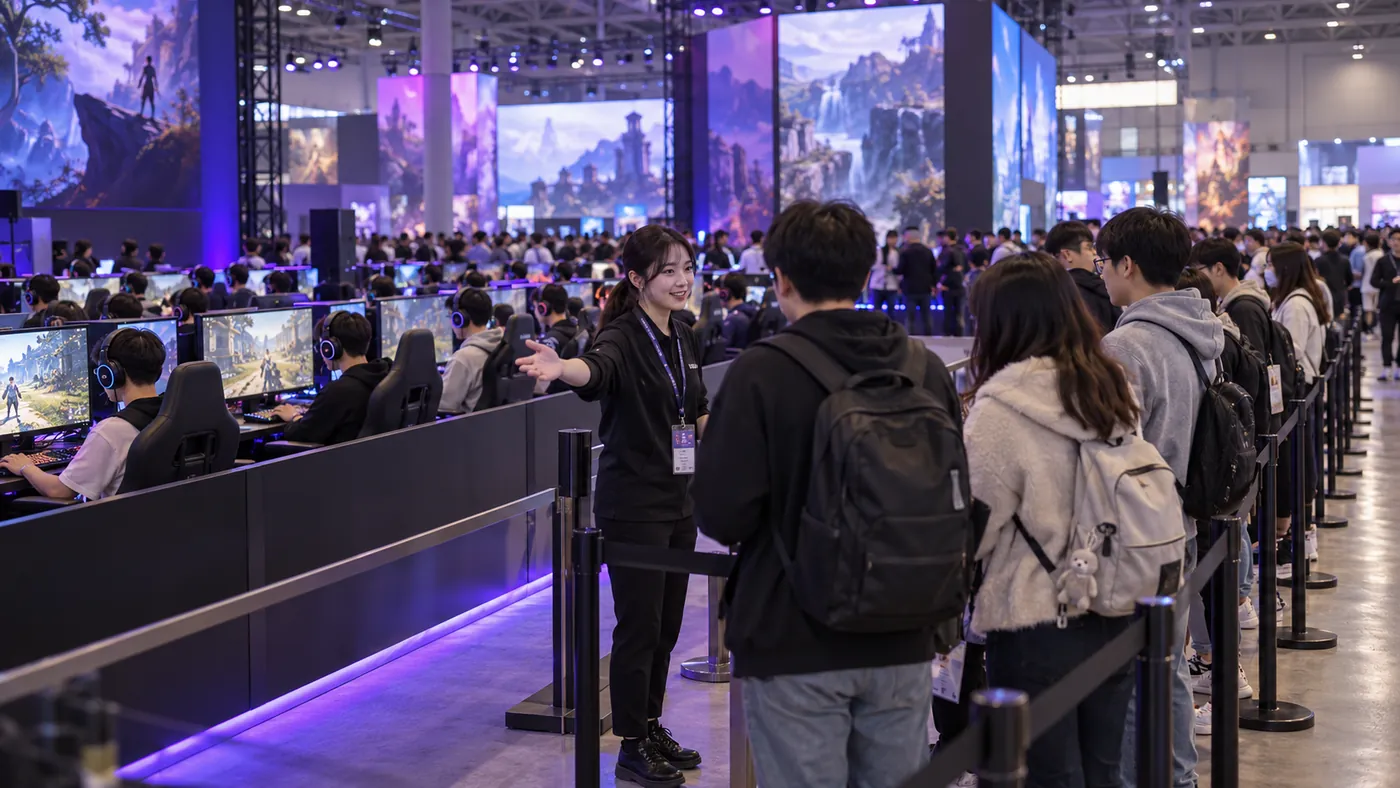
One of the pleasures of the international game exhibition G-STAR is the chance to play new games before their release at demonstration booths. For G-STAR 2025, NCsoft prepared a large experience zone with no fewer than 100 seats for AION2. Yet crowds on the opening day meant waits of more than four hours, and the organiser eventually decided to suspend new queue intake at around 2 p.m. for safety.
Many planners assume that installing 100 PCs will produce enormous turnover. From an event planner’s perspective, however, a booth’s actual throughput does not rise in direct proportion to the number of machines. As the queue-control principles in the “Case Article Review” file also explain, even a booth that seats 100 people will develop an uncontrollably long queue unless the invisible turnaround time before the next 100 can sit down is precisely reduced.
1. The error in throughput calculations: separate play time from turnaround time
The calculation “A demo lasts 15 minutes, so there are four rotations per hour and we can handle 400 people an hour” exists only on an Excel sheet.
- Measure hidden time: The time the previous player takes to remove the headset, stand up and leave; the time staff spend disinfecting the keyboard and mouse and resetting the game; and the time the next visitor takes to find an empty seat, walk over, sit down and hear the controls explained are not included in pure play time. If this turnaround creates a loss of 3–5 minutes per seat, actual hourly throughput falls by more than 30% below the planning team’s estimate. Before adding seats, the planner needs to measure and optimise reset and seating time down to the second during the dry run.
2. Cut off endless waiting: stopping a queue is better than extending it
If the rate at which visitors join the queue (inflow) exceeds the rate at which players finish and leave (outflow), the line begins to encroach on exhibition aisles.
- A hard stop for safety: NCsoft’s response—temporarily restricting queue intake at 2 p.m. and resuming 30 minutes later—is excellent back-end risk management. If the main corridor around the booth is blocked by waiting crowds, threatening fire-safety access and ordinary visitors’ movement, the organiser needs to put up a “Line closed” sign immediately, without hesitation. Taking more people than the operation can handle and leaving them standing for 4–5 hours is not fan service. It is an ordeal for visitors and a cause of secondary crowd-crush incidents.
3. Decoupling messages for handover
When a queue is paused, the message that on-site staff deliver through a megaphone needs to be carefully separated for each audience.
- Separate guidance for existing queue members and new arrivals: When staff announce that queueing has stopped, people already waiting can become extremely anxious: “Does that mean I cannot play and am being sent away too?” Staff need to hand over a clearly divided message: “Everyone already in the queue will be able to try the game (reassuring existing queue members). However, because the aisle is congested, we will restrict new arrivals from joining the queue for the next 30 minutes (a cut-off for new inflow).” This prevents confusion approaching a riot.
4. A four-stage protocol for a game demo zone
When planning a large demo booth with dozens to hundreds of devices in operation, the practical team needs the following four stages.
| Stage | Working standard |
|---|---|
| [Stage 1: Measure total turnaround time] | Use a stopwatch to measure the entire five-stage loop—entry and seating → controls explained → actual play → departure → device reset—and establish the true hourly throughput. |
| [Stage 2: Set the limit of the physical holding area] | Calculate the maximum number of people the queue barriers can accommodate without encroaching on shared exhibition aisles, and mark that limit on the floor. |
| [Stage 3: Activate staged cut-off rules] | Agree an escalation rule: display a waiting-time delay notice when the queue reaches 80% of its limit, and immediately put up a “New intake temporarily suspended” sign when it reaches 100%. |
| [Stage 4: Record operating status and debrief] | If the queue grows explosively at a particular time, identify and record the precise cause in the operations log. Distinguish a surge in visitors from a reduction in usable seats caused by several PCs going down with errors. |
Planner’s note: a complete demo experience begins when you give up extending the queue
A huge queue circling a booth may look like a badge of honour to a brand marketer. To a planner responsible for safety on site, however, an uncontrolled long line is a ticking time bomb.
The real skill in operating an excellent demo booth at an event with tens of thousands of visitors lies beyond packing more people tightly into the space. It lies in the decisiveness to tell people firmly not to join the queue any further. Stop the line before the fatigue of a four-hour wait erodes the enjoyment of 15 minutes of gameplay. That cool-headed, unsentimental hard stop is the strongest back-end operation for protecting both the game and its users.
Conditions for applying this elsewhere
Observe a full cycle before adding seats. Restrictions follow the event safety plan and responsible lead’s decision; no numerical safety threshold is proposed.
Information not established
Session length, reset time, completed demo count, waiting-time methods and sample, precise restriction trigger and actual reopening time were not established. NC’s 14 November statement is not a measured four-day average.
Reference material
- NC official release · 14 November 2025: 100 AION2 demo seats and a reported average wait exceeding four hours at the time
- Aju Business Daily on-site and post-event report · 17 November 2025: opening-day queue restriction, announced 2:30 p.m. resumption, and event dates
- ZDNet Korea post-event report · 17 November 2025: confirmation that G-STAR took place at BEXCO, Busan, on 13–16 November
Next tasks and related resources
Instruction, play and next-player start times; usable stations and intake restrictions
Related practical guides
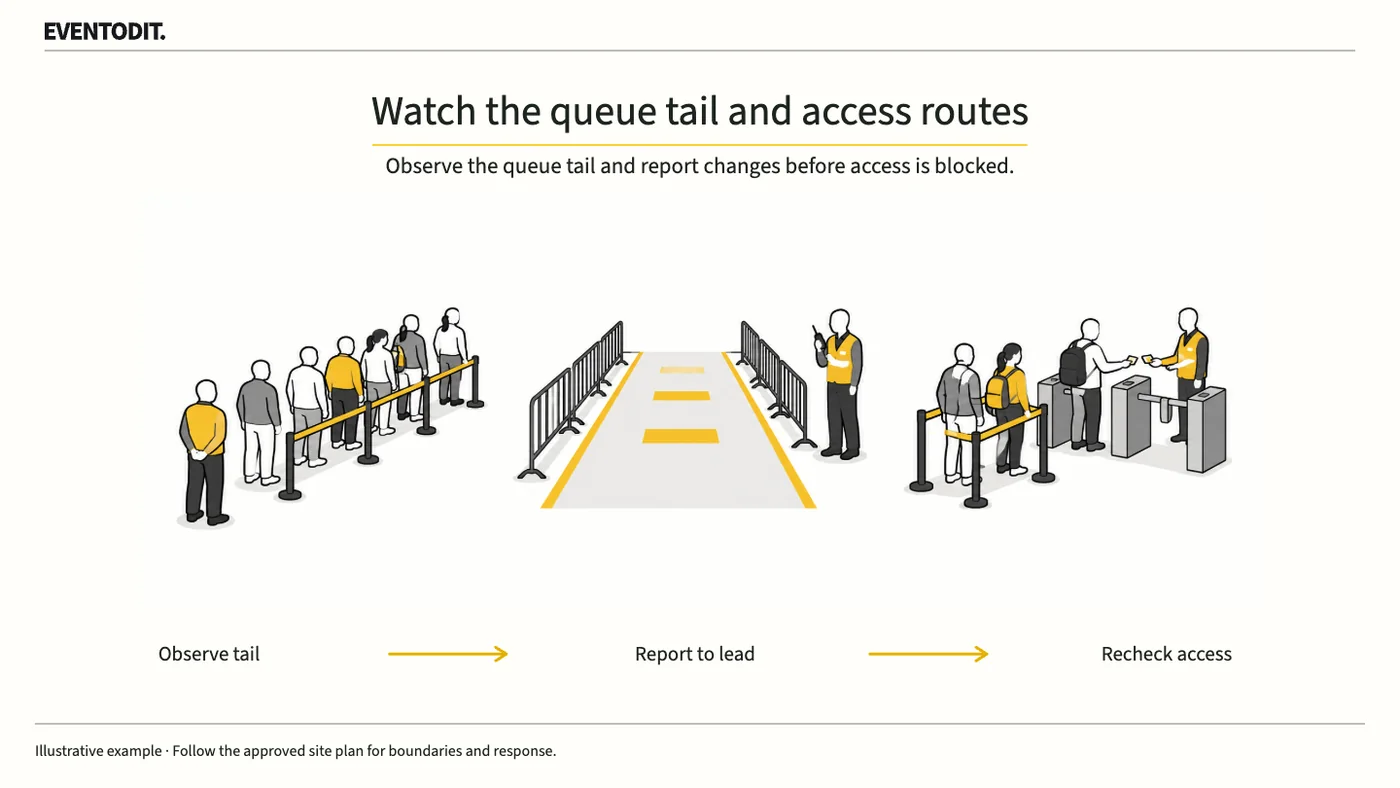
Event Entrance Queue Management
Track the tail of the queue and people spilling out to its sides, not just admissions processed. Agree where staff report a growing queue and who acts before it reaches vehicle or emergency routes.
Read guideHave a correction or additional evidence? Request a correction