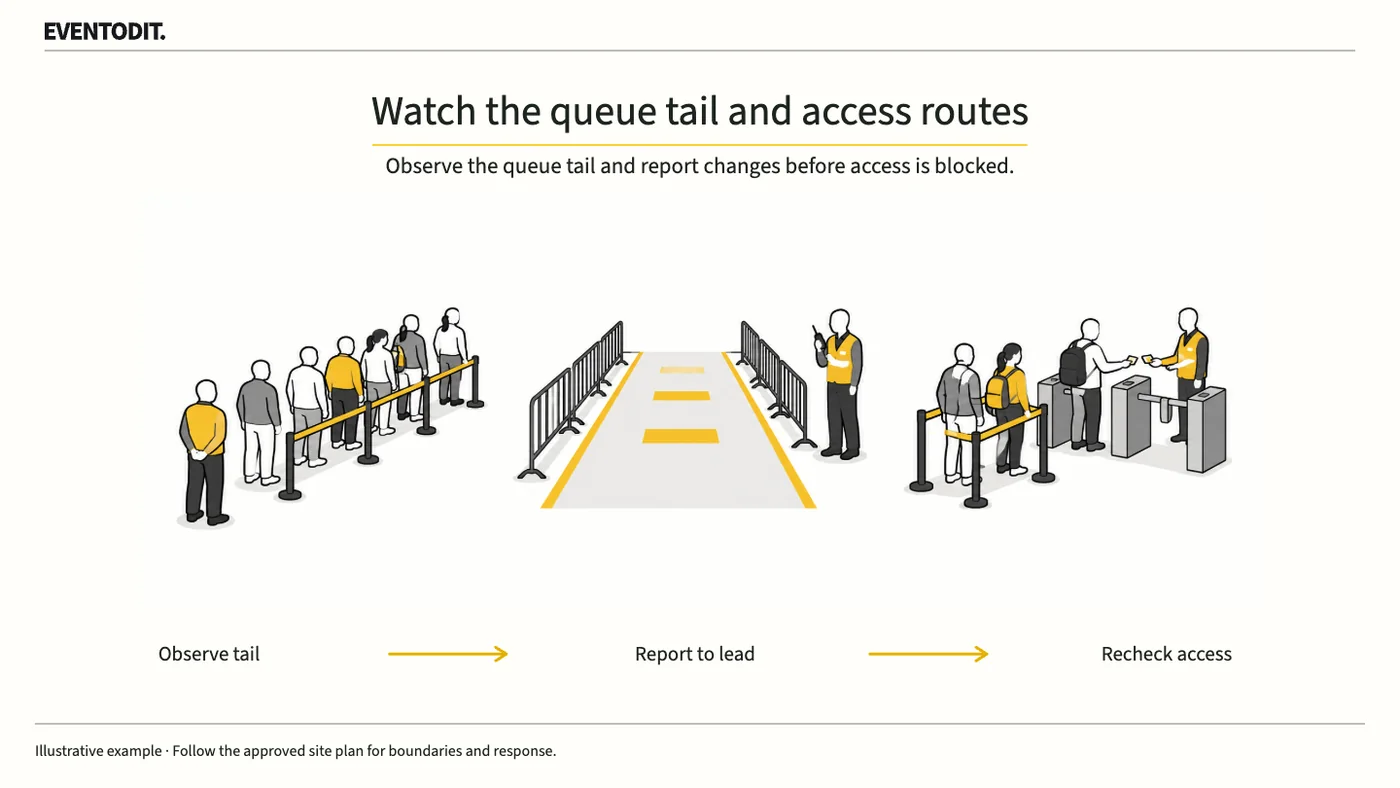
Part 1. Site and Safety Lead
"Intervene before the tail of the queue reaches a safety route."
- Define queue limits and danger areas in advance: Before opening, clearly mark the boundaries the growing queue must not encroach on, including vehicle routes, emergency evacuation passages and entrances to neighbouring businesses.
- Separate roles for a fuller view: Assign different people to monitor admission processing speed at screening or ticket desks and to observe the queue tail and people spilling out to the sides from outside the line.
- Delegate authority to divert and regulate flow: Designate a site lead in advance who can quickly decide and direct where to redeploy stewards or whether to open more admission desks when the queue reaches its boundary.
Part 2. Admission and Ticket Desk Staff
"Do not assume the site is running smoothly from admissions processed alone."
- Check processing speed against queue length: Even with the same 100 people admitted, the queue can grow sharply when visitors arrive at once. Recognise that ticket throughput and the length of the outside queue do not necessarily move in proportion, and adjust the pace accordingly.
- Check downstream effects before opening another desk: If you open a reserve desk or change a route to shorten the queue, also check whether that creates a bottleneck in another pedestrian passage or an already crowded area inside.
- Communicate immediately with the safety lead: If a crowd extending beyond the control line makes a safe diversion impossible, do not force admissions to continue. Report immediately to the safety lead and temporarily hold entry or change the control method.
The rate at which a queue grows depends on arrival and processing rates.
Part 3. External Observers and Stewards
"Report the risks in the space the queue reaches, not just the end of the line."
- Monitor the queue tail and spillover in real time: From the designated observation point, monitor how far the tail extends and whether visitors have left the marked line and spilled out to the sides, then report to the control room.
- Recheck pedestrian and emergency access after action: If the control room directs a change to the queue route to reduce congestion, immediately recheck not only the length of the line but whether pedestrian and emergency access routes are actually clear and open.
- Record report and action times separately: Distinguish when the queue-tail position and degree of congestion were reported from when staff actually carried out the control-room instruction. If an area is obscured and unverified, do not force a report that conditions are stable.
UK HSE advises keeping queues clear of vehicles, stairs and emergency access, and monitoring arrivals and congestion. An Australian running-event study examined density, flow and participant perceptions at a start area. Its findings cannot be used as permitted queue-density values for Korean exhibitions or performances.
- Before openingMark boundaries and observation pointsIdentify vehicle routes, emergency passages and queue tail
- During admissionObserve throughput and tailSeparate desk and queue monitoring roles
- Near boundaryDecide actionReport to authority; divert or adjust flow
- After actionRecheck passagesConfirm queue, emergency access and records
Final check before use: Before the entrance gates open, check that all observers know the queue boundaries and emergency-route locations on the plan.
Conditions for applying this elsewhere
Where screening or ticket checks create queues that may meet external pedestrian or vehicle routes
Information not established
No universal safe queue length or statutory density is specified. Site capacity planning and consultation with relevant agencies are needed.
Reference material
After reading, complete the next task
Queue observation points, reporting triggers and action-result record
This article’s template
Admission Queue Location and Action Log
A shared record of queue position and actions for entrance, control-room and traffic teams.
Instructions, examples & downloadsRelated practical guides
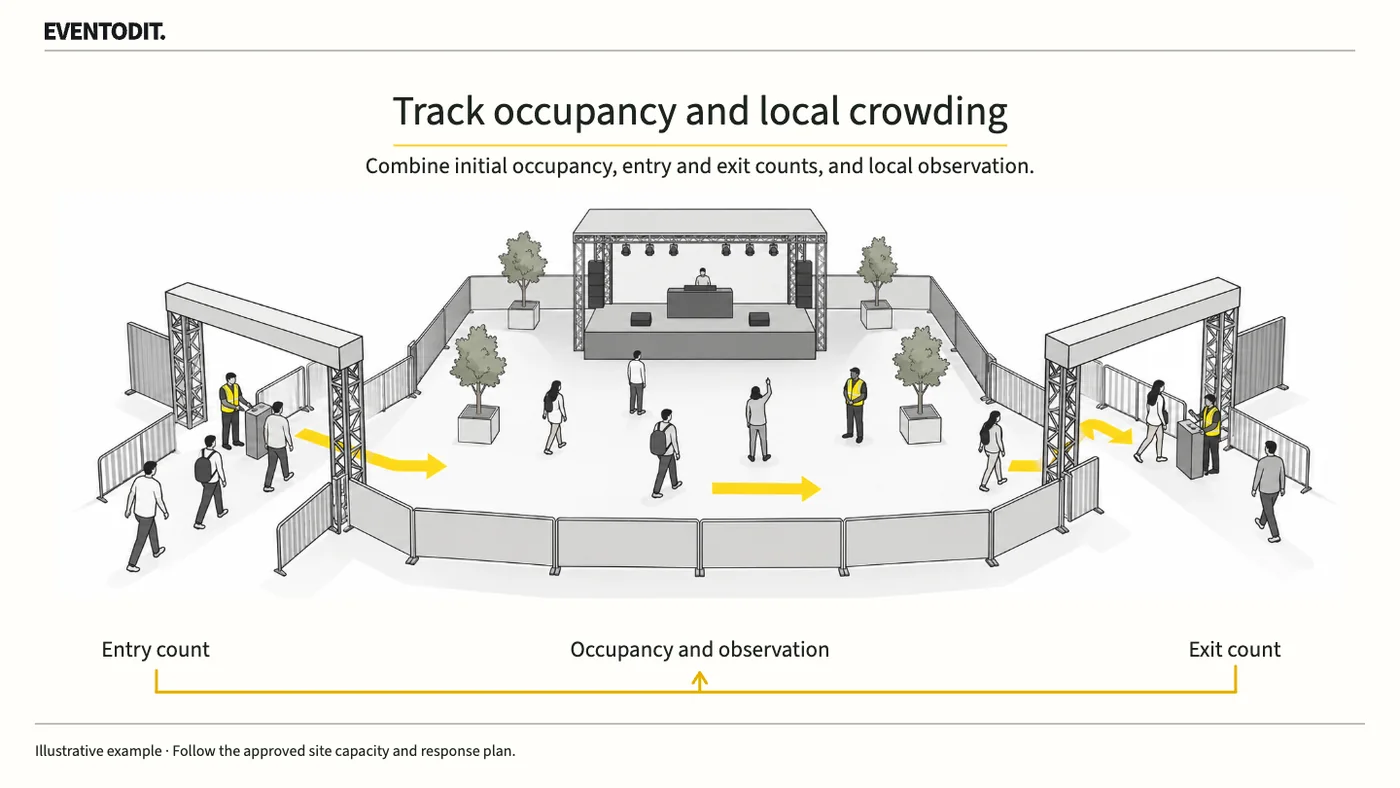
Event Occupancy and Crowd Density Management
The day’s entry total cannot show which area is crowded now. Event control should compare entry and exit counts with observations from the same period and identify any gaps in the count.
Read guideHave a correction or additional evidence? Request a correction