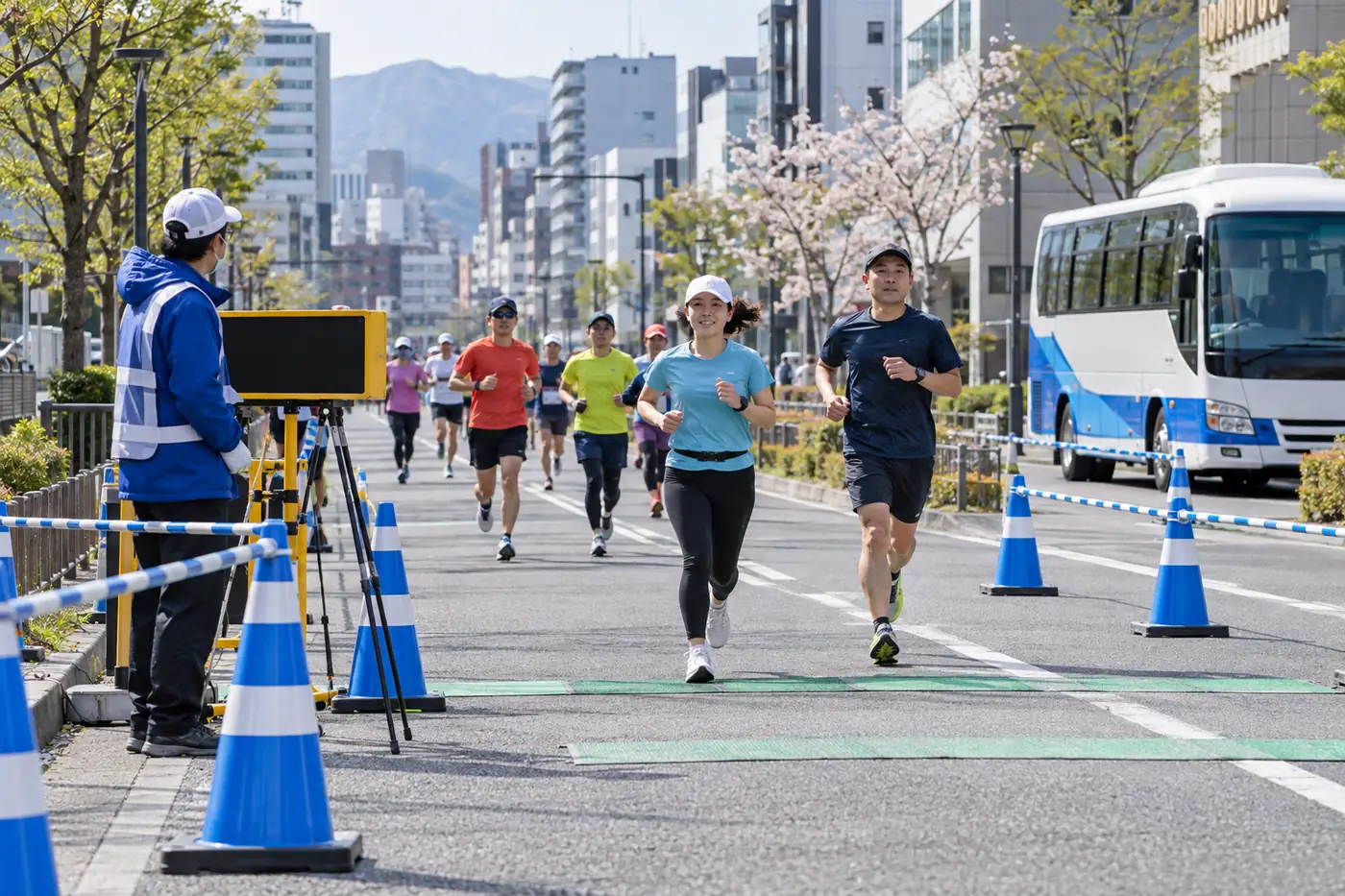
At an urban marathon with tens of thousands of participants, wave starts that send groups off at different times have become an essential operating technique for preventing major bottlenecks at the start line. Hokkaido Marathon 2026 also chose to spread congestion on the course by dividing its starts into two groups, at 8:30 a.m. and 8:45 a.m.
From an event planner’s perspective, however, a wave start is more than simply sending people off at 15-minute intervals. As the on-site operating principles in the “Case Article Review” file also explain, successful marathon course control depends on designing a clear separation between the “individual result clock” used by runners and the “course operations clock” used by the police and local authorities to control the roads.
1. Decoupling time: “the time limit” and “checkpoint closing time” are different
Participants may easily assume, “If the time limit is six hours and I start 15 minutes later, the checkpoints will close 15 minutes later too.”
- The absolute nature of a hard stop: Hokkaido Marathon’s official overview applies the same intermediate checkpoint closing times and final finish-line closure at 14:45 to both the first and second groups. The city’s clock, which governs lifting traffic restrictions and reopening roads to ordinary vehicles, cannot wait for individual participants’ circumstances. From registration and participant information onward, the planner needs to communicate the firm cut-off rule transparently: “The later you start, the less time you have available to pass the checkpoints.”
2. A penalty rule set that allows no exceptions
Controlling tens of thousands of people depends on strict rules.
- Control movement between groups: A runner assigned to the later group who secretly starts with the earlier group is immediately disqualified (DQ). Conversely, a runner assigned to the earlier group who arrives late may start with the later group. Even then, the official result (gross time) is calculated less favourably from the gun time of the earlier group originally assigned to that runner, rather than the time the runner actually started. These back-end rules need to be firmly established to prevent participants moving between groups at will and to maintain order at the start line.
3. Logistics and roles-and-responsibilities handover for sweeping runners off the course
Dealing with participants who miss a checkpoint closing time belongs to the substantial field of transport logistics, rather than simply race timing.
- Link removal from the race with follow-up action: Passing the cut-off time does not justify merely removing a runner’s bib and leaving them at the roadside. As specified in the English participation guide, once a checkpoint closes, course marshals need to guide participants onto the pavement, board them on a sweeper bus and transport them safely to their destination. A clear handover manual is essential so that course officials, medical staff and shuttle-bus drivers can cross-check the number of runners leaving the race and their boarding locations.
4. A four-stage protocol for operating a wave-start marathon
When planning an urban sports event with staggered starts, the practical team needs the following four stages.
| Stage | Working standard |
|---|---|
| [Stage 1: Confirm common cut-off clock times] | Work backwards to the time traffic restrictions will be lifted, using the pace of the final wave that starts latest, and draw up a hard-stop timetable for every checkpoint that applies equally to all groups. |
| [Stage 2: Prepare two distinct participant messages] | Use a clear visual table or infographic in the participant information to explain that checkpoint closing times are absolutely fixed, regardless of a runner’s net time (the time actually spent running). |
| [Stage 3: Dispatch sweeper vehicles and assign roles and responsibilities] | Station large buses and medical teams at each checkpoint to transport runners who are out of the race. Assign on-site officials responsibility for compulsory course clearance, moving every runner on the course onto the pavement 10 minutes before traffic restrictions are lifted. |
| [Stage 4: Emergency changeover for weather conditions] | Be sure to include a waiver and consent clause in the participant declaration stating that the organiser may, at its discretion, bring cut-off times forward or add checkpoints in adverse weather such as extreme heat. |
Planner’s note: real safety comes from a cool-headed timetable
Telling a marathon runner, “Your time is up. Please remove your bib and board the bus,” is painful for an event planner too. We understand the runners’ effort and determination better than anyone.
Yet at an event that borrows a city’s roads, a planner’s sentimentality can lead to the greater disaster of a terrible traffic accident or paralysis across the city. Planners need to support participants’ enthusiasm while knowing how to stop the stopwatch in their hand more coolly and precisely than anyone. The firmness that never overlooks those late 15 minutes ultimately becomes the strongest shield for getting tens of thousands of runners safely home.
Conditions for applying this elsewhere
Use where waves starting at different times share roads or a course.
Information not established
Actual checkpoint changes, removals and congestion reduction were not verified. A conflicting distance for the 13:35 checkpoint was excluded.
Reference material
Have a correction or additional evidence? Request a correction