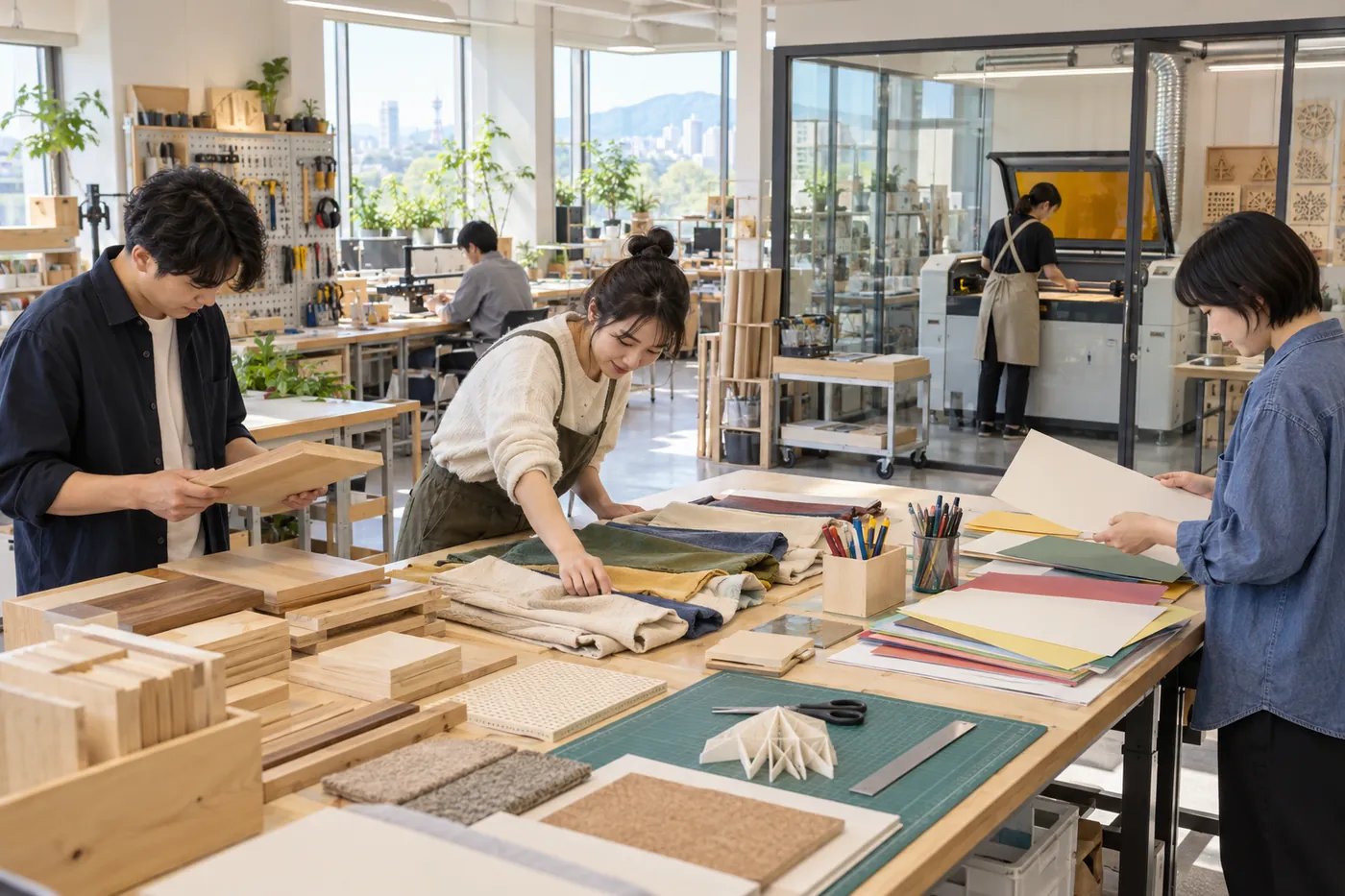
Uniform activities that give every visitor the same kit and ask them to assemble it in a prescribed order are gradually disappearing from exhibitions and festivals. In their place, self-directed making programmes, in which visitors choose materials and equipment to create their own work, are attracting attention. MAKIVE at Korea JobWorld also operates separate spaces for structured classes led by professional artists and for independent making, where visitors choose materials and equipment to plan their own products.
A programme that gives visitors full ownership of their choices is highly appealing. From an event planner’s perspective, however, the instruction to “make whatever you like” introduces a vast number of variables on site. As the operating guidelines in the “Case Article Review” file repeatedly emphasise, the more autonomy visitors have, the more precisely and coolly back-end logistics and circulation need to be designed to prevent the site from grinding to a halt.
1. Worktables and equipment run on different clocks: an imbalance in throughput
Unlike a class in which everyone finishes together at the instructor’s pace, a self-directed making space accommodates participants working at widely different speeds.
- Bottlenecks at shared equipment: Participants may have plenty of time to sit at a table, choose materials and develop ideas. The problem arises when they need expensive shared equipment, such as a 3D printer, laser cutter or specialist sewing machine. An imbalance in throughput, or hourly processing capacity, develops: ordinary worktables have plenty of empty seats, while a queue of several tens of minutes forms at a particular machine. The planner needs to work backwards conservatively from the maximum hourly throughput of the slowest shared machine to determine participant capacity, rather than counting chairs at worktables.
2. Controlled freedom: distinguish freedom from neglect
Independent making must not be promoted or operated as unlimited use of every machine.
- Cut off the options: Complete freedom can leave visitors uncertain and delay their decisions. The planning team needs to distinguish clearly between variable elements visitors can choose, such as colour, materials and design, and fixed elements the organiser must control, such as equipment-use time and prohibited hazardous materials. A cut-off rule such as “Laser-cutter use is limited to a maximum of 10 minutes per person” needs to be communicated in advance to address dissatisfaction among those waiting next.
3. Decoupling the roles and responsibilities of on-site help-desk staff
In a self-directed making space, participants call for staff for two main reasons.
- Separate creative support from technical support: One person asks for ideas: “What could I make with these materials?” Another needs technical help: “Could you show me how to use this machine?” If a single member of staff is left to handle both, the site comes to a standstill. Staffing needs a complete separation of roles and responsibilities: a facilitator who helps visitors develop ideas, and a technical operator dedicated to the safety and operation of shared equipment.
4. A four-stage protocol for self-directed making activities
When planning an open making programme without a predetermined answer, the practical team needs the following four stages.
| Stage | Working standard |
|---|---|
| [Stage 1: Classify variable and fixed resources] | Use Excel to keep clearly separate lists of consumable materials participants may choose freely and shared machines whose usage the organiser must strictly control. |
| [Stage 2: Activate a virtual queue for shared equipment] | Instead of leaving slow bottleneck equipment, such as laser cutters, open to unrestricted use, switch to on-site reservations through tablets or numbered tickets to prevent waiting routes from becoming tangled. |
| [Stage 3: Sign off roles, responsibilities and safety] | Designate staff dedicated to machine operation. For tools visitors will operate themselves, establish a procedure in which staff provide safety training and approval before handing over the equipment. |
| [Stage 4: Log a data-based debrief] | After the event, go beyond simply counting participants. Record which material-selection stages caused the most decision delays and which machines had the longest waits, then use these as tuning indicators for the next session. |
Planner’s note: complete freedom grows from the most closely woven rules
Giving participants a blank canvas and a variety of materials is an excellent way to stimulate their creativity. Yet the freedom they feel on site does not come from the planner standing back and doing nothing.
The materials I need are fully stocked; an expert is ready to help me use a complicated machine safely; and a system means I do not have to waste time in an indefinite queue. We should remember that this complete freedom, which allows visitors to focus entirely on making, comes from the planner’s meticulous, cool-headed back-end design: controlling variables out of sight and calculating waiting times down to the second.
Conditions for applying this elsewhere
Use where individual work times differ and materials, equipment access and assistance can be managed separately.
Information not established
Current booking and safety requirements for individual machines, actual waits, staffing and participant satisfaction were not verified.
Reference material
Have a correction or additional evidence? Request a correction