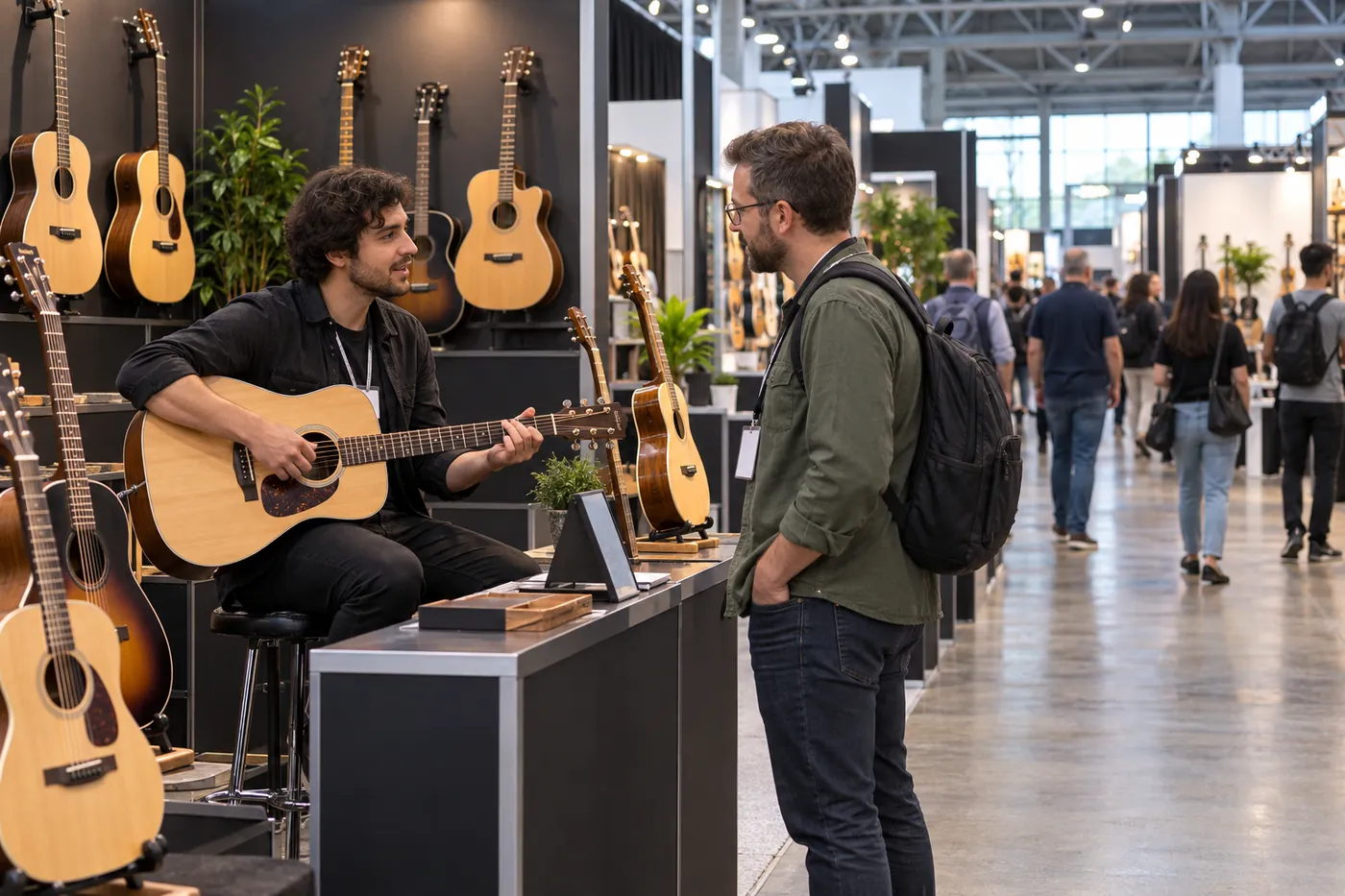
At a B2B exhibition, exhibiting companies pay anywhere from several million to hundreds of millions of won for a booth in order to meet buyers. Yet some opportunistic companies open catalogues and sell in exhibition aisles or nearby hotel lobbies without taking a booth. The industry calls this “suitcasing”: arriving with little more than a briefcase to do business.
The 2027 NAMM Show, the world’s largest musical-instrument and audio-equipment exhibition, announced in its participation rules that it would strictly restrict unauthorised commercial activities not only in the exhibition hall but also in associated hotel rooms, lounges and corridors. From an event planner’s perspective, this measure goes beyond maintaining order. As the back-end operating principles in the “Case Article Review” file also explain, it is a measure of trust: how thoroughly can the organiser protect the opportunity cost (ROI) invested by exhibiting companies? An admission badge provides a right to visit, rather than an invincible licence to roam the entire exhibition selling.
1. Decoupling networking and sales
On-site staff cannot stop every conversation between visitors in the name of policing suitcasing.
- Define prohibited physical activities: Clearly distinguish networking, such as exchanging business cards or brief greetings, from the selling that needs to be controlled. The organiser needs to specify the commercial activities subject to enforcement in the participation terms and conditions in concrete detail: physical product demonstrations, mass distribution of printed brochures and catalogues, and taking orders or completing sales contracts. Only then can on-site staff apply sanctions on the basis of a clear rule set, without relying on arbitrary judgement.
2. Expanding the space: hotels outside the exhibition hall are also part of the event
Business at a B2B exhibition does not happen only inside the hall.
- Introduce officially sanctioned exceptions: Many companies want to receive VIP buyers in quiet hotel suites away from the exhibition hall. NAMM extended its controlled area to hotel spaces in order to bring this demand into an official sponsorship framework. Requiring the organiser’s formal sign-off and a sponsorship payment for commercial activities in an external hotel lounge or guest room prevents a sense of unfairness among companies that have legitimately purchased booths and protects the organiser’s revenue model.
3. On-site enforcement staff: record rather than judge
When suspected unauthorised selling is discovered on site, temporary staff must not be left to argue directly with visitors.
- Collect evidence and escalate: Staff members’ roles and responsibilities do not include ruling on a violation on the spot. When they observe suspicious circumstances or receive a complaint from another exhibitor, they need to record the location, time, and the people’s badge details and observed activities, such as distributing catalogues, exactly as found, then immediately hand the record over to event operations. The organiser’s lead manager needs to implement the final badge confiscation or compulsory removal on the basis of that information to guard against legal and emotional disputes.
4. A four-stage anti-suitcasing protocol
To prevent free-riding sales activity at an exhibition and protect exhibitors’ rights, the planning team needs the following four stages.
| Stage | Working standard |
|---|---|
| [Stage 1: Codify the boundaries for locations and activities] | Set out, in bold in the advance participation rules, the definitions of prohibited physical commercial activities outside booths, including in aisles, associated hotels and cafeterias, and obtain agreement. |
| [Stage 2: Bring off-site business into an authorised framework] | Create a separate “private lounge sponsorship” package for companies wishing to do business in external hotels or meeting rooms, keeping an official approval channel open. |
| [Stage 3: Establish an on-site inquiry point] | Connect an anonymous QR reporting form or KakaoTalk hotline to event operations so that legitimate exhibitors can immediately report suitcasing companies they discover at the show. |
| [Stage 4: Enforce zero-tolerance penalties] | Once a report has been received and the operations team has completed on-site evidence collection, immediately withdraw the person’s admission badge without a verbal warning and enforce firm penalties restricting the company’s participation in the following year. |
Planner’s note: strict rules are the strongest sales tool
For sales managers responsible for selling exhibition booths, the hardest question when persuading an exhibitor is this: “Can’t I do business just by attending as a visitor and handing out business cards, without buying a booth?”
When the organiser’s planner can firmly answer, “Our event thoroughly identifies and removes unauthorised sellers in exhibition aisles and hotel lounges. We will never tolerate activities that take buyers away from companies that have legitimately purchased booths,” the value of the event’s booths rises dramatically. Good exhibition planning goes beyond attracting impressive booths. It is completed by coolly and strictly blocking, on site, every attempt to undermine those booths’ commercial value.
Conditions for applying this elsewhere
Use where an organiser sells booths and sponsorship and needs to define commercial activity.
Information not established
Actual sanctions, loss reduction and sales outcomes were not verified. An undated Networking Pass page was excluded because its relationship to the current policy was unclear.
Reference material
Have a correction or additional evidence? Request a correction