
After a B2B exhibition or trade show concludes successfully, an organiser’s announcement of tens of thousands of business matches can be a rewarding and important measure for planners. IMEX Frankfurt 2025 likewise announced a total of 67,000 meetings and more than 100,000 badge scans after the event, demonstrating its energy.
These broad figures are useful evidence of an event’s scale and vitality. A more detailed approach is needed, however, before practical planners can use the data directly to shape the next event’s strategy or support sales teams’ contracting work. System bookings, actual meetings on site and eventual contracts each have different Measurement criteria. Removing potential inflation in Vanity Metrics and Decoupling substantive business Conversion data are central steps in understanding an event’s real ROI, or return on investment.
1. Break down the Denominator: read Bookings and Meetings differently
The organiser’s total of 67,000 meetings is likely to include not only individual one-to-one consultations, but Group Bookings and open-session attendance as well.
- Classify the Counting Unit: counting a meeting at a one-to-one, in-depth consultation desk and a presentation attended by 50 people as the same single unit reduces the data’s resolution. Just as all participants and Hosted Buyers have different population bases, Parsing meeting counts by purpose—[individual one-to-one bookings / session attendance / group-tour participation]—provides a better compass for the next plan.
- The value of Delivered data: a system booking represents a Scheduled activity. It is advisable for the on-site operations team to use barcode tagging or desk-approval procedures to remove unavoidable Cancelled/No-show cases and manage only genuine Delivered data as Actuals.
2. Understand platform data: a Scan is interest, not a contract
The 107,000 badge scans and 560,000 in-platform Conversations reported by provider ExpoPlatform show the event’s explosive Interaction.
- Distinguish Interaction from Transaction: scanning a badge at a booth to take part in an activity or requesting materials through an app belongs to the exploratory Contact stage of business. Adding these figures directly to consultation results risks overstating performance. It is important to manage expressions of interest separately from actual quotation requests.
- Prepare a Deduplication Rule-set: defining clear back-end rules beforehand for how to count a buyer who visits and scans at the same booth several times can further improve data reliability.
3. Sales Hand-over: connect operations and sales roles smoothly
The operations team facilitating on-site matching and participating companies’ sales teams pursuing contracts afterwards track different kinds of data.
- A clear handover based on booking IDs: it is helpful for the on-site operations team to focus on confirming whether each meeting was Delivered, using its booking ID. Clearly drawing the pipeline boundary so participating companies’ sales teams can lead Follow-up through Commercial Stages such as Quotation, Proposal and final Contract helps both sides work efficiently.
- Separate verification: the organiser’s booking data alone has difficulty demonstrating both the on-site meeting-completion rate and the final contract-conversion rate. Evaluating the stages through separate measures is therefore reasonable.
4. A four-stage protocol for measuring B2B matching outcomes
When planning a trade show that uses a business-matching system, the team could apply the following four-stage criteria.
| Stage | Work criteria |
|---|---|
| [Stage 1: Define the Counting Scope] | Classify meeting types, including one-to-one, group and presentation sessions, confirm badge-scan Deduplication criteria and explain them to exhibitors in advance. |
| [Stage 2: Filter the data] | Manage platform Pre-booked counts separately from Delivered counts cross-verified through on-site Access Control devices. |
| [Stage 3: Operations–sales handover (Sign-off)] | After the event, operations hands the initial data marked completed/cancelled/no-show to exhibitors’ sales teams and smoothly closes the matching platform’s operation. |
| [Stage 4: Protect the Comparison Scope] | When reporting results, focus beyond simple numerical growth and clearly Tag the comparison basis, such as all meetings or one-to-one meetings, helping future events make objective Like-for-like comparisons. |
A planner’s note: good data begins with refined numbers
Exhibition planners can feel an event’s success in a post-event report full of meetings and scans. Those abundant figures, however, will naturally also contain brief greetings and records of simple participation in activities.
An excellent B2B planner goes beyond displaying vast numbers and Filters meaningful data from them. Providing a Cleansed, genuine database helps exhibitors’ salespeople concentrate on substantive business partners. The true value of a B2B event lies not only in the size of its population, but in how sharply and usefully the data is refined.
Conditions for applying this elsewhere
For exhibitions and business-matching events combining booking systems with exhibitors’ sales follow-up.
Information not established
Published totals do not establish individual meeting completion rates, order values, contract conversion or detailed platform deduplication rules.
Reference material
- IMEX · Frankfurt 2025 closing release: dates, pre-booked meetings and growth in one-to-one meetings (2025.5.22)
- IMEX / isla · IMEX Frankfurt 2025 Event Sustainability Report, p. 4: meeting scope, participants and buyer categories
- ExpoPlatform · Supplier case study of IMEX Frankfurt 2025: badge scans, conversations and favourited exhibitors
Next tasks and related resources
Results separating bookings, meetings held and subsequent sales follow-up.
Related practical guides
Event Review and Data Evaluation
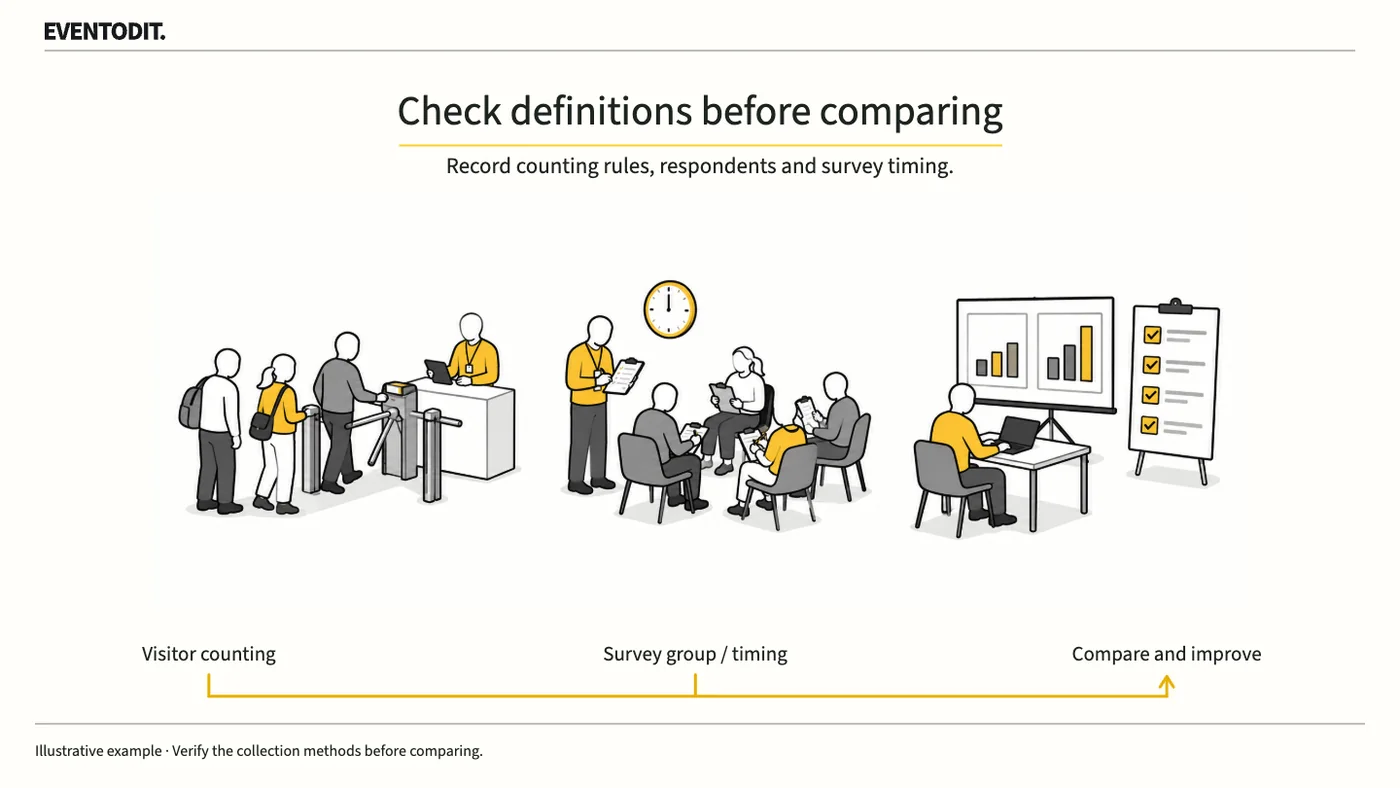
This year’s attendance and last year’s may not be comparable if the method changed. Establish who was counted or surveyed, when and how, and what is missing before interpreting the result.
Read guideHave a correction or additional evidence? Request a correction