Reconsider who receives support and who buys
KAMS grants go to venues, which contract performing companies for services.
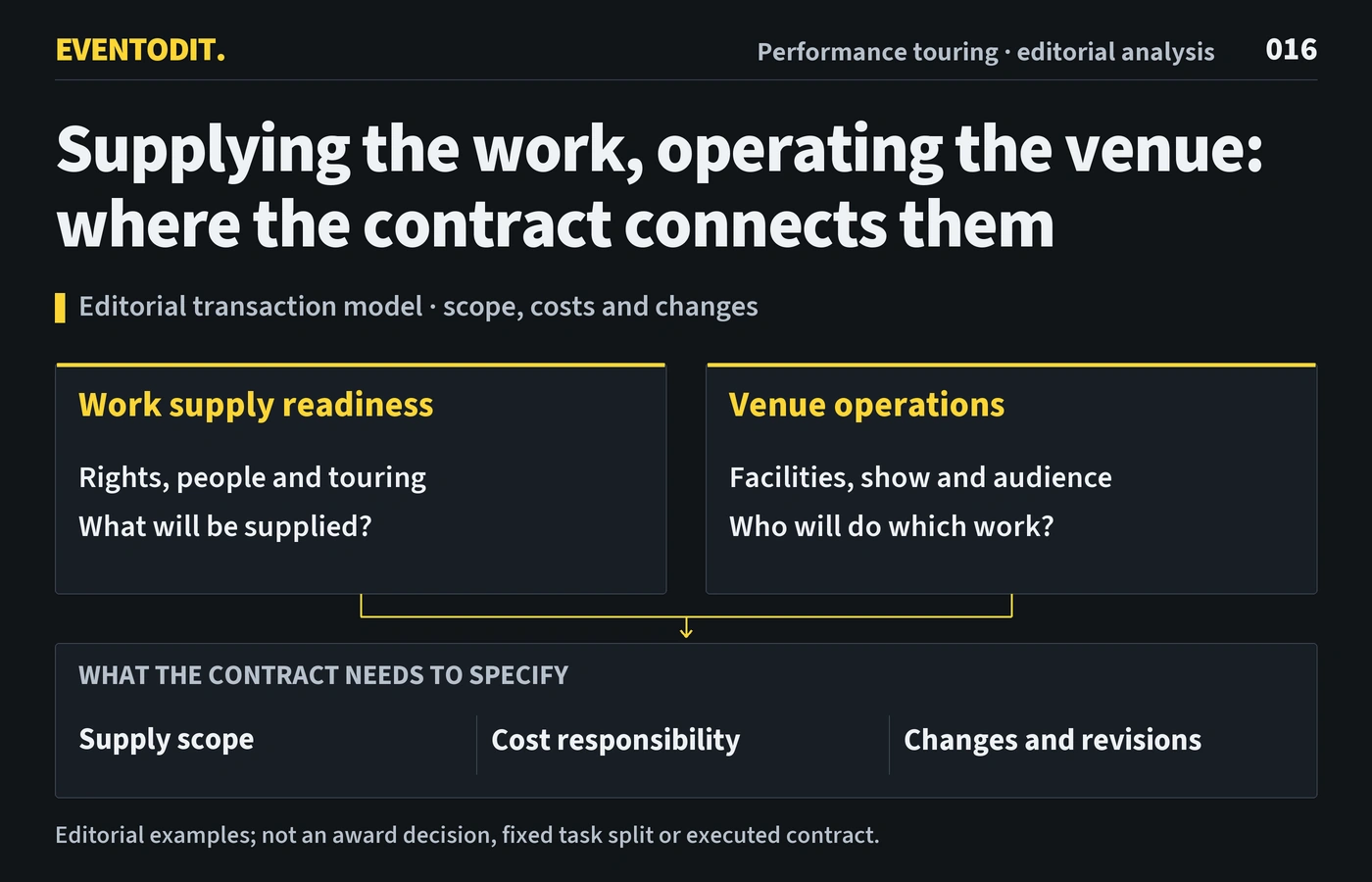
The editorial team sees a reason to reconsider whom producers are selling to. Discussions change according to which organisation reviews the work and which operating body will contract and pay for it. Artistic interest alone does not establish that the other organisation is ready to purchase.
A producer must explain the performance to be delivered at a particular place alongside the artistic proposition. A fee becomes comparable when the venue's equipment and staff can be distinguished from work brought in externally. This is an editorial business interpretation of the transaction, not an additional KAMS assessment criterion.
A venue's grant ceiling is not a price list for the work
Venue contributions must cover at least 10% of total project costs. The KRW 200 million venue grant ceiling may fall if applications exceed the overall budget.
A ceiling does not make its entire amount one producer's revenue. Operating the venue and supplying a work are different costs. Setting a performance fee from the available support can hide the actual work and purchasing scope behind the amount.
How partners handle reduced support is itself part of their collaboration. If one party expects the same work on unchanged terms while the other assumes delivery can shrink with funding, they are discussing different performances rather than simply negotiating a price. The editorial team favours comparing essential scenes separately from adjustable work. Whether a reduction is feasible remains a decision for the creators and contracting parties.
Unsuccessful matching still consumes distribution resources
The guidance provides no separate rematching after failed self-matching.
Producers need to consider the progress of discussions, beyond the number of enquiries. Sending technical material, comparing dates and checking availability take time. These are editorial considerations about distribution costs, not measured workloads from this programme.
When several venues consider the same date, provisional requests should not all be counted as orders. If enquiry handlers are separated from the people arranging performers and equipment, terms described externally can drift from actual supply. Who maintains discussions before a match, and for how long, becomes part of the producer's service scope.
The same fee can buy different work
The work's title may stay the same while the tasks a buyer needs change with the venue. The table gives editorial examples for comparing transactions, not the notice's mandatory division of duties.
| Proposal wording | Choices to distinguish before contracting | Why the cost changes |
|---|---|---|
| Supply the work | Remount the existing version or remake it with local performers | Rehearsal, revision and usable material differ |
| Use venue equipment | Equipment alone or operators and adjustment too | Owned equipment and supplied labour are different |
| Promote jointly | Transfer material or also create new assets and handle local enquiries | Recurring tasks and points of responsibility differ |
This is not a list for driving down fees. It tests whether the other party can actually undertake work omitted from a quotation. Tasks do not disappear when the supplier excludes them, so a contractual boundary also needs the conditions the partner will provide.
Eligible expenditure and necessary touring work are different scopes
Permanent staff salaries are ineligible project expenditure.
Creative Australia's current Playing Australia guidance separately addresses coordination fees for managing tour logistics and travel bookings. It is a different Australian funding model, not a basis for accepting costs in the Korean scheme.
The purpose of comparison is not to rank schemes by how much money they offer. It is to identify which agreement and resources cover discussion and coordination. Excluding a budget item does not remove the work. Distinguishing core organisational costs from work directly required for a performance makes the conditions for repeat touring clearer.
A venue supplying a work has assets beyond its building
The notice also specifies participation by public performance venues supplying works.
Buildings and seats are not the only assets to examine. The editorial team would also consider materials and people needed for a remount, changes between venues and the rights scope to agree with the parties. Having participated in production and being able to explain what can be supplied elsewhere are different business capabilities.
For cooperation between a producer and venue, the deliverable each party provides matters more than a general statement about owning or introducing a work. A wider network's value can lie in conditions for repeat presentation rather than its number of connected institutions. This article does not judge that any particular public venue has already secured such contracts or touring outcomes.
Conclusion
The business question is more than how far a work can travel. A transaction also includes who supplies what at the host venue and who undertakes unfunded or additional work. Touring's value becomes concrete beyond the moment of listing a work, when its performance and responsibilities can be explained at another place.
Conditions for applying this elsewhere
This concerns eligible non-capital public venues and works meeting additional criteria. Annual regional-festival programmes and site-specific works, among others, are excluded. The analysis does not replace the complete call. Australian conditions are not Korean expenditure rules.
Information not established
Final grants, individual matches and contracts, producer profit and actual staff workloads have not been verified. The support proposal is distinguished from editorial transaction examples. No direct programme participation, on-site reporting or external expert review was conducted.
Reference material
Have a correction or additional evidence? Request a correction