
Job roles alone cannot fully describe the intended participants
The Linux Foundation’s Open Source Summit Europe 2026 took place in Prague, Czech Republic, on 7–9 October. The organiser’s post-event report recorded 2,344 in-person attendees. The official introduction identified developers, system operators, community managers and executives among its intended participants. It is a professional event bringing together people who want to learn about technology and collaborate.
The organiser published information on free on-site childcare for children aged 12 and under. What this article verified is that the event took place and the publicly stated conditions for childcare. It did not verify the number of children who used the service or its effect on broadening participation.
Even among developers, someone who needs to travel with their children cannot decide whether to attend based on presentation topics and speakers alone. Finding interested people and enabling them to make time to participate need to be considered together. This is the editorial team’s interpretation of the publicly described support arrangements.
Free childcare still required decisions in advance
The childcare application deadline was 4 September at 23:59 CEST. The organiser stated that late applications and on-site applications would not be accepted. As checked on 1 November 2026, the application form on the official page was also closed.
Advance registration is more than a process for collecting contact details. It is the point at which participants’ needs become demand for a service that must actually be prepared. For someone who can attend only if childcare is available, the service application deadline may effectively become the point at which they must decide whether to participate. Before encouraging people to register for the event, organisers therefore need to explain what support must be requested and by when.
Age, language and food requirements defined who the service could actually support
Alongside the fact that the service was free, the childcare information specified age, language and food preparation requirements. The right-hand column below is the editorial team’s interpretation of what participants would need to consider in light of those conditions.
| Published condition | What participants need to consider |
|---|---|
| For children aged 12 and under | Does the child meet the stated eligibility requirement? |
| Childcare staff speak English | Can the child express their needs and ask for help? |
| Parents must provide food and snacks; food containing peanuts is prohibited | Can the family prepare the meals needed during travel and their stay? |
Even a free service does not suit every family in the same way. Some families may read the language requirement and need to make a separate enquiry; others may need to consider food preparation and travel arrangements. These differences cannot be explained by parents’ level of interest or willingness to participate.
Defining the intended participants therefore requires more than categories such as job role or age. The activities people want to take part in, the conditions that make those activities difficult and the support the organiser can actually provide must be considered together. Rather than treating families as one group, it is important to understand what difficulties remain even when they use the same support.
Daytime childcare and evening networking were different commitments
The official childcare information listed daily hours of 08:00–17:00 on 5–9 October. However, it noted that the hours could change after the programme was announced, so they cannot be treated as a final operating record. A separate evening events notice listed the attendee reception on 7 October from 18:30 to 21:30.
Based on the times shown in the respective notices, daytime childcare did not extend to participation in the evening reception. This is not a claim that participants actually experienced inconvenience. It means that, when meeting people and collaborating are part of an event’s purpose alongside acquiring knowledge, planners can examine which participation opportunities the support hours cover.
For planners of other events, it is more useful to place the times required for key sessions, official networking and travel alongside the support hours than simply to ask whether childcare is available. If the service cannot be extended into the evening, options include scheduling important encounters during the day or communicating the service’s end time in advance. Which option is appropriate depends on participants’ needs and the event’s resources.
Free services also come with preparation costs and conditions
The childcare information also included cancellation conditions. It asked those unable to use the service to notify the organiser by email at least two weeks before the event began, and said late cancellations due to illness or emergencies would be reviewed individually. It stated that a no-show without advance cancellation would result in a $500 charge to the card used for event registration (the source did not specify the currency).
The point to note is that a service being free to participants does not mean that the resources prepared by the organiser have no cost. If people and space are arranged around reserved demand, time is also needed to adjust the plan when that demand changes.
Identifying participants’ needs does not end with a list of desired services. Planners must also establish who can confirm their intention to use a service and by when, and how changes should be communicated. Only then does the gap between the promised support and what can actually be prepared become clear.
For events in Korea, assess the support needed separately from the support to be provided
The following is the editorial team’s proposal for applying the case to events in Korea. The first decision is to identify the participation constraints faced by the intended attendees, rather than whether to introduce on-site childcare. Even among participants with caregiving responsibilities, planners cannot assume that everyone will apply for childcare or need support at the same times.
The planning team can first establish information needed to select a service: the programmes participants do not want to miss, the hours of support they need, their children’s age groups and the languages in which they can understand and use the support. This provides a basis for comparing the participation opportunities that most need support with the services that can be provided.
When considering on-site childcare, planners should confirm the following with the provider, venue and event operations team.
- The childcare provider’s qualifications and method of identity verification
- Child safety and emergency response procedures
- Communication with guardians and handover records
- The scope of children’s information to be collected and the criteria for retaining it
- Responsibility for costs and cancellation conditions
These requirements vary according to Korean law and venue standards and should be decided after consultation with the relevant authorities. It is not appropriate to adopt Prague’s age limits, deadlines or fee conditions as general standards.
If the budget cannot cover every form of support, options include adjusting the timing of core programmes or communicating early what support can and cannot be provided. The important task is to give participants specific conditions on which to decide whether to attend and how much to take part, rather than promising services that have not been confirmed.
Conclusion
Open Source Summit Europe’s childcare information shows that people in the same professional field may face different conditions for participation. When defining the intended attendees, planners should consider both the experiences people want and the conditions that make participation difficult, then specify who the support is for, when it is available and how to apply.
Conditions for applying this to another event
- Refer to this case when seeking to include groups with different circumstances for attending a professional event, such as those needing childcare.
- Decide whether to introduce support and what the service will include after checking participant demand, the provider, venue, applicable Korean requirements and budget.
- Do not treat overseas age limits, deadlines or no-show fees as general standards.
Information not verified
- The 2026 event and the published childcare information were verified.
- Actual provision of childcare, usage numbers, hours used, staffing, provider, costs, instances of no-show fees being charged and effects on participation were not verified.
- The childcare information listed 08:00–17:00 on 5–9 October, but these hours could change after the programme was announced and were not used as a final operating record.
- The childcare and reception notices did not separately specify time zones, so the times were compared as displayed, without time-zone conversion.
- The source did not specify the currency of the $500 amount.
- The total in-person attendance figure of 2,344 was not used as evidence of the effect of childcare.
- The interpretation of the intended participants and applications to other events are the editorial team’s analysis. No field reporting or independent verification was undertaken.
Sources
- Linux Foundation, Open Source Summit Europe 2026 official website: event dates and city
- Linux Foundation, About Open Source Summit: the event’s intended professional roles and purpose of exchange
- Linux Foundation, Child Care: application, age, hours, language, food and cancellation conditions for free childcare
- Linux Foundation, Evening Events: the announced reception times for 7 October
- Linux Foundation, Open Source Summit Europe 2026 post-event report: the event and total in-person attendance
Next tasks and related resources
Related practical guides
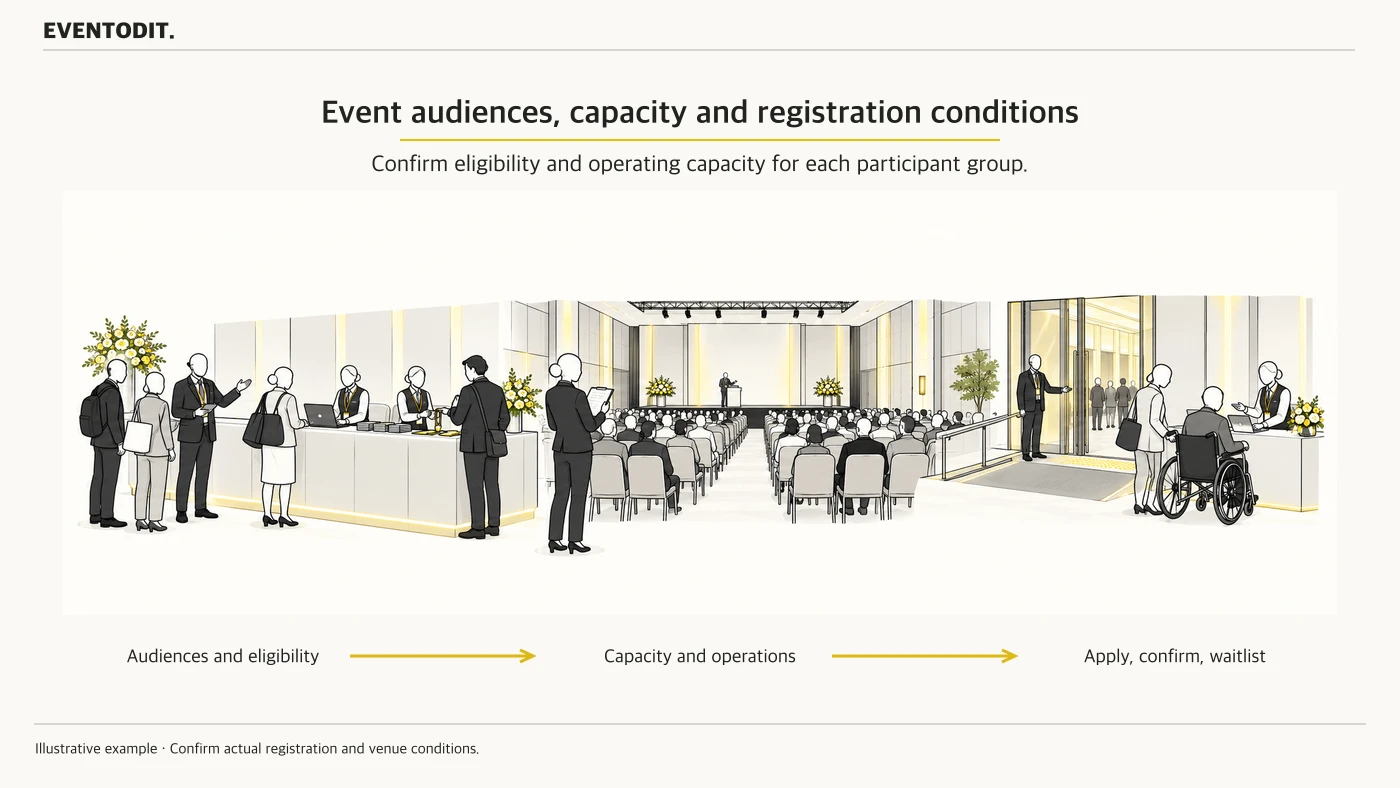
Event audiences, capacity and recruitment conditions
General attendees, buyers, speakers and exhibitors attend for different reasons and need different support. Set eligibility and registration routes for each group, then check workable capacity, waiting-list and accessibility arrangements.
Read guideHave a correction or additional evidence? Request a correction