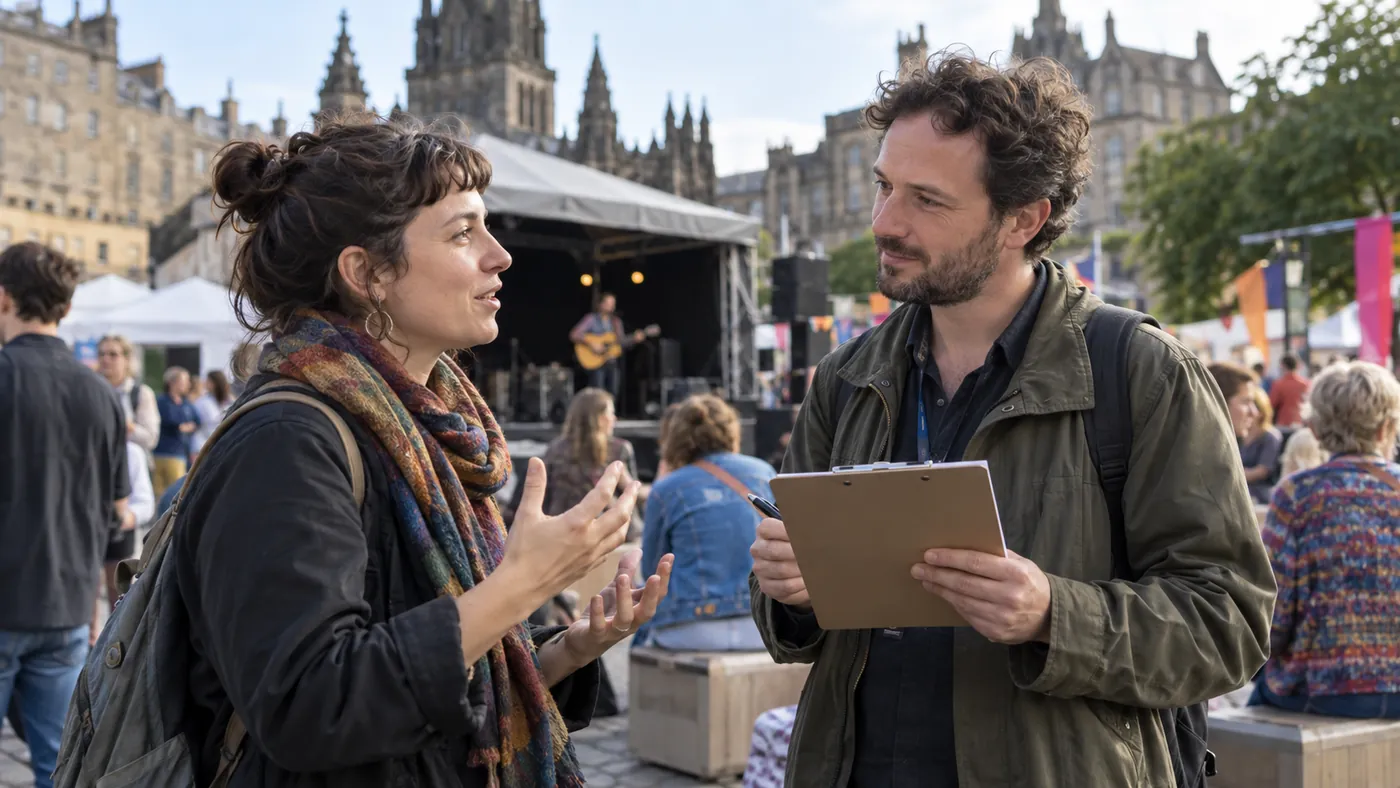
What remains after a festival ends?
Audience numbers are the quickest way to describe a festival’s scale. But an event intended to build relationships with local residents and one intended to attract overseas visitors need to answer different questions, even when looking at the same admission records. Gathering a large audience does not establish that both objectives have been achieved.
The Edinburgh impact study published in June 2026 examined audiences’ cultural experiences, relationships with communities, Scotland’s creative and event-production ecosystem, and economic impacts separately. It is not a document that converts one festival’s success into a single score, but a study that examines the value of several festivals from different perspectives.
Multiple objectives require different evidence
Edinburgh’s 2030 vision sets a direction towards a sustainable, world-leading festival city and identifies several priorities, including international exchange, work and skills, and equitable access. Making a city attractive to outside visitors and broadening residents’ cultural participation can be pursued together, but achievements in one do not automatically prove achievements in the other.
The principle for planners is to distinguish the change to be examined for each objective, rather than to remove objectives.
- If the aim is local participation, examine whether relationships actually formed with groups that were not previously connected.
- If the aim is to support creators, establish what opportunities were provided to them, as well as the number of performance slots.
This distinction also provides a logical basis for deciding where to spend publicity budgets, programme budgets and time collaborating with partners.
Asking about experiences admission records cannot capture
Appendix A of the report explains that common questions were included in each festival’s 2025 audience survey, collecting approximately 8,000 responses. In the published results, 90.3% agreed that the festivals gave them the opportunity to encounter things they would not otherwise see, while 79.4% agreed that the festivals helped make Edinburgh a special place to live in or visit.
These figures, however, come from a self-report survey showing how audience members perceived their experiences. The reviewed report does not state a separate response count for each question. They should not be extended into claims about the views of all Edinburgh residents or evidence of a causal effect on cultural change. Even so, they provide information that admission records alone cannot: whether audiences actually felt the cultural discovery the programmes intended to offer.
When applying this approach to another event, it is more useful to choose questions aligned with its objectives than to ask only, “Were you satisfied?” An event intended to offer new perspectives should ask which experiences felt new. An event intended to connect partners should ask whether connections formed that could lead to a further conversation. These are the editorial team’s application suggestions, not a common survey Edinburgh recommended for every event.
More activity is different from deeper relationships
The evaluation of the PlaCE programme introduced in the report used a logic model distinguishing resources invested, activities, short-term outputs, short- and long-term outcomes, and overall impact. In plain terms, it examined stages: what went in, what was done, what resulted immediately, and what changed over time. The evaluation framework was developed jointly by festivals and funding bodies, drawing on annual data, surveys of different groups, workshops and case studies.
The official announcement describes changes over five years of the PlaCE programme between 2018 and 2023. According to the impact study, the number of participating community organisations increased from 64 to 377 and the number of schools from 497 to 694. These figures record the breadth of organisations connected by the programme. Recasting them as numbers of new participants or the proportion of relationships sustained would change what was measured. Alongside organisation counts, the evaluation also examined qualitative cases and partners’ experiences. However, the reviewed portions of the report do not establish whether these figures are cumulative or show changes by year.
Commissioners and planners of other events can use the same distinction: establish separately how many times a programme ran, who participated, and what changed after participation. The number of activities delivered on the day can be recorded on site, but whether collaboration continued can only be established later.
Defining evaluation questions first changes programme choices
If performance measurement is left until the final stage of the results report, programmes may already be fixed by the time readily available admission numbers and photographs are used to explain their achievements. The following questions need answers before the event.
- Who needs what change?
- How much of that change can be established at this event?
- What evidence will establish it, and when?
- If the objective is long term, how will records of activity on the day connect with later verification of change?
The following table sets this out by objective. The verification timings and responsible roles are examples and should be adjusted to the event’s scale.
| Objective | Expected change | Question to establish it | Evidence | Verification timing (example) | Responsible role (example) |
|---|---|---|---|---|---|
| Offer cultural discovery | Did participants experience something they would rarely encounter? | Which experiences felt new? | On-site survey | Immediately after the event | Planning |
| Broaden local participation | Did relationships form with groups that were not previously connected? | Which groups were newly connected? | Participation records, partner interviews | 3–6 months after the event | Community partnerships lead |
| Support creators | Were meaningful opportunities provided to creators? | What opportunities—performance slots, funding or connections—were provided? | Contract and support records | After the event ends | Programme lead |
Scroll sideways to read every column.
A small event does not need to reproduce a study on Edinburgh’s scale. What matters is the relationship between objectives and evidence, not the quantity of material. If there is one objective, securing the questions and records needed to establish it is more useful for decisions than collecting many figures and assigning meaning afterwards.
Example of a minimum approach: one objective, two or three verification questions, one on-site survey and one follow-up contact
Questions to check before planning
- Who is this event intended to bring change for?
- What change can be established on the day, and what can be established a few months later?
- What evidence and responsible person will establish each change?
- Are admission numbers or counts of participating organisations being used incorrectly as proof that objectives were achieved?
Conclusion
The value of the Edinburgh case does not lie only in large economic impacts or audience numbers. It lies in examining different objectives through different evidence, distinguishing the scale of activity from participants’ experiences and from changes that only emerge over time. Defining the criteria for success before an event makes it easier to align programmes, budgets and research plans. In this article, “success” means achieving the objectives set before the event.
Conditions for applying this to another event
- Apply this when different objectives, such as cultural experiences, local participation and collaboration, coexist.
- Do not combine organisation participation counts, audience surveys and long-term outcomes into a single score.
- Scale the evaluation method down to fit the event’s size and resources.
Information not established
- The relevant figures and logic model in the 2026 impact study, the 2030 vision and the official announcement were checked against the original sources on 31 October 2026 after publication.
- The audience survey records self-reported perceptions; it does not represent all residents’ views or establish long-term causal effects.
- The Appendix A survey figures were checked on page 17 of the report. The response count for each question and the method used to aggregate the organisation figures—cumulative or by year—were not established.
- This article does not cover the report’s economic impact analysis.
- The PlaCE programme and the 2025 audience survey concern different groups and periods.
- No reanalysis of raw data or on-site reporting was undertaken. Discussion of applications to other events is the editorial team’s interpretation.
Sources
- Festivals Edinburgh, City of Imagination: 2030 Vision strategy information: https://www.edinburghfestivalcity.com/about/strategy
- Festivals Edinburgh, The Impact of the Edinburgh Festivals, June 2026 (pages 17 and 20–23): https://www.edinburghfestivalcity.com/assets/000/000/937/Edinburgh_Festivals_Impact_Study_-_June_2026_original.pdf?1782491819
- Festivals Edinburgh, official impact-study announcement (29 June 2026): https://www.edinburghfestivalcity.com/about/news/698-untitled
Next tasks and related resources
Related practical guides
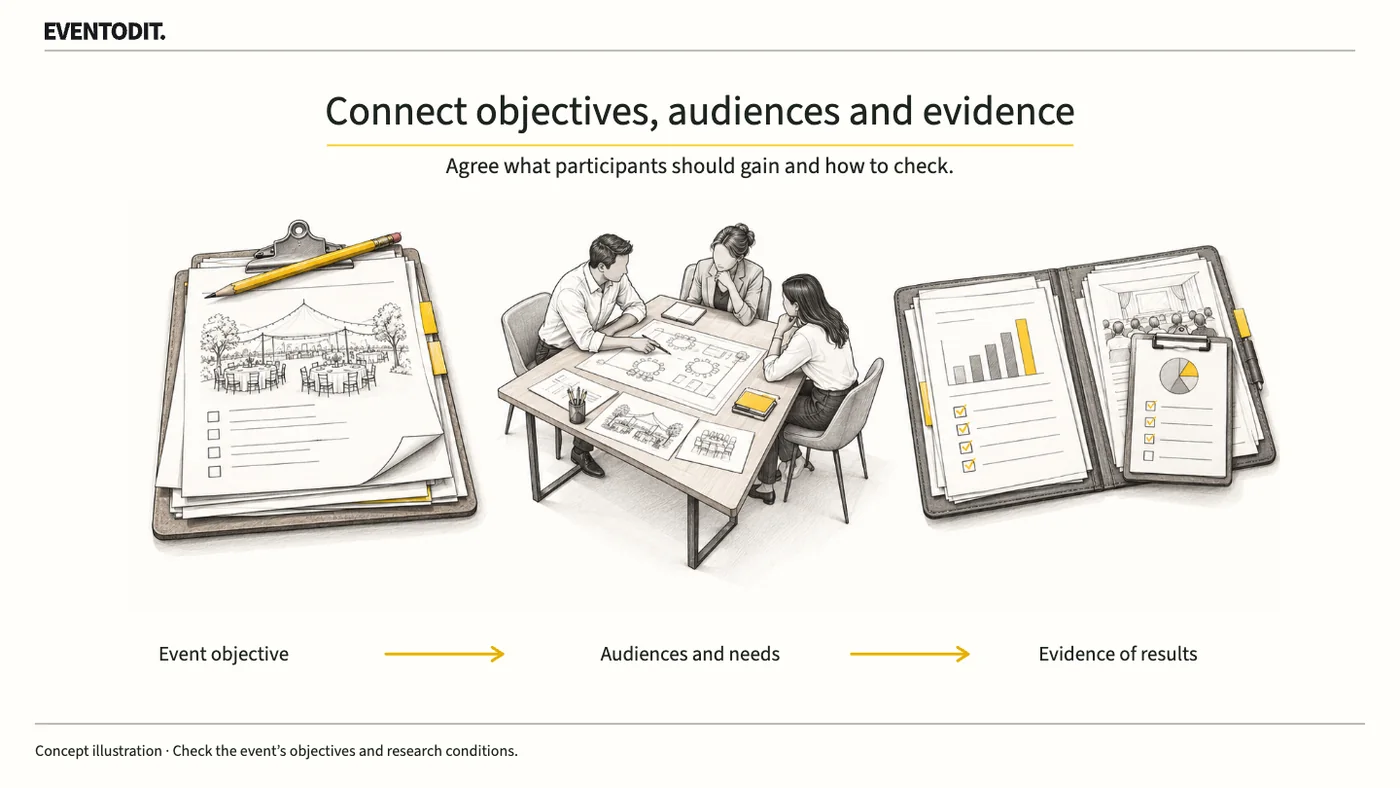
Set event objectives and audiences before choosing how to measure success
Define participant outcomes, audiences and evidence before collecting event data.
Read guideHave a correction or additional evidence? Request a correction