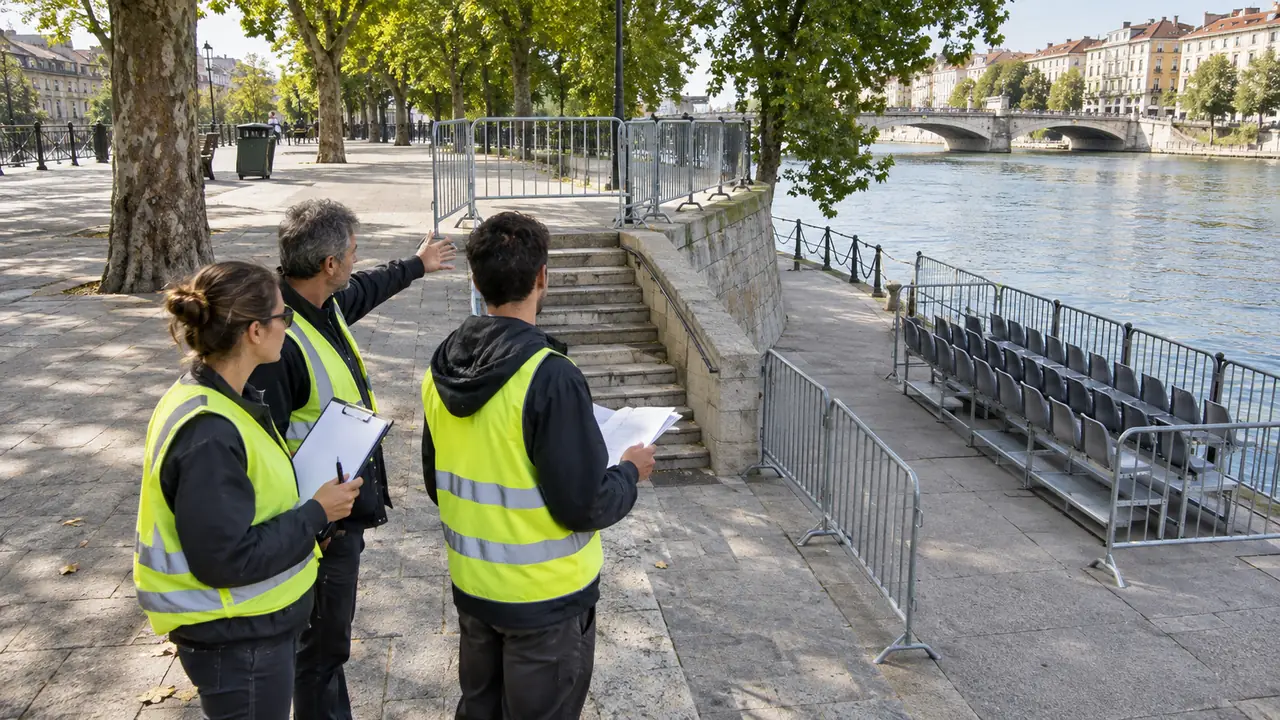
The initial idea treated the whole city as a stage
In December 2021, the Île-de-France regional government, whose region includes Paris, presented a concept using six kilometres of the Seine as a stage, with room for 600,000 people to watch. Athletes would travel along the river by boat, with riverside buildings providing the backdrop. This number was the initially announced target, not the number of people who actually entered.
A long river offers many places to watch. But a place with a view of the river is different from a place that can actually accommodate people. The length of the riverbank does not determine how many people can be admitted.
The point to examine in this case is that, after announcing a large number, the organisers defined viewing locations and ways to enter them together. Choosing places, selecting people and admitting them to designated zones became parts of a single plan.
Different riverside zones were used in different ways
At a French Senate hearing in March 2024, the then Interior Minister explained the arrangement as follows. There would be 104,000 paid tickets for the lower quays, while 222,000 people would be invited to watch free of charge on the upper quays. Seating would be installed on the lower quays.
Not every part of the riverbank could be used for viewing. Routes had to remain open for people to pass along the upper quays. The riverside booksellers’ book boxes also had to stay in place. Viewing therefore used separate sections rather than the entire six kilometres of riverbank.
Dividing the areas did not mean that they had separate access routes. Spectators for the lower quays passed through the same entrances as those for the upper quays, underwent checks and were directed to their destinations.
| March 2024 announcement | Number | How to enter |
|---|---|---|
| Paid viewing on the lower quays | 104,000 tickets | Seating on the lower quays and some bridges |
| Free viewing on the upper quays | 222,000 people | Designated zones after invitation and registration |
| Total | 326,000 people | Planned number of people entering the riverside areas |
Scroll sideways to read every column.
Applying this approach to another event requires more than changing the total headcount. Where to install seating, where to leave routes clear and who may enter each zone must change together. This is the editorial team’s interpretation of the public materials.
Free viewing also required an invitation and registration
The upper quays were free of charge, but they were not open to anyone who wished to enter. Local authorities, the organising committee and state bodies selected the people to invite. Invitees registered through a link and entered after QR-code and identity checks.
Records also show that this process was carried out. In June 2024, the French Government announced that several bodies were jointly allocating the 222,000 invitations for the upper quays. The City of Paris’s July guidance stated that its final invitations had been sent on 4 July and that registration had closed on 8 July.
When free places are allocated by invitation, deciding whom to invite and when to require a response becomes part of the plan. The number of invitations sent, the number of people registered and the number who actually attend are different figures. Public materials alone, however, do not reveal how many people failed to respond or did not attend.
Riverside spectators and people living nearby must be considered separately
People other than the 326,000 who entered the riverside areas also watched the opening ceremony. Some residents watched from the windows of nearby buildings, while other spectators used separately provided fan zones. These people did not use the same seating or go through the same admission process.
In May 2024, the Interior Ministry explained this in spatial terms. The event site and the security perimeter were not identical, and nearby buildings with views of the river were also included within the security perimeter. Access routes for residents and shops, the operation of existing facilities and travel routes also had to be determined. Reducing riverside numbers did not remove the need to consider everyday city life.
Ticket numbers and the number of people in surrounding areas should therefore not be combined into a single figure. They are connected but must be explained separately. A large number watching from outside the riverside areas does not mean that riverside capacity can be increased by the same amount.
Actual results and the initial plan must be considered separately
The opening ceremony took place on the Seine on 26 July 2024. According to the IOC, about 320,000 people watched in person along the river. People watching from the windows of riverside homes were not included in this figure.
The March plan for 326,000 people and the actual figure of about 320,000 refer to different points in time and use different bases. Subtracting one from the other does not establish the number of empty places or non-attendees. Nor does the difference from the initial 600,000 mean that people gave up admission. The initial number was a target; the later figures describe the prepared plan and actual spectators.
Evaluating the plan requires two separate questions: did the event actually take place, and was that number the most appropriate? These materials do not provide the number of people present in each zone, the speed at which entrances processed them or spectator satisfaction. This case alone therefore cannot establish how much congestion was reduced or whether the approach cost less than alternatives.
Reducing numbers also changes participation and preparation
The participation model changed between the initial announcement of 600,000 people and the 2024 plan for 326,000. Even free places came to require invitations. The City of Paris stated that, in allocating its share of invitations, it would prioritise families who usually found it difficult to attend major events, local young people, and residents and traders affected by the ceremony. As numbers were reduced, a separate decision was made about who would receive the opportunity.
It is therefore difficult to regard this approach simply as a successful reduction in scale. Invitations allocate places only to selected people. People who were not invited did not have the same opportunity. Nor does Paris’s approach represent the right answer for every event.
A reduction in numbers does not reduce preparation work in the same proportion. Providing information in each zone, checking admission and answering invitation enquiries still remain. The French Government also discussed transport and travel plans in its announcement. Audience numbers alone are insufficient to explain city operations.
How to think about this for other events
Consider, for example, a parade along an urban river or street in South Korea. Instead of writing only a goal to “attract many people”, also record what will be shown, to whom and in which location. Using this structure to compare a baseline option, a smaller option and a larger option also makes the differences clearer. This method of organising the information is an editorial proposal, not a reproduction of a table actually used by Paris.
If viewing space cannot be expanded, increasing the number of invitations does not increase the number of people who can actually enter. A proposal to use additional space must also consider access routes, information and the effects on people nearby. Even with the same number of people, changing from free entry to admission by invitation changes what participants must prepare.
In South Korea, the actual layout, passage conditions and legal requirements must be checked with the venue operator, relevant authorities and on-site personnel when deciding numbers. There is no basis for importing France’s numerical limits, security perimeters or invitation methods unchanged. The lesson is not a particular number, but a method of choosing the scale that can actually be accommodated by considering the location, intended audience and admission method together.
Conclusion
The Paris 2024 opening ceremony replanned its initial large target by dividing it into spectator numbers and admission methods for each location. Other events should also record three things together when deciding numbers: what will be shown to whom and where, the conditions for entering those places, and the effects on people nearby. Planned numbers and actual spectators must be recorded separately to judge what the next event should carry forward.
Conditions for applying this to other events
- Refer to this case when several urban zones are used as viewing locations and invitation-based, paid and open admission are combined.
- Do not transfer France’s numerical limits, security perimeters or invitation-screening methods into common standards for South Korea. Actual site conditions and applicable requirements must be checked separately.
Unconfirmed information
- Final admission records and simultaneous occupancy by zone, the number who registered but did not attend, entrance-processing speeds and waiting times, spectator satisfaction and costs by zone were not confirmed.
- The effects of adjusting numbers on safety or costs were not confirmed.
- The figure of 326,000 belongs to the March 2024 plan. It was not subtracted from the IOC’s figure of about 320,000 to calculate empty places or non-attendees.
- No on-site reporting, analysis of raw data or external expert review was conducted.
Sources
- Île-de-France regional government, initial concept for the opening ceremony on the Seine (13 December 2021)
- French Senate Law Committee, hearing transcript (5 March 2024)
- French Interior Ministry, explanation of opening-ceremony security and surrounding areas (May 2024)
- French Government, Council of Ministers announcement (26 June 2024)
- City of Paris, guidance on solidarity-ticket allocation and upper-quay invitations (updated 23 July 2024)
- IOC, post-event coverage of the Paris 2024 opening ceremony on the Seine
Next tasks and related resources
Related practical guides
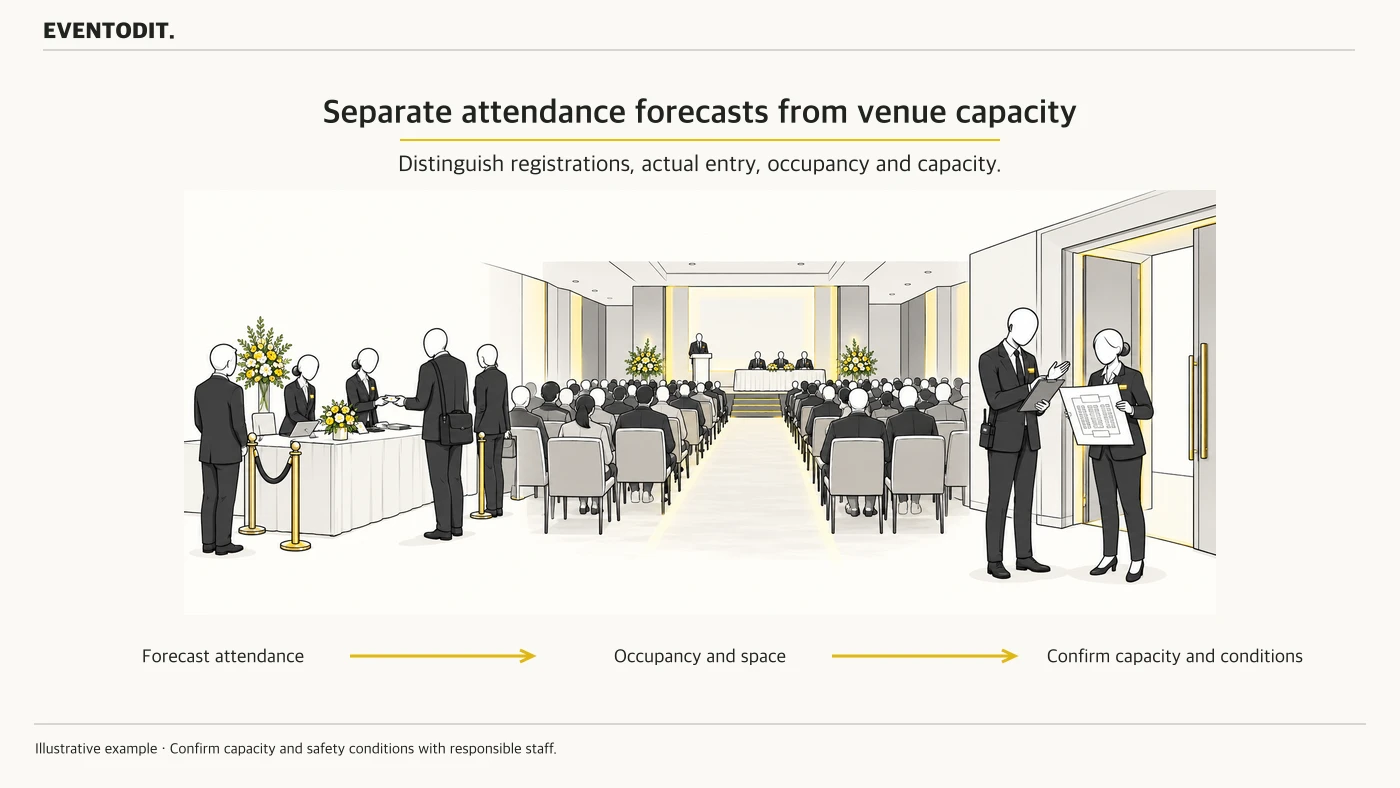
Separate attendance forecasts from venue conditions when planning event scale
Registrations, people present on site and venue capacity figures for different layouts are not the same measure. Compare evidence-based scenarios and confirm the actual operating conditions.
Read guideHave a correction or additional evidence? Request a correction