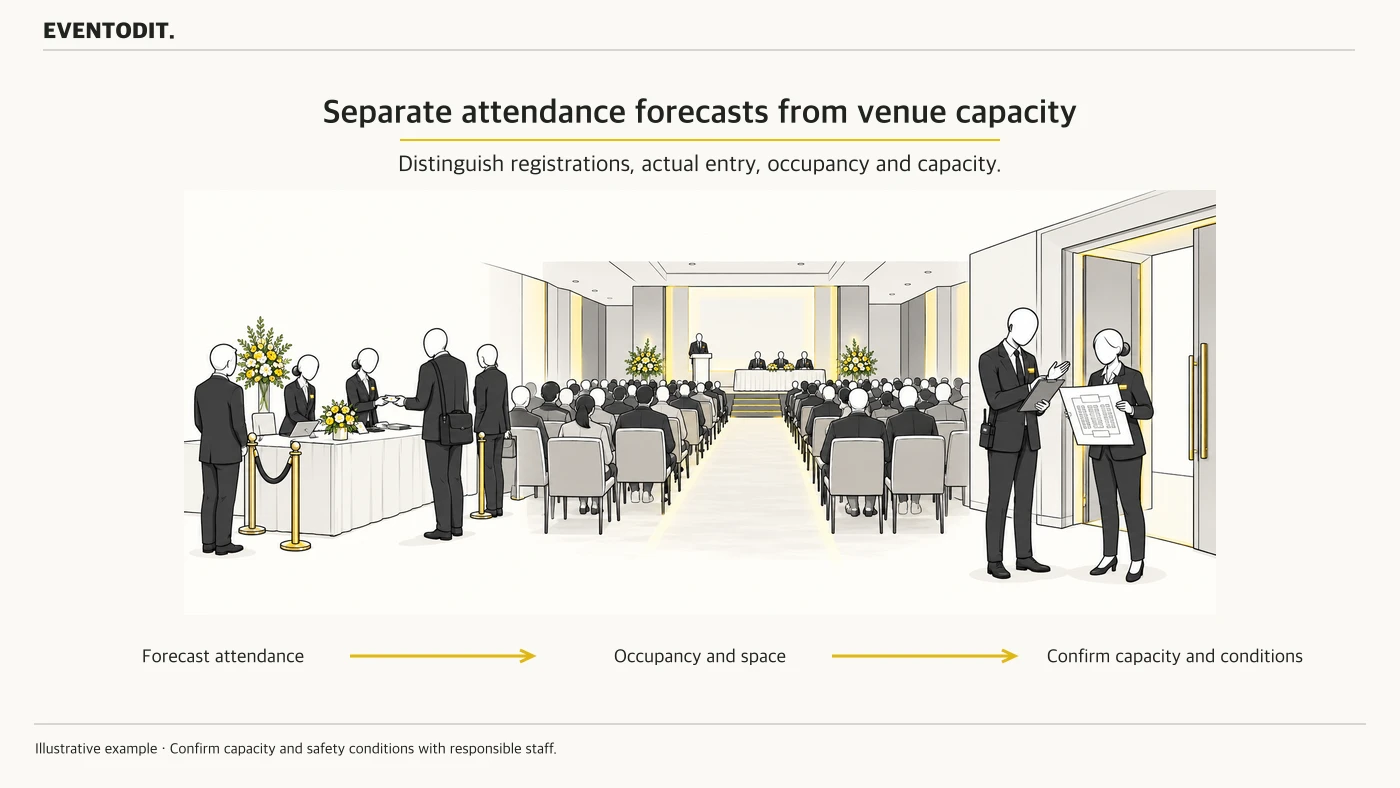
Separate registrations, entries, occupancy and capacity
Before setting event scale, define what each number represents, who it includes, and its counting period and method. Applications or registrations, actual visits and the number present at the same time are different measures. Gate passages can include re-entry and repeat passages, so do not treat them as unique entrants.
| Measure | Meaning and counting basis to check |
|---|---|
| Registrations | People who applied or registered. Specify the period and treatment of cancellations, duplicates and confirmation status. |
| Actual entries | People who actually entered during a period. Specify whether the figure counts unique people or gate passages, and how re-entry is handled. |
| Simultaneous occupancy | People present on site or in an area at a particular time. Specify whether attendees, speakers, staff and contractors are included. |
| Applicable space limit | The restriction confirmed by the venue and safety leads for the actual layout and conditions, separate from a general published figure. |
Scroll sideways if needed to read every column.
Before using records from an earlier event, compare the population, time window and counting method. Where conditions differ, retain them as reference values and explain the differences rather than mixing them as comparable measurements.
Record the basis for baseline, lower and higher scenarios
Compare baseline, lower and higher demand using registration trends and application pace, verified participation at previous events, session counts and venue access hours. Record the source, period and assumptions for each figure; mark values without evidence as unconfirmed.
For each scenario, record the conditions under which to change sessions or consider another venue, who makes that decision and the check deadline. A higher-demand scenario is a planning option, not permission to increase an approved capacity.
| Scenario | Registration and entry forecast and evidence | Simultaneous occupancy forecast and evidence | Unconfirmed operating and safety conditions | Adjustment trigger, decision-maker and deadline |
|---|---|---|---|---|
| Baseline | ||||
| Lower | ||||
| Higher |
Scroll sideways if needed to read every column.
This table is an editorial recording example; adapt it to the event’s counting methods and actual approval process.
Compare published room figures with the actual layout
COEX Magok Convention Center lists the combined fifth-floor Room 501 at 360 people in theatre layout, 180 in classroom layout and 160 in banquet layout. These are the facility’s published figures for those configurations, not the capacity of another event or space. A published figure alone does not establish the approved capacity or safe limit for the actual event layout.
With the venue operator, check the actual plan showing stage, equipment, seats, aisles and accessible space, the restrictions and conditions applying to that layout, and accessible areas and evacuation routes. Record who must confirm the plan and whether approval is required.
Review total occupancy and congestion by area
Look separately at the number across the venue and distribution around entry queues, entrances and stairs, popular booths or the front of the stage, toilets and food areas. The UK HSE advises observing crowd size and distribution and identifying congestion risks. This UK guidance helps identify risk; it is not a Korean venue capacity standard. Actual capacity and safety measures follow the conditions confirmed by the venue, relevant authorities and qualified safety lead.
The on-site lead agrees entry and exit counting methods, observation owners and frequency for each area, reporting times and contacts. Specify who will investigate missing counts or congestion and which site plan they will follow. An attendance estimate alone does not establish that a space is safe.
Compare resources and responses for each scenario
Operations asks the relevant leads to check seats and stewards, accessibility support and transport, waiting space, toilets and additional costs for each scenario. If resources cannot be secured, discuss with the decision-maker whether to adjust scale or sessions or consider another venue.
Do not confirm increased audience capacity or an expanded layout before required venue and safety checks and approvals. This does not mean delaying safety staff or measures needed to address a risk; follow the approved emergency and on-site response procedures when danger arises.
Fictional example: seminar registrations rise quickly
This fictional situation illustrates the decision process; it is not an approval or result for a real event. If seminar registrations grow faster than expected, the planning lead records registrations and expected actual entries separately, with the basis for each.
Operations compares the published fifth-floor room figures with the actual seating plan and venue team. The safety lead checks crowd distribution around entry queues and stairs and the response plan. The higher-capacity option remains unconfirmed until the required checks and approvals are complete.
Recheck when scale or layout changes
When scale or layout changes, ask the venue and safety lead whether existing approvals and limits still apply. Recheck the emergency plan and evacuation routes against the changed layout, as well as staffing and accessibility support, and obtain required change approvals or reconfirmation. Hand the same updated information and remaining unconfirmed conditions to planning, venue, operations and safety leads.
Final check before use: Before confirming scale and recruitment capacity, compare the counting basis for registrations, entries and simultaneous occupancy, the evidence for each scenario, the venue and safety conditions for the actual layout, and the staffing and response plan.
Scope and limitations
This is EVENTODIT’s planning proposal informed by COEX Magok’s published layout figures and UK HSE crowd-safety guidance. The tables and seminar situation are editorial examples. The venue figures apply to that facility and UK guidance is not a Korean legal standard.
This article does not replace a capacity determination or professional safety assessment. The forecast, layout, approved capacity, decision authority and actual results for any particular event have not been established. Follow the conditions confirmed by the venue, relevant authorities and qualified safety lead.
Use the form for the next handover
Use the [Attendance measures, scale scenarios and venue conditions](/en/templates/attendance-capacity-scenarios.html) for the records described here. The XLSX contains Blank, Example and Instructions sheets. Write your event in Blank; the fictional example is a guide to what to enter.
Define inclusion, period and duplicate treatment for each measure first. Use the same definitions across baseline, lower and higher scenarios and link evidence and assumptions.
Planning sends consistent scenario definitions and layout versions to venue, operations and safety leads. Link the handover to the separate live area-observation log.
Conditions for applying this elsewhere
Verify the event, venue and local requirements with the people responsible; overseas guidance is not Korean law.
Information not established
Specific site conditions, authorities and actual event outcomes have not been verified.
Reference material
Have a correction or additional evidence? Request a correction