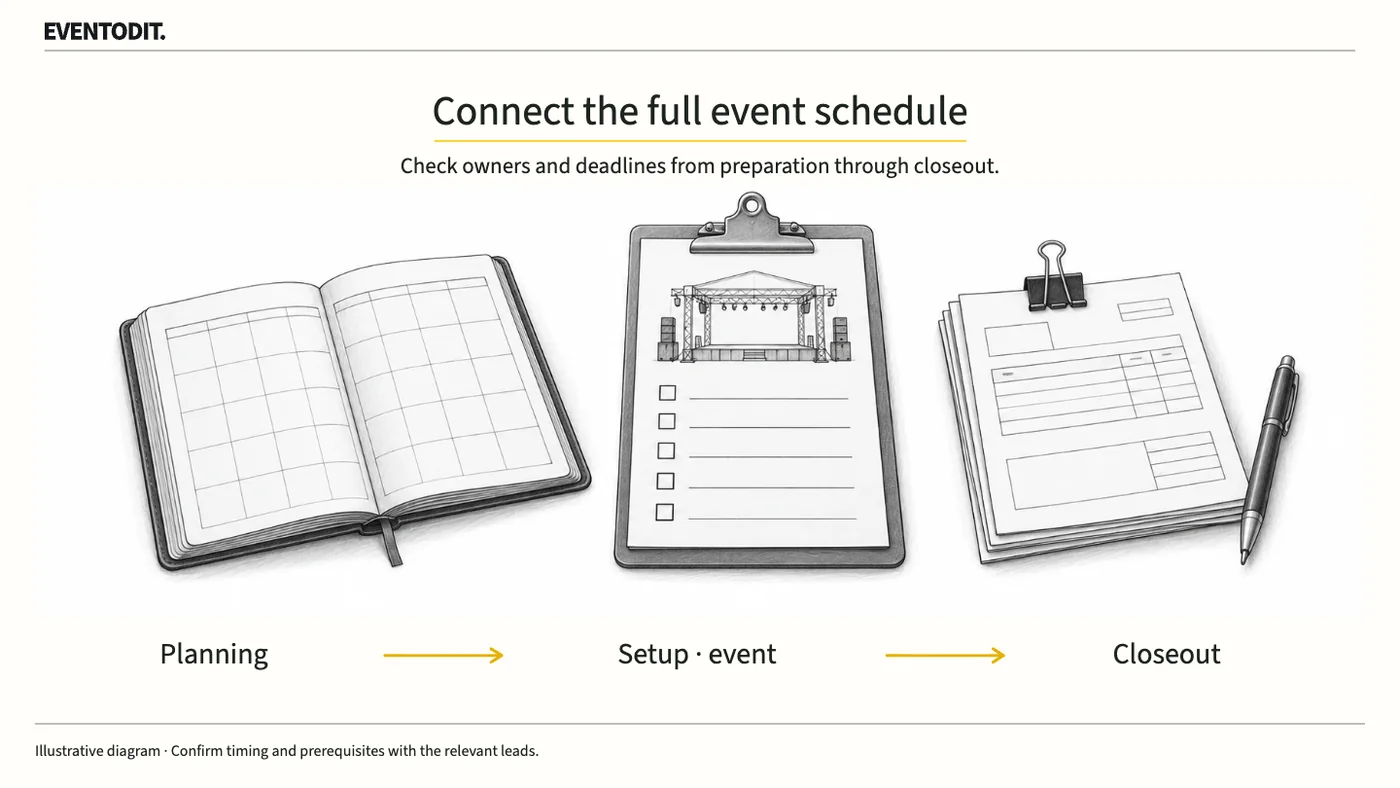
Start with the work that begins before the event
The planning lead preparing an event master schedule should gather the work from preparation through dismantling and closeout in one place. Include objectives and budget decisions, venue checks, procurement, participant recruitment, permits and safety coordination, production, delivery, setup and rehearsal, operations, dismantling and restoration, settlement and final reporting. Rather than deleting an item that may not apply, record who will confirm whether it is needed. Place work that can happen in parallel, such as recruitment and production, in the same period, and identify decisions such as venue approval that affect later work.
Dover District Council in England publishes an example timeline from event purpose, venue and safety checks through on-site operations and post-event cleanup. Its lead times and deadlines are local examples. Do not treat them as uniform requirements in Korea; check the actual terms set by the venue, relevant authorities and contracting parties.
Record the start, finish and response for each task
The planning lead should record the owner, start time and completion deadline, required inputs, the next task, the person who must confirm it and the status. Distinguish when information was sent from when the recipient confirmed it. Sending paperwork is not the same as its receipt or approval. If a date has not been supplied, mark it unverified and name the person and deadline for obtaining a response.
The following is a fictional example assuming an event on 15 May 2027. The dates, times, roles and states are neither a real event nor recommended lead times.
| Task and owner | Schedule and response to obtain | Prerequisite and current status |
|---|---|---|
| Venue check · venue lead | Request confirmation of setup and dismantling hours by 20 April, 17:00 | Venue permission pending; the setup day is an assumption |
| Registration preparation · communications lead | Planned opening 22 April, 12:00; announce after venue information is confirmed | Venue details unverified; prepare a draft notice only |
| Equipment delivery · logistics lead | Planned delivery 14 May, 08:30; obtain venue and supplier confirmation | Pending delivery permission and loading space |
| Rehearsal · technical lead | Planned 14 May, 14:00; proceed after installation is confirmed complete | Equipment installation and essential checks incomplete |
| Dismantling · site lead | Planned start 16 May, 08:00; confirm audience departure and permitted venue hours | Pending dismantling conditions and responsible leads’ response |
Scroll sideways if needed to read every column.
Seoul’s guidance on temporary use of city parks lists an event plan, installation and restoration plans, and safety-management documents as application materials. Park procedures and event conditions can differ. Do not use the fictional dates above as application deadlines; check with the relevant park authority.
Connect the work that must finish before the next step
If venue conditions must be confirmed before final procurement requirements can be set, link those tasks. Record the arrival of the equipment vehicle, availability of the loading area, completed installation, technical checks and start of rehearsal as separate states. A planned vehicle arrival is not evidence that installation is complete or rehearsal can begin.
Where different teams share a loading area, lift, stage or power supply, check their overlapping times and areas and agree who tells whom when the preceding work is complete. Do not force tasks that can run concurrently into a single sequence. The UK HSE also describes coordinating phased work and informing the relevant people during delivery, setup, dismantling and load-out. This is UK safety guidance, not a basis for deciding domestic legal duties.
Recheck connected work and costs when a date changes
If venue access is delayed or a supplier changes its delivery window, the schedule lead first informs the affected task owners. Each owner replies whether the work can proceed and whether additional staff, cost or a contract change is needed. Update the schedule after the authorised person decides; follow procedures confirmed by the relevant specialists and the venue for safety matters.
In the fictional example above, a late delivery permission does not automatically make rehearsal complete. The logistics lead checks the new delivery window, the technical lead reviews installation and testing time, and the programme lead decides how the start time is affected. Until resolved, retain the original time, proposed change, outstanding question and response deadline. Do not recover lost time by rushing unsafe work.
Include post-event work and share one current version
Assign owners and deadlines to post-event work such as receiving settlement evidence, confirming supplier balances, checking venue restoration and submitting grant results. Overseas exhibitions may specify separate deadlines for outbound documentation and carrier arrival. GES’s guidance for one 2024 exhibition separately lists documents to submit after packing and the carrier arrival deadline. Check the current rules for the specific show rather than applying that event’s times elsewhere.
Show the schedule’s reference time, version, author and recipients, and communicate what changed from the previous version. Completion means each task has an owner, time, prerequisite and response status, and people are assigned to unverified items and post-event work. Separately confirm the site safety plan, venue permission and deadlines in individual contracts.
Use the form for the next handover
Use the Master schedule, prerequisites and reply log for the records described here. The XLSX contains Blank, Example and Instructions sheets. Write your event in Blank; the fictional example is a guide to what to enter.
Give each task an ID, owner, planned time, deadline and time zone. Link prerequisite IDs and required approvals; do not impose a sequence on work that can run in parallel.
The schedule owner sends the version, as-of time and change impacts to each lead. Confirm receipt and completion replies before updating the next task’s prerequisites.
Conditions for applying this elsewhere
Verify the event, venue and local requirements with the people responsible; overseas guidance is not Korean law.
Information not established
Specific site conditions, authorities and actual event outcomes have not been verified.
Reference material
- Seoul City Parks · Temporary venue use · Park-specific application, event plan, installation and restoration conditions
- Dover District Council · Event Planning Timeline · A local scheduling example from Dover, England
- UK HSE · Managing an event · Coordination and safety during load-in, setup, dismantling and load-out
- GES · Outbound Shipments · Outbound paperwork and carrier arrival deadlines for the specified 2024 exhibition
After reading, complete the next task
A master schedule showing task owners, start times, completion deadlines, prerequisites, response status, post-event work and the current version
This article’s template
Master schedule, prerequisites and reply log
A connected schedule and change record from early decisions through settlement
Instructions, examples & downloadsRelated practical guides
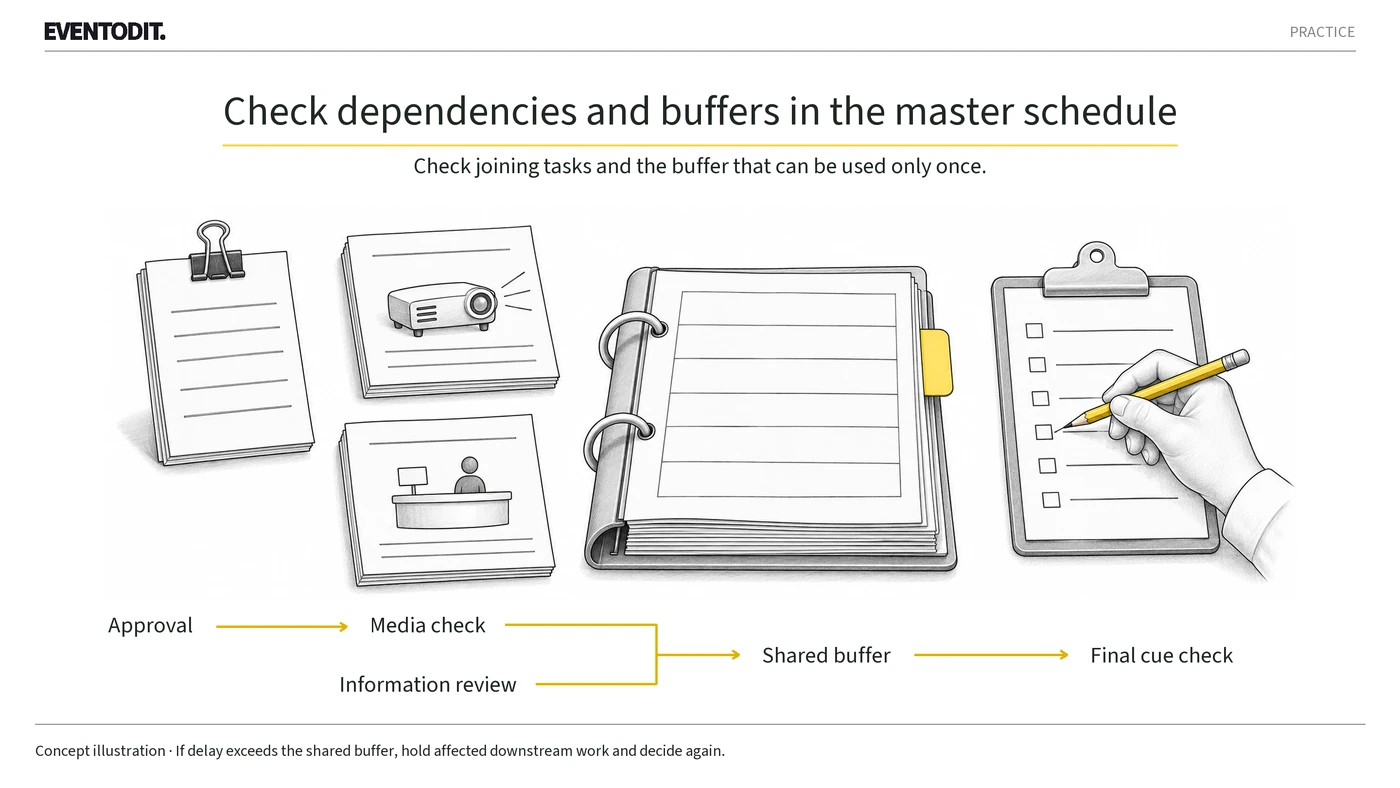
A schedule shows when the next task can start
Hand over a consistent view of absorbable delay and work requiring a new decision.
Read guide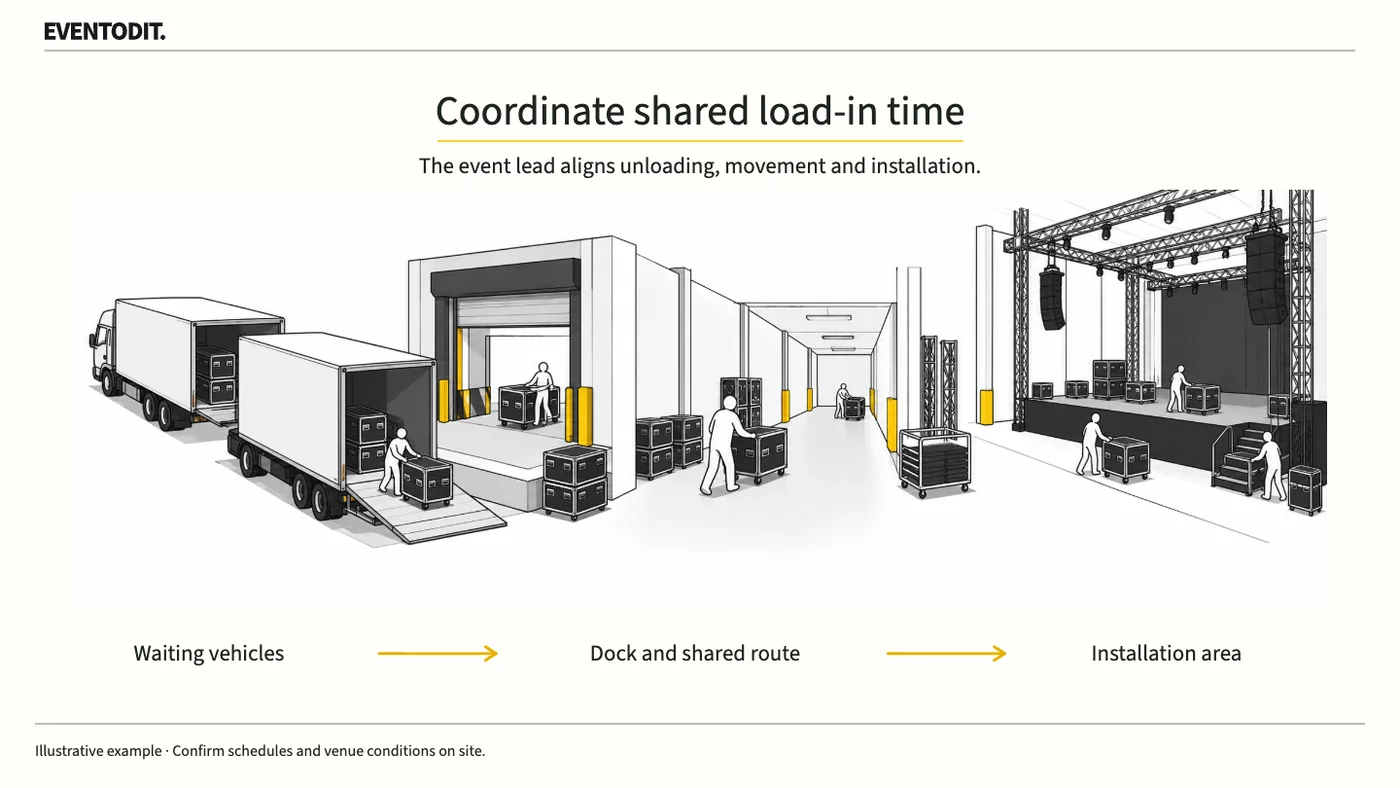
Venue Load-in Scheduling and Shared-area Coordination
Installation start times alone can hide clashes between vehicles and equipment at the loading bay. Combine arrival, unloading, movement, installation and departure times, then resolve clashes in shared areas.
Read guideHave a correction or additional evidence? Request a correction