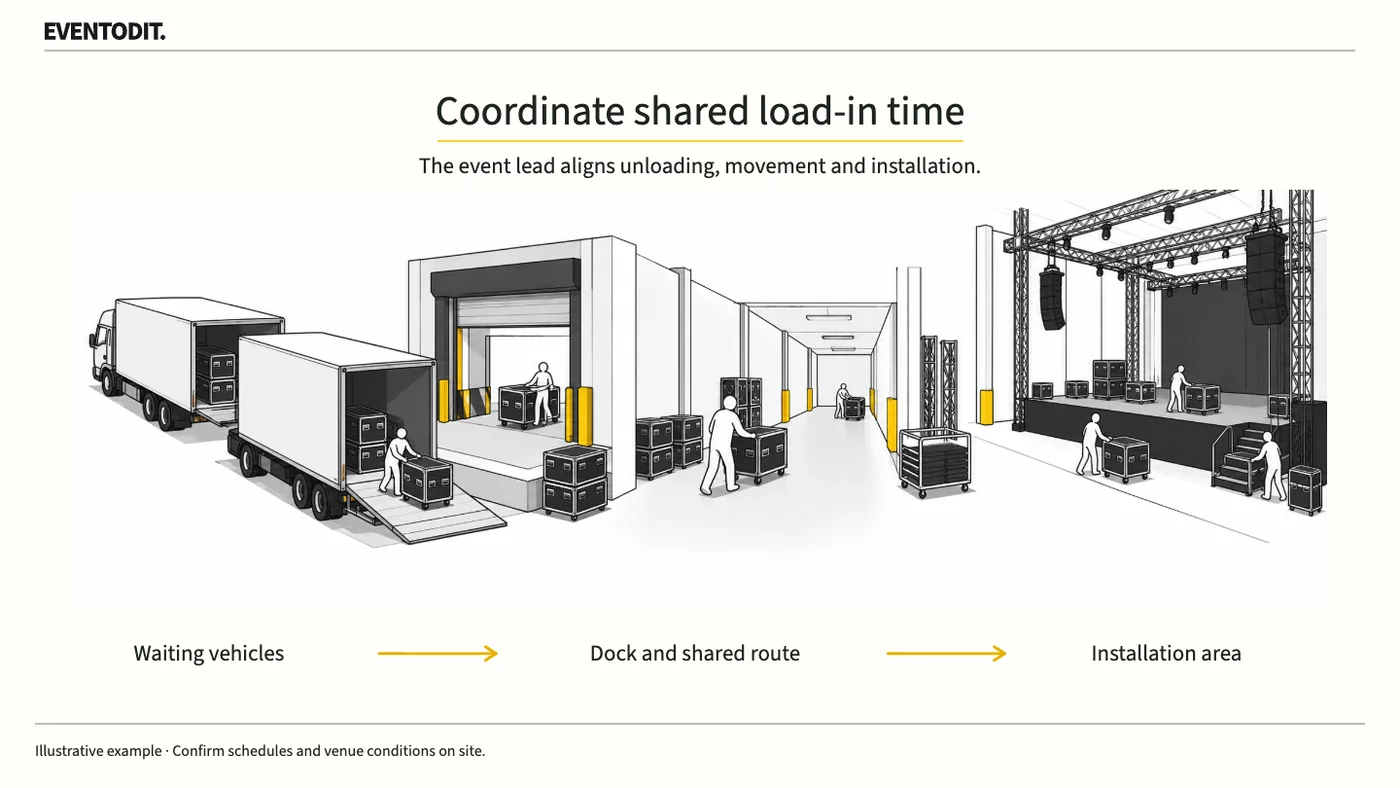
Part 1. Overall PM and Planning and Operations Lead
"Control the time shared routes are occupied, not just each supplier's installation start time."
- Collect and coordinate one load-in schedule: Do not ask suppliers only for equipment installation times. Combine their timelines for vehicle arrival, unloading, movement inside the venue, installation and empty-vehicle departure in one schedule. Identify and adjust overlapping use of the loading bay and routes.
- Separate routes for large structures and sensitive equipment: Do not allow heavy stage structures and sensitive broadcast equipment such as cameras and lenses to use a narrow corridor or lift at the same time. Separate their time windows or assign different routes.
- Recheck contingencies and agree a delay rule the day before: Reconfirm the work sequence and closed passage sections on the day before load-in. Agree in advance which supplier's work will go first if an earlier supplier's vehicle arrives late.
Part 2. Venue Hire and Facility Manager
"Provide officially confirmed route dimensions and load limits rather than supplier estimates."
- Specify shared-area availability: Before asking suppliers for schedules, obtain an official timeline from the venue facilities team showing exactly when the loading bay, freight lift, doors and temporary storage can be used.
- Distribute confirmed infrastructure limits: Do not leave suppliers to guess physical conditions such as route width and height, floor load limits and permitted vehicle weight. Distribute the limits officially confirmed by the venue with the purchase order in advance.
- State required venue protection conditions: Tell suppliers where and how protective materials must be installed to protect floors and walls when heavy carts or loads move. Exercise stop-work authority if the requirements are breached.
When rechecking the work sequence and passage closure times, also confirm that emergency access remains available. UK HSE guidance describes coordinating work and sharing risk information during event build, load-in and removal. Confirm Korean legal roles and permits separately for the site and contract.
Scroll sideways if needed to follow each role.
- Venue: Confirm usable conditionsAccess, loading limits and bay hours
- Supplier: Submit supplier work plansArrival, unloading, movement and installation sequence
- Overall PM: Resolve conflictsAdjust shared passages and vehicle occupancy
- Overall PM: Approve combined scheduleConfirm revised version and delay-response owners
- VenueConfirm usable conditionsAccess, loading limits and bay hours
- SupplierSubmit supplier work plansArrival, unloading, movement and installation sequence
- Overall PMResolve conflictsAdjust shared passages and vehicle occupancy
- Overall PMApprove combined scheduleConfirm revised version and delay-response owners
Columns identify roles. Read steps from top to bottom; arrows show the handover direction.
Part 3. Stage, Video and Audio System Suppliers
"Check whether your work starts when another team's unloading ends."
- Provide a detailed time estimate: Do not simply tell the overall PM that installation starts at 14:00. Break down the times for positioning the vehicle at the bay, unloading, passing through routes and starting installation to the minute so conflicts can be identified.
- Follow coordination instructions when work conflicts: If your route overlaps with another supplier's and you must wait, do not push ahead on your own. Follow the overall PM's coordination instructions and check the revised version of the timetable before working.
- Manage waiting vehicles and idling: Brief drivers in advance to wait in the designated external parking area if they cannot enter the loading bay. Empty vehicles should leave promptly after unloading to clear the approach for the next supplier.
Final check before use: On load-in day, check that every supplier understands the latest integrated load-in schedule and that all overlaps at the loading bay and shared routes have been resolved.
Conditions for applying this elsewhere
Where multiple suppliers and vehicles share one venue's access, unloading and installation spaces
Information not established
Vehicle restrictions, load ratings, lift specifications and the safety-management plan need venue confirmation.
Reference material
After reading, complete the next task
Use timetable for vehicles, loading bays, shared passages and installation zones
This article’s template
Loading-bay and Shared-route Schedule
A supplier load-in schedule showing shared-area bookings and how clashes were resolved.
Instructions, examples & downloadsRelated practical guides
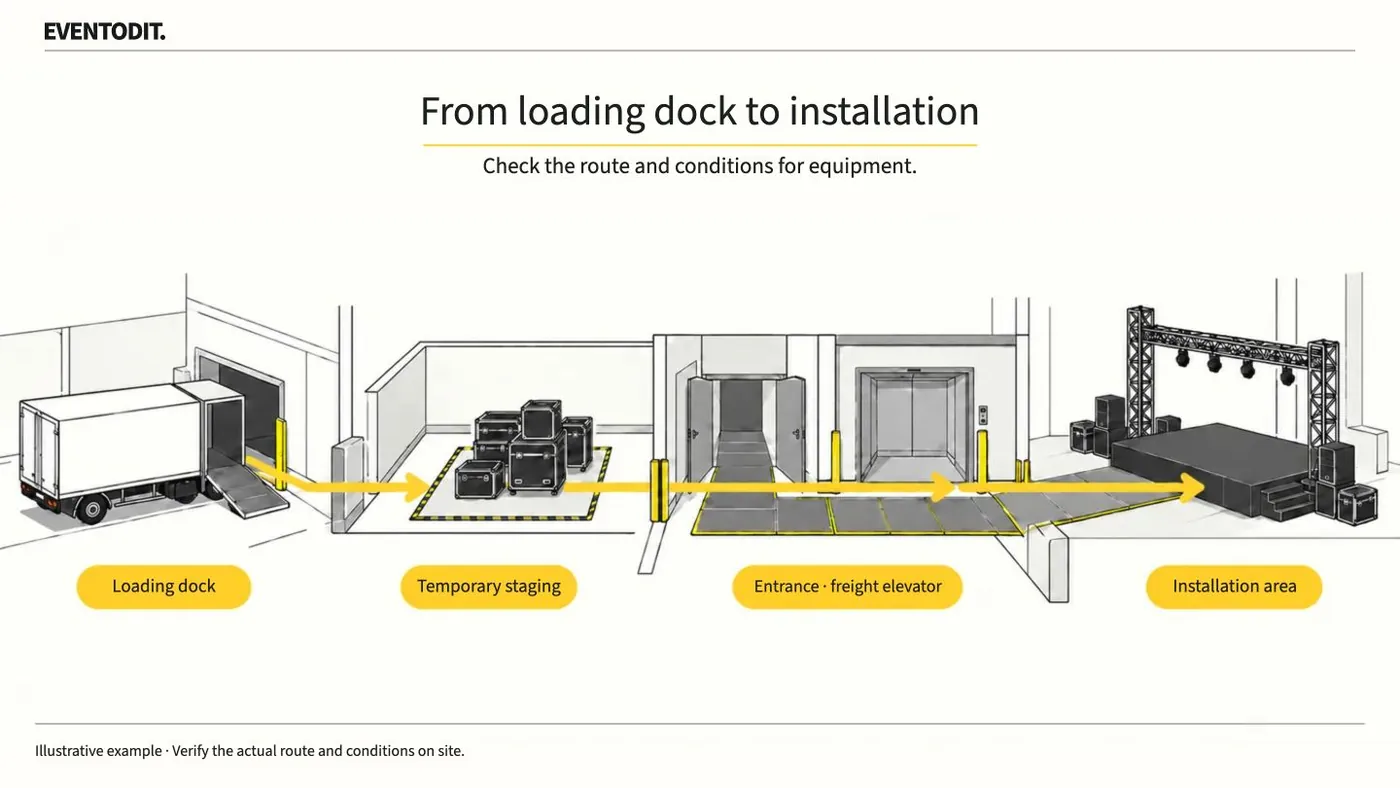
Venue Survey and Load-in
Check the route equipment will actually travel and the routes visitors will use. Mark questions for the facilities and technical teams on the plan and assign a person and deadline to resolve each one.
Read guideHave a correction or additional evidence? Request a correction