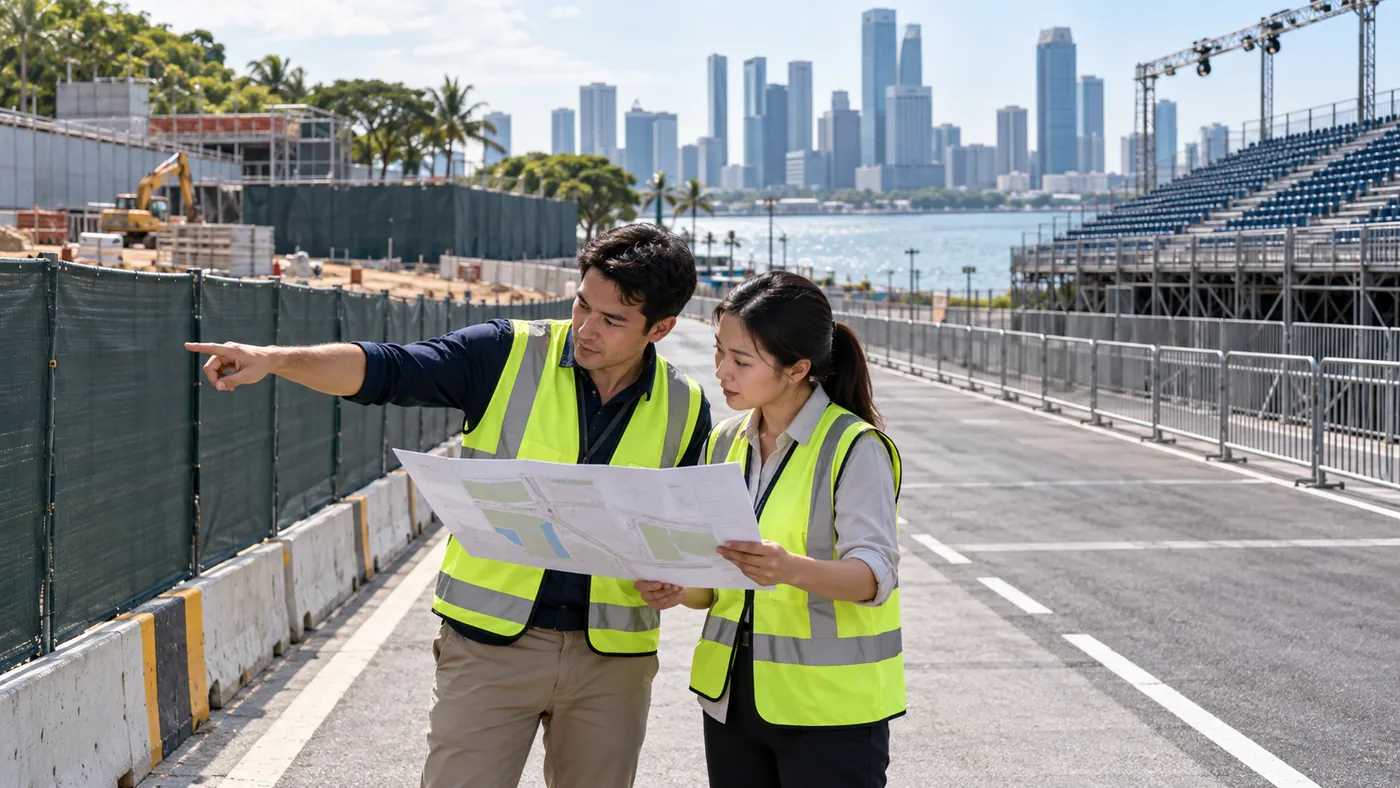
A space the event had used became unavailable
The Float at Marina Bay was redeveloped as a new facility called NS Square. As a result, the Bay Grandstand and the surrounding areas became unavailable for the event. In October 2022, the organisers announced in advance that this grandstand would not be part of the circuit during the construction period.
The planning team faced more than a minor shortage of space. Specific facilities and sections were clearly designated as unavailable that year. The team therefore redesigned how racing and viewing would continue in the remaining space.
The circuit became shorter, but racing and performances continued
The circuit was shortened to 4.94 km, and the race was adjusted to 62 laps. FIA documents recorded changes including the removal of several corners and the installation of new walls. The actual race results were also recorded on the basis of 62 laps.
The reduction in grandstands did not mean that every part of the event programme was reduced. Music performances and support races continued throughout the weekend. In other words, the available space was reduced, while the weekend experience combining an urban night race with performances was retained.
The lesson from this case is this: identifying the experience to retain first allows changes to the venue and decisions to maintain the programme to be considered separately.
More ways to watch replaced the unavailable grandstand
In April 2023, the organisers stated that they were working with local authorities to find locations for additional grandstands. A subsequent announcement identified the new grandstand locations.
- The Sheares grandstand near Turn 1
- The Promenade grandstand between Turns 17 and 18
- Seats in the Pit Entry grandstand at Turn 19
These tickets provided access to all zones of the Circuit Park. At the time of the announcement, prices started at SGD 1,188.
The organisers also released limited quantities of additional single-day Zone 4 and Premier Walkabout tickets. Prices started at SGD 128, and Walkabout tickets included viewing while moving around the circuit.
These prices reflect the conditions announced in 2023. They are not products or prices currently on sale.
The key point is that the organisers did not find one additional location with the same capacity as the unavailable grandstand. They combined different viewing positions, access zones and single-day options. When viewing locations change, participants must therefore also be told where their tickets allow them to go.
Selling the alternatives does not restore the original scale
On 17 September, the organisers announced that six new grandstands and the additional tickets had sold out. The same announcement also stated that the event was smaller in scale that year than in 2022. Because the announcement was made before the race that evening, it is difficult to treat it as a final report issued after the entire event had ended.
Strong sales of the alternatives do not mean that all the lost places were replaced. The overall scale can be smaller even when sales are strong. Nor can revenue recovery be calculated simply from the fact that six grandstands were created. Prices and installation costs differ by zone.
Evaluating such choices therefore requires two things to be recorded together: what was compensated for, and what was given up.
Announced plans must be checked against actual operational documents
The circuit changes announced in 2022 were subject to FIA approval. In other words, making an announcement did not mean that every operating condition had been confirmed. The actual work, including corner removal and wall repositioning, was confirmed in the 2023 race documents.
However, although circuit conditions and the conditions for grandstand locations are connected, they are not the same items to verify. Documentation of circuit changes does not establish that safety inspections for each grandstand or all local approvals had been completed.
How to apply this to events in South Korea
This case can inform situations with fixed constraints, such as a square under construction, a venue with reduced operating hours, or a festival that can use only part of its site. There is no need to move every element of the previous event into a new venue from the outset. First separate the experiences that must be protected at this event from what is difficult under the current conditions.
| Decision to make | Singapore case | Question for an event in South Korea |
|---|---|---|
| Unavailable space | Bay Grandstand closed for redevelopment | Which areas are unavailable, and for how long? |
| Core programme to retain | Racing and performances retained on a modified circuit | What must participants experience? |
| Alternative ways to watch | New grandstands and additional tickets | If locations or access zones change, which information and conditions must be revised first? |
| Remaining constraints | The scale remained below 2022 levels even after the alternatives sold out | What will still be reduced after the alternatives are provided? |
Scroll sideways to read every column.
For example, if a large seating area is to be divided among several smaller zones, matching the seat count alone is insufficient. Check whether the same programme can be seen from the new locations, whether movement and accessibility support are possible, and whether the advertised admission conditions can be met. Leaving some zones closed or reducing the number of participants recruited may also be alternatives.
Before choosing an alternative, also establish who can change the constraints. If the venue operator has not permitted use of an area or construction is still scheduled, the event team cannot immediately promise participants an expanded plan of its own. In South Korea, the scope of what will be provided must be determined after checking venue-use conditions, consulting the relevant authorities, and conducting safety and technical reviews.
Conclusion
The Singapore GP did not relocate the unavailable grandstand to a single replacement site. Taking the unavailable space as a given, it changed the circuit, viewing locations and access scope together. It also explained openly that the event remained smaller in scale even after the alternatives were provided. The planning principle from this case is to decide together which experience to retain, what to reduce and the conditions for the alternatives when constraints exist.
Conditions for applying this to other events
- Refer to this case when an event’s configuration must change because part of a venue is unavailable.
- Determine the actual scope of provision after checking venue conditions in South Korea, conducting safety and technical reviews, and consulting the relevant authorities.
- Do not transfer F1 approval procedures, circuit measurements or ticket structures into standards for events in South Korea.
Unconfirmed information
- The seat counts, sightlines, crowding, installation and operating costs, and revenue by zone for the new grandstands were not confirmed.
- Approval and inspection results for individual grandstands were not confirmed.
- The 17 September announcement was made before the race and was therefore not treated as the final result for the entire event.
- Attendance figures in the announcement were not used in the analysis because their counting method was not confirmed.
- Circuit measurements in the 2022 announcement documents differ between versions, so the 2023 event materials and race results were used for verification.
- No on-site reporting, reanalysis of raw data or external expert review was conducted.
Sources
- Singapore GP, announcement dated 19 October 2022, ‘Updates to the Marina Bay Street Circuit’
- Singapore GP, announcement dated 17 April 2023, ‘New grandstands added for the Formula 1 Singapore Airlines Singapore Grand Prix 2023’
- Singapore GP, 2023 event media kit (copy published by the FIA)
- FIA, 2023 Singapore Grand Prix Event Notes v2 (16 September 2023)
- Singapore GP, announcement dated 17 September 2023, ‘Sensational turnout for the 14th edition of the Formula 1 Singapore Grand Prix’
- Formula 1, official race results for the 2023 Singapore GP
Next tasks and related resources
Related practical guides
Define the event scope and decision-makers before procurement
Separate confirmed conditions from assumptions and agree who decides each event change.
Read guideHave a correction or additional evidence? Request a correction