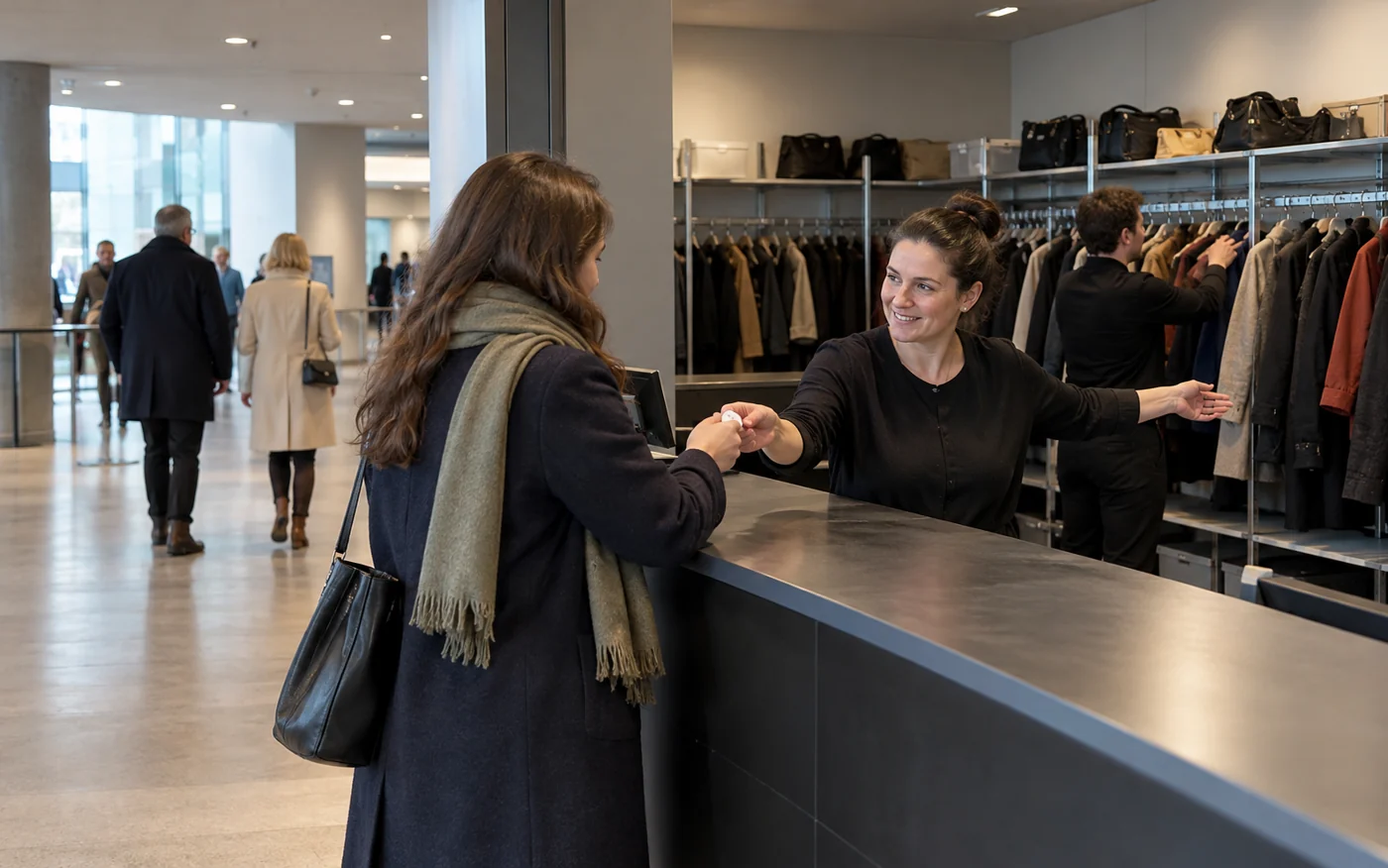
Large performance and exhibition venues increasingly restrict bags above a certain size for security and comfortable viewing inside auditoriums. The UK’s Southbank Centre, a multi-arts venue, also strictly prohibits bags exceeding 40×25×25cm in its auditoriums while operating cloakrooms for visitors’ convenience.
From a practical planner’s perspective, however, a simple message such as “You can leave prohibited items at the cloakroom” can create an enormous bottleneck on site. As the operating guidance in the `Case Article Review` file emphasised earlier, a successful cloakroom is more than a place that takes in bags: it is a back-end logistics operation in which admission control, storage capacity measurement and rapid retrieval routes must mesh as precisely as gears.
1. Clearly separate auditorium bans from storage acceptance
Many planners mistakenly believe the operations team is obliged to store any belongings that cannot be taken into the auditorium.
- Decouple the decision criteria: Deciding through a bag check that an item cannot enter the auditorium and deciding whether the cloakroom can safely accept it are entirely different matters. If large suitcases flood a limited space designed mainly for coats, umbrellas and small bags, such as the Hayward Gallery cloakroom at Southbank Centre, the service will grind to a halt in an instant. For items exceeding the cloakroom’s physical capacity, the booking information page must give a firm cutoff message: “Large luggage cannot be stored on site, so please do not bring it.”
2. The end of a performance is only the start of the “retrieval war”
The moment audiences leave the auditorium, the day’s most intense queue forms in front of the cloakroom.
- Design the retrieval turnaround: Southbank Centre specified a timeline in which its cloakroom opens one hour before a paid event and closes approximately 15 minutes after the performance. At events attracting large audiences, however, safely returning hundreds of people’s belongings within 15 minutes is almost impossible in terms of throughput, or the number processed per hour. Planners must calculate audience exit rates and staff retrieval rates to set a realistic closing time, and establish a clear follow-up manual specifying when and to whom uncollected belongings will be handed over after closure, such as a lost-property office.
3. Synchronise storage capability with audience messages
The mere existence of a cloakroom does not magically solve every visitor’s luggage problems.
- Guard against the risks of overpromising: A blanket promotional message such as “You can leave all your large bags at the venue” is a typical mistake that results when planners have not carefully agreed available capacity with the facility manager in advance. If storage specifications or opening hours change, the booking-site guidance, freestanding signs on site and cloakroom staff’s response manual must all follow exactly the same rules, without a single character’s discrepancy, to reduce unnecessary friction with visitors.
4. A four-stage cloakroom operating protocol for practitioners
When planning a cloakroom linked to auditorium admission restrictions, the operational team should follow these four stages.
| Stage | Work standard |
|---|---|
| [Stage 1: separate admission and storage specifications] | Determine auditorium bag-size limits and cloakroom acceptance limits separately, and state in bold in advance that items which neither location can accommodate must not be brought to the venue. |
| [Stage 2: confirm on-site R&R and space capacity] | Check the actual number of available hangers and shelves inside the cloakroom, and separate the roles of pre-event drop-off staff and post-event pick-up staff so their routes do not become tangled. |
| [Stage 3: finalise the turnaround timeline] | Set the pre-performance check-in cutoff and post-performance final collection deadline with ample time, and display them on the back of claim tags and on queue banners. |
| [Stage 4: hand over unclaimed items] | Once collection hours end, activate a sign-off procedure to transfer belongings their owners have not collected safely to the venue’s lost-property office or designated security lead. |
A planner’s note: perfect guidance starts with being honest about what you cannot do
Planners always want to offer audiences as much convenience as possible. But blindly promising a storage service whose physical capabilities have not been verified is not kindness: it is planting a huge detonator at the venue.
Excellent house management begins by accurately counting the cloakroom’s empty racks. Assess dispassionately how many belongings the site can safely accept, and use clear, gentle messages to ensure visitors do not pack items at home that the venue cannot accommodate. Sometimes that transparent, honest guidance is the dependable first step towards the safest, most comfortable audience experience.
Conditions for applying this elsewhere
Apply at venues with separate cloakroom and auditorium access rules; confirm items and hours with facilities staff.
Information not established
Storage capacity, average intake/return time, loss rates and event-specific extra restrictions were not verified. Suggested staffing and work sequences are editorial applications of the public case, not verified records of the event’s internal procedures.
Reference material
Next tasks and related resources
Item-by-item admission/storage permissions, hours, same-day collection conditions and handover when unavailable
Related templates
Supplier Work Scope and Handover Sheet
A sheet for finding missing or duplicated work during installation, operation and strike.
Use this for: Alongside equipment quantities, record the start conditions and completed work for unloading, internal transport, connections, testing, storage and strike.
Instructions, examples & downloadsRelated practical guides
Event Equipment Procurement and Handover
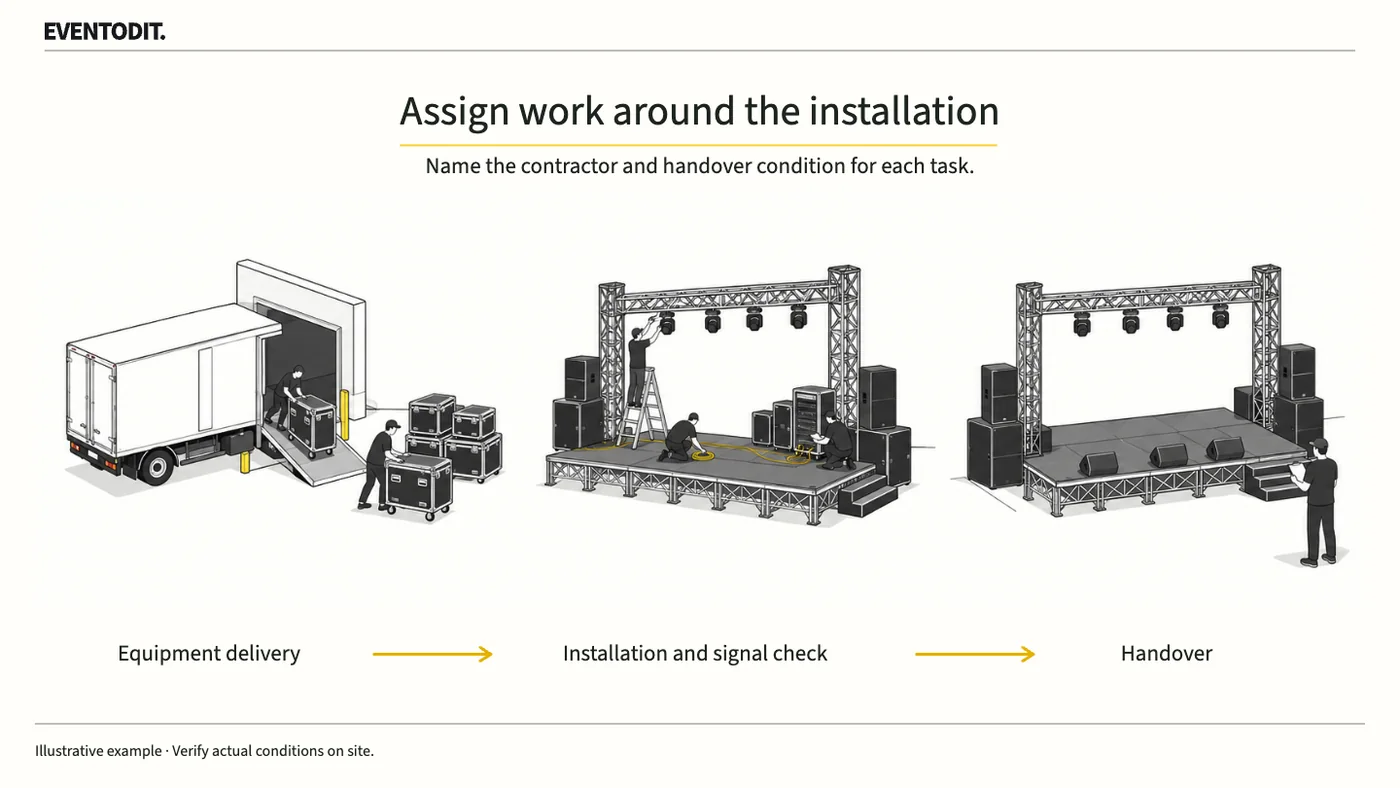
“Equipment installation included” does not assign unloading, power connections, operation or removal. Name the contractor for each task and what they must hand to the next team to expose gaps and duplicate orders.
Read guideHave a correction or additional evidence? Request a correction