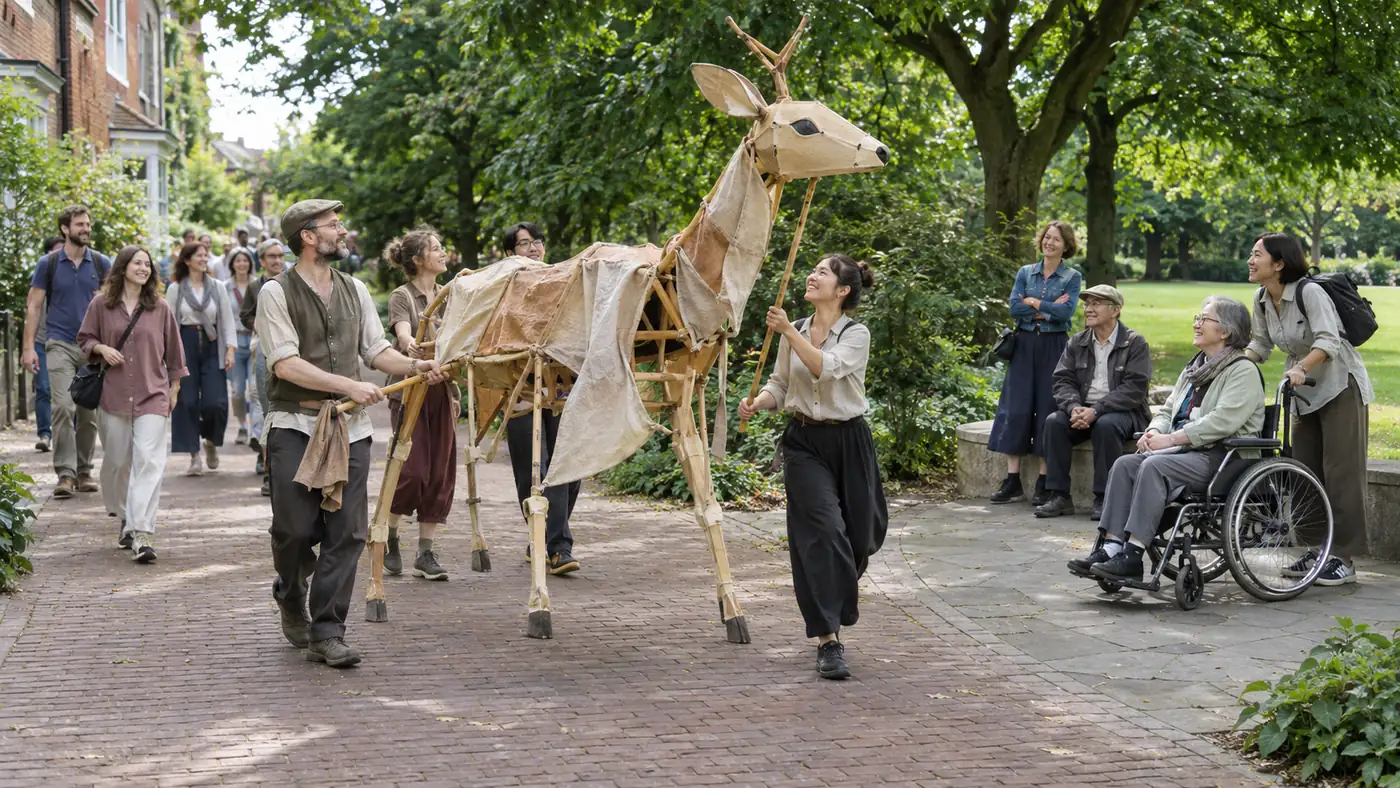
An animal migration made the neighbourhood a performance space
According to the Rochdale Development Agency’s (RDA) post-event account of 7 July 2025, life-sized animal puppets moved through Heywood’s residential streets to the lakeside in Queen’s Park. Rather than people entering a building to see the work, the work passed through their everyday surroundings.
The street was more than a route to the performance. Houses, roads and the park became the setting for the animals’ passage, giving people a reason to see a familiar neighbourhood differently. Encountering a work also differs from sitting down and waiting for a curtain. People might discover it at a street corner or accompany it for part of the journey. These are possibilities the editorial team reads in the published format.
THE HERDS is a public-art project concerned with the climate crisis and the natural world. Its official account describes the animals’ journey through African and European cities to the Arctic Circle. Within that story, Heywood’s streets and lake become more than start and finish points: they provide scenes of movement and temporary refuge.
Must everyone walk from the beginning to the end?
Factory International’s information at the time recommended several viewing points, including Aspinall Street, Miller Street and the park lake. It described a roaming event with limited seating in the park.
The important choice is to avoid imagining the audience only as a single moving column. At an event with a travelling work, performers and spectators need not follow identical routes. Knowing where the work will pass allows planners to consider a viewing encounter in which people wait for it. If following the whole distance is treated as the only proper way to attend, differences in pace or stamina can become differences in access to the work.
That does not mean every scene is equally visible from a street corner. Following and waiting produce different encounters. Rather than promise to erase those differences, the editorial team favours explaining which parts of the work can be encountered from each position. Making movement a choice requires giving people an artistic reason to remain in one place too.
The viewing information did not conceal the slope
The same information described the residential location and park terrain as wheelchair-accessible, while stating that the park’s viewing position was on a gradient. This requires reading the conditions for passing through alongside those for staying to watch.
While spectators move with a performance, the space and pace of passage matter. When they remain somewhere, what they can see behind other spectators and whether they can rest and encounter the work again become important. Listing several viewing points therefore does not complete accessibility. Each option needs an explanation of the different experience and support it involves.
The principle is not a fixed prescription to add a separate viewing area. Start by asking whether the staging depends on continuous movement or whether the work can approach the audience. Published information does not establish that every service was delivered on the day or that users had an equivalent experience. This article does not evaluate accessibility outcomes.
Arrival at the lake was followed by time together
RDA’s same retrospective records arrival by the lake to Global Grooves’ rhythms, followed by a Riot Jazz Brass Band performance in the park.
This offers a different possibility from dispersing as soon as a journey ends. Movement is central while the animals pass through the town; arrival creates time to hear other music together. The editorial team reads this as a connection between moving and staying. What people encounter before and after travelling can shape their day more than the fact of completing a route.
This transition matters at other street festivals too. Whom the next programme can wait for, and how early and later arrivals might stay together, changes the time and space required. Adding a travelling performance is more than inserting another act between locations. The staging of departure and arrival must be considered alongside people’s actual journey home.
In Korea, design opportunities to encounter the work rather than a uniform pace
The transferable idea for Korean festivals and branded street events is not the puppets’ appearance or a particular route length. It is the possibility of encountering the same work from different positions and through different ways of moving. Distinguishing scenes that depend on travel from those available in one place makes audience choices more concrete before everyone is sent down the same route.
For example, a travelling work exploring traces of a neighbourhood might offer both a longer following experience and a story encountered at a particular location. Work with the artist on what each scene offers instead of treating one as a shortened version of the other. This is the editorial team’s hypothetical application. The actual movement, sightline and rest conditions for participants still require confirmation with the venue and relevant accessibility and safety specialists.
These choices retain costs and work. Providing information at several viewing points or maintaining places to stay requires staff and time. Asking everyone to follow may look simpler, but reduces the options for people who cannot manage that movement. Planners need to compare the ways of watching they retain and the support those ways require, not only staffing numbers.
Conclusion
Accessibility in a moving performance does not mean making every spectator walk at the same speed. It begins with deciding how following, waiting for an encounter and staying at the destination become scenes within the work. Designing viewing positions alongside routes can make neighbourhood streets part of the performance rather than simply the way to reach it.
Conditions for applying this elsewhere
Confirm actual local venue use, movement, sightlines, accessibility support and safety conditions with the venue and relevant specialists in Korea. Overseas guidance is not a common Korean suitability standard.
Information not established
Actual use by viewing point, delivery of support, measured routes/gradients, crowding and satisfaction were not verified. The archived audio-description information describes the 3 July Manchester event and was not used as evidence of provision in Heywood on 4 July. No on-site reporting or external expert review was conducted.
Reference material
Next tasks and related resources
Scenes and locations for each way of watching, movement/rest/sightline conditions and support not yet verified
Related practical guides
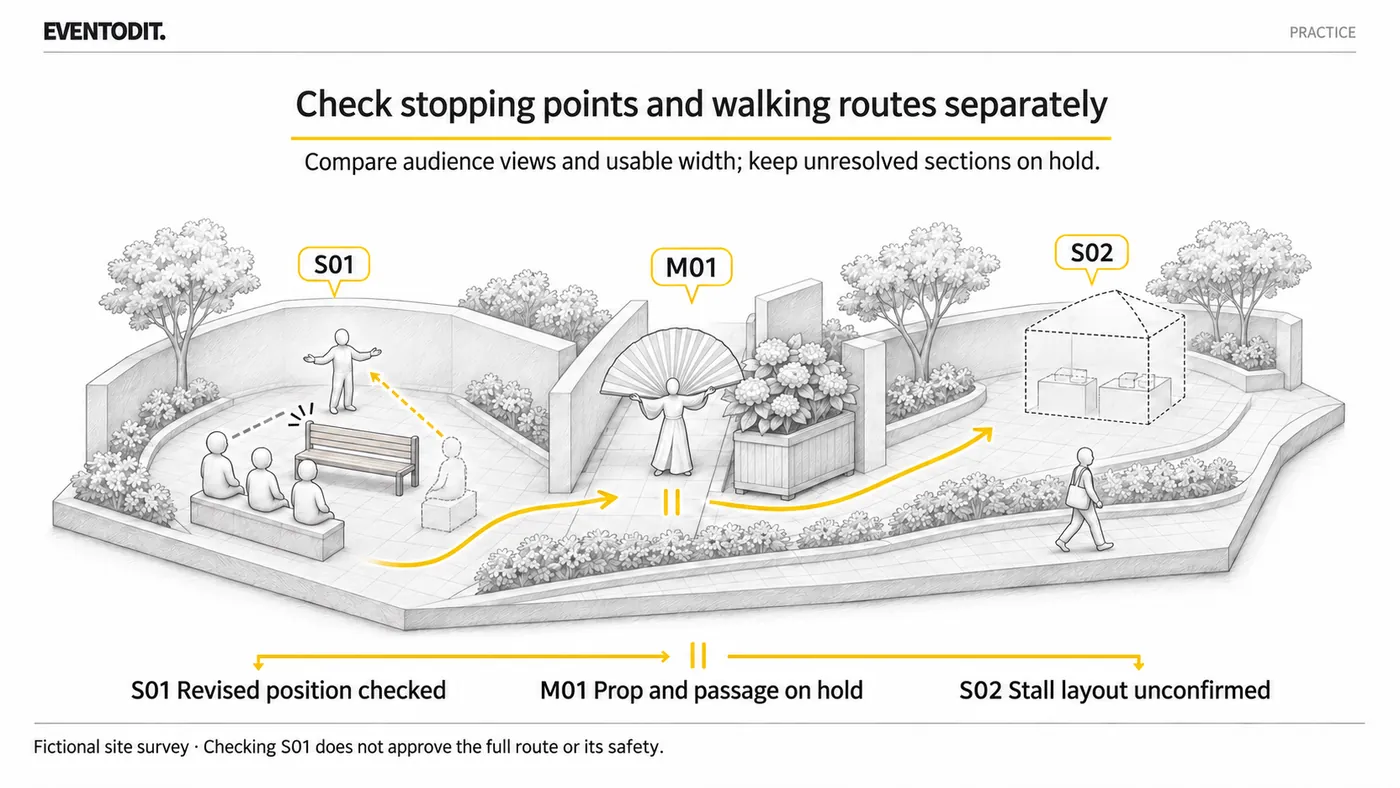
For a moving performance, check stopping points and walking routes separately
Record viewing positions and route sections checked from audience and performer positions, alongside changes and holds on one applicable plan.
Read guideHave a correction or additional evidence? Request a correction