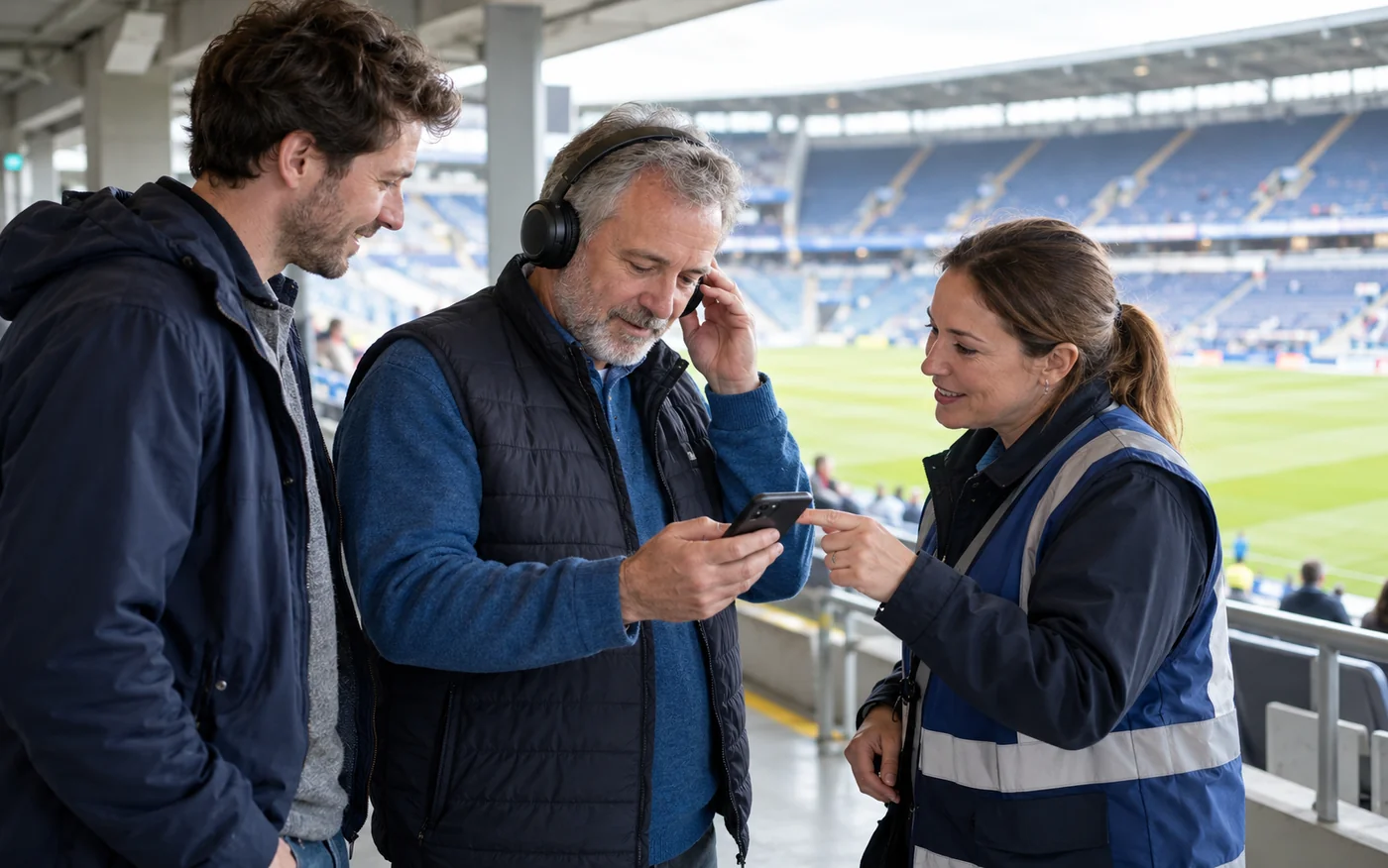
Audio Description services that describe the visual action for blind and partially sighted audiences are increasingly being introduced at sports matches and major performances. Women’s EURO 2025 in Switzerland likewise provided web-based audio description through a dedicated app for all 31 matches, achieving meaningful results with 1,217 unique listeners and 3,421 interactions.
When practical planners design these digital Barrier-free services, a key point is that successful sound transmission from the organiser’s server does not automatically mean visitors are hearing it well. The test that really matters should focus not on the console, but on the Last-mile UX when an actual visitor takes out their smartphone and plugs in earphones.
1. Audience-device UX/UI acceptance: "It is no use if people cannot find the menu"
Audio Description has a different purpose from a conventional live broadcast. Careful advance testing that considers the primary audience’s smartphone-use environment is essential.
- Check Screen Reader compatibility: when testing the app or web page before the event, it is advisable to go beyond checking that sound plays and directly examine whether screen-reading functions for visually impaired users correctly recognize and read buttons and menus.
- Simulate reconnection and Failover: LTE/Wi-Fi signals frequently drop in crowded stadiums. Including checks that visitors can return directly to the audio-description screen without complicated steps after connectivity is lost and restored can provide practical support for viewing.
2. Separate visitor service (CS) from Tech: "An usher is not a technician"
The Women’s EURO 2025 organisers deployed 53 dedicated accessibility volunteers across eight stadiums. They are valuable staff supporting visitors’ movement and comfort.
- An Escalation Rule-set for faults: when a visitor reports being unable to hear the audio, guidance staff must not be left to guess whether the problem is an individual smartphone setting or the organiser’s server transmission. To prevent on-site confusion, clearly hand staff both a manual explaining connection methods and a hotline to the back-end technical contact to call immediately if problems persist.
3. Decouple outcome data: prepare for next time through analysis from several angles
When evaluating the service after the event, examining data from different routes separately rather than lumping it together can greatly help the next budget.
- Separate On-site and Remote traffic: because the service was web-based, its 1,217 listeners included people seated in the stadium and people connecting from home. Analysing these groups separately helps identify whether the next event should expand stadium wireless internet or strengthen online promotion.
- Distinguish unique listeners from interactions: UEFA’s separate reporting of whether one person listened to several matches, counted as interactions, or many distinct people arrived, counted as unique listeners, is a useful example of accurately diagnosing service loyalty and reach.
4. A four-stage operating protocol for audio description on personal devices
The following four-stage criteria offer a useful reference when preparing audience-specific audio services through a dedicated app or the web.
| Stage | Work criteria |
|---|---|
| [Stage 1: Accessibility-based UI acceptance] | Before launch, cross-check with external experts or intended users that screen-reading/text-to-speech and automatic language-switching functions work correctly on mobile devices. |
| [Stage 2: Network and reconnection Failover testing] | Test disconnections and the smoothness of automatic reconnection in crowded conditions similar to the actual venue or in communications dead zones. |
| [Stage 3: Establish on-site R&R and emergency contacts] | Give visitor staff guidelines for helping audiences connect initially and share a clear contact chain for immediate handover to transmission/technical staff when a problem cannot be resolved. |
| [Stage 4: Report segmented post-event data] | In the results report, separate measures such as connection location, on-site/remote, average listening time and interruption frequency as well as total connections, using them as indicators for service improvement. |
A planner’s note: the technology of care is completed with eyes closed
Event technology has recently advanced remarkably towards providing visitors with more information and convenience. For audiences needing visual or hearing support, however, the finest technology may be a voice arriving smoothly and without interruption when needed, rather than a spectacular app design.
When planners close their own eyes and walk the venue’s corridors relying only on their smartphone’s sound, they begin to understand which thresholds are high and which app buttons are awkward. Barrier-free planning is completed not when the server is switched on, but by carefully smoothing those small thresholds so audiences can listen to our story in the greatest comfort.
Conditions for applying this elsewhere
For audio description accessed on personal devices at performances, matches and exhibitions.
Information not established
Published announcements do not establish the on-site/remote split of the 1,217 unique listeners, a detailed interaction definition, or device-level delay and fault results.
Reference material
- UEFA · Women’s EURO 2025 impact results: 31 matches, 1,217 unique listeners, 3,421 interactions (2026.7.27; updated 7.28)
- UEFA · Post-event ESG results: 53 accessibility volunteers across 8 stadiums (2025.11.4)
- UEFA · Pre-event service guidance: commentary languages, web access through official app and on-site accessibility staff (2025.6.23; updated 7.16)
- European Blind Union · Post-event confirmation of audio description for match video and app, distinguished from broadcaster services (2025.8)
Next tasks and related resources
Playback checks by language and contacts for audience information and transmission.
Related practical guides
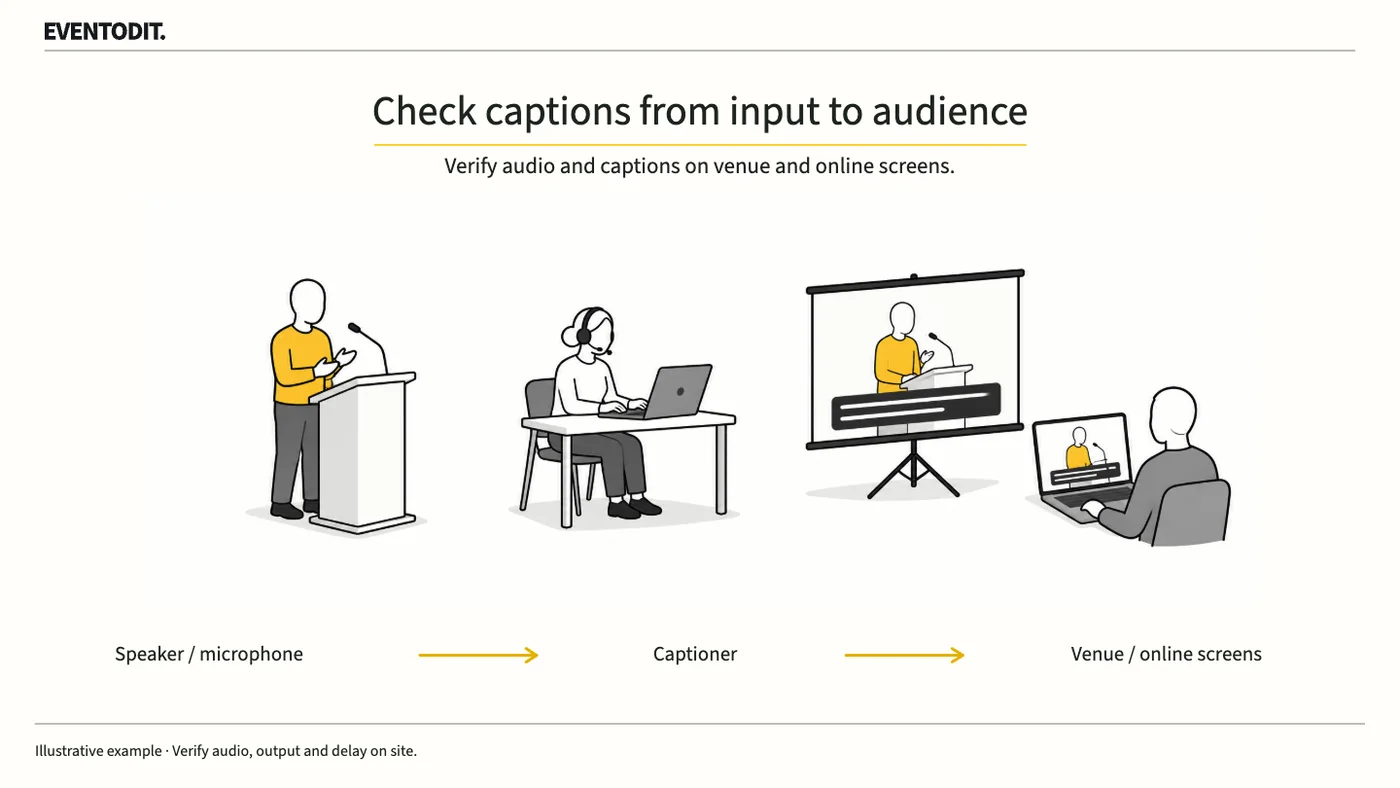
Live Event Caption Delivery and Acceptance
Clear audio for the captioner does not guarantee readable captions in the room or online. During rehearsal, follow the same spoken passage from audio input through caption production to each audience screen.
Read guideHave a correction or additional evidence? Request a correction