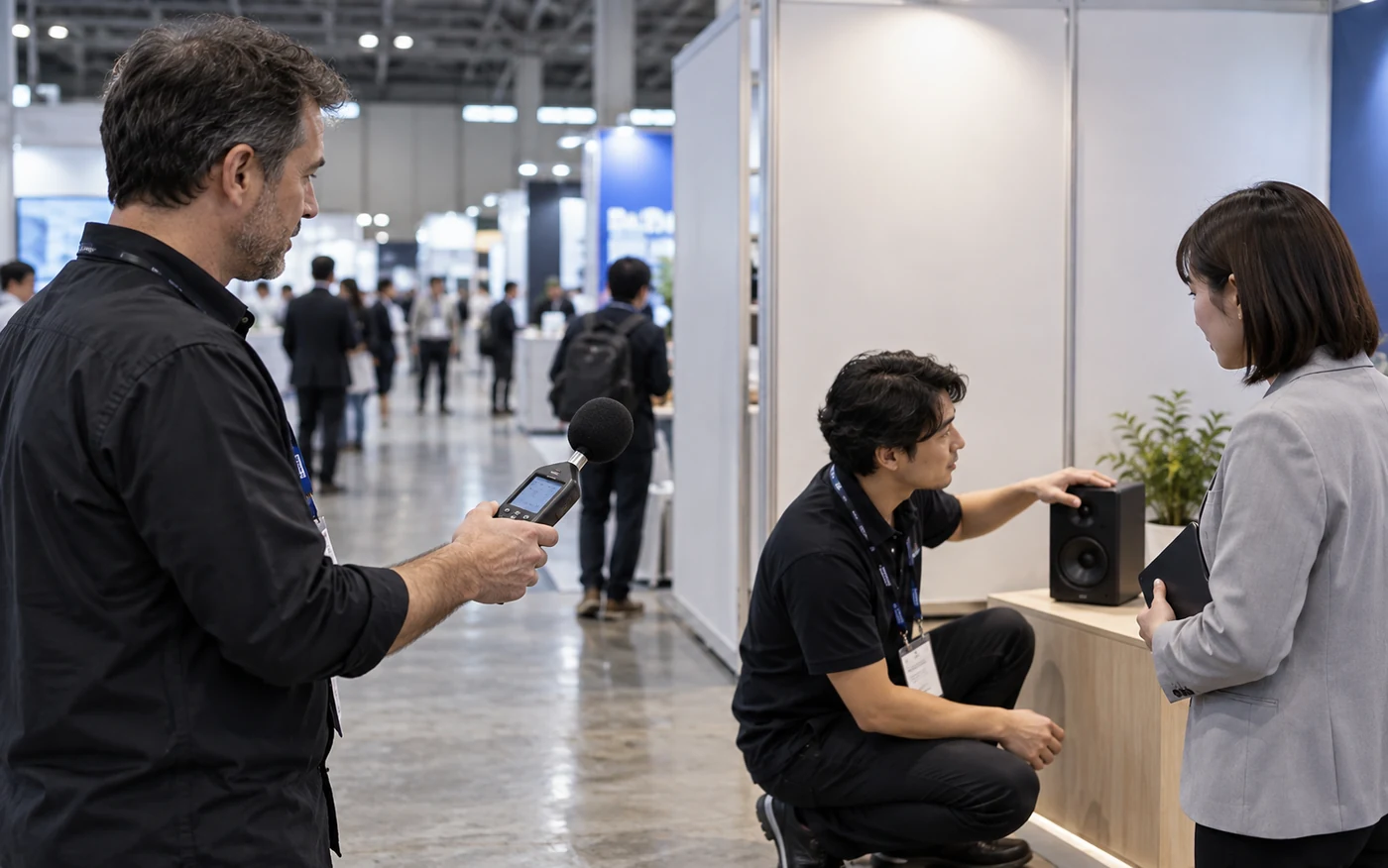
At a major B2B exhibition where hundreds of companies announce new products, noise is one of the hardest variables to handle. When a neighbouring booth’s spectacular speakers disrupt an important buyer meeting, invisible audio wars break out across the venue. Japan’s IT exhibition CEATEC 2025 limited booth volume to 80dB or below, while explicitly establishing a strong rule allowing adjustments to be demanded even within the limit if complaints arise nearby.
For practical planners, noise management is not simply walking around with a Sound Level Meter and recording numbers. True Back-end audio control means understanding the gap between rental suppliers’ Console readings and the noise visitors experience, then carefully designing mediation Rule-sets that go beyond mechanical numbers to protect the business environment.
1. Decouple measurement reference points: look at the boundary, not the Console
An audio operator stationed in a booth can easily argue that the rules have been met while the mixing Console’s volume meter stays green, in its safe range.
- Clarify the physical measurement position: CEATEC’s use of a point 2 m from the booth boundary as the measurement reference is highly practical. What matters is the sound where a neighbouring booth’s buyer stands, not directly in front of a speaker or at the audio desk. To prevent disputes, the planning team must hand over clear criteria for which device, location and time to measure, rather than leaving only a decibel number in the procurement order and exhibitor manual.
2. Control qualitative risks: numbers cannot capture every discomfort
Even if the meter shows 79dB and passes the rule, complaints from surrounding booths can surge.
- Frequency and interference: low readings do not prevent strong, chest-thumping bass or piercing high frequencies from completely drowning out the presenter next door. This is why CEATEC included a clause requiring improvement when unpleasant sound causes complaints, even if the numbers comply. The organiser must specify discretion in the rules to assess qualitative conditions, including sound character and clashing demonstration schedules, and direct lower volume or changed speaker orientation without being bound by numbers alone.
3. R&R and Hard Stop rules: can the sound be stopped immediately?
The most difficult situation is a surge of neighbouring complaints with no one in the booth authorized to turn the sound down.
- Assign responsibility to on-site staff: if a rental supplier installs equipment and leaves, no one is there to lower the volume Knob in an emergency. Require an audio operations supervisor to remain in the booth, and require Sign-off sharing emergency contacts with the organiser’s central desk when that person is absent.
- An immediate emergency-cutoff protocol: each booth’s sound must be Muted immediately when venue-wide emergency announcements such as fire alarms are broadcast. Alongside provisions such as CEATEC’s ban on audio use the following morning after three accumulated warnings, exhibitor contracts must include a physical Hard Stop allowing forced power and sound cutoffs for refusing the on-site manager’s improvement instructions, making effective sanctions possible.
4. A four-stage protocol for exhibition-booth audio management
To minimize audio interference and create a comfortable business environment, the planning team must follow these four-stage criteria.
| Stage | Work criteria |
|---|---|
| [Stage 1: Put spatial Metrics in writing] | Specify noise rules with spatial context, such as measurement at a point 2 m outside the booth boundary, rather than simply a maximum of 80dB. |
| [Stage 2: Secure qualitative mediation authority] | State in the contract that the organiser can require immediate adjustments if particular bass/high frequencies or persistent vibration disrupt another booth’s business, even within the numerical limit. |
| [Stage 3: Register an on-site R&R owner] | Collect each booth’s contact for a person able to control its audio Console immediately, and verify a system capable of immediate muting during emergency announcements. |
| [Stage 4: Activate Escalation penalties] | Apply staged penalties: a first verbal warning, a second written warning, then, if no correction follows, a third-stage power cutoff during a specified period that day or the next. |
A planner’s note: a good exhibition is completed through harmonious decibels
Spectacular video and overwhelming sound are powerful tools for attracting visitors to a booth. But the moment volume is raised fully for one booth’s success, the entire exhibition becomes a noise-pollution zone where business is impossible.
Excellent event planning shines in delicately balancing volume so exhibitors can show themselves to the fullest without drowning out one another’s voices. The organiser’s noise meter is not simply a yardstick for policing exhibitors. It is the planner’s most dependable shield for protecting a safe business space where hundreds of companies can negotiate and converse comfortably.
Conditions for applying this elsewhere
At exhibitions with simultaneous booth demonstrations, confirm applicable rules and agree measurement/adjustment procedures with the site owner.
Information not established
Actual recommendations, violating booths, complaint reduction and measurement duration/frequency weighting absent from the source were not verified. Suggested staffing and work sequences are editorial applications of the public case, not verified records of the event’s internal procedures.
Reference material
Next tasks and related resources
Boundary-based measurement points, demonstration content/results, on-site owner, improvement requests and recheck records
Related templates
Supplier Work Scope and Handover Sheet
A sheet for finding missing or duplicated work during installation, operation and strike.
Use this for: Alongside equipment quantities, record the start conditions and completed work for unloading, internal transport, connections, testing, storage and strike.
Instructions, examples & downloadsRelated practical guides
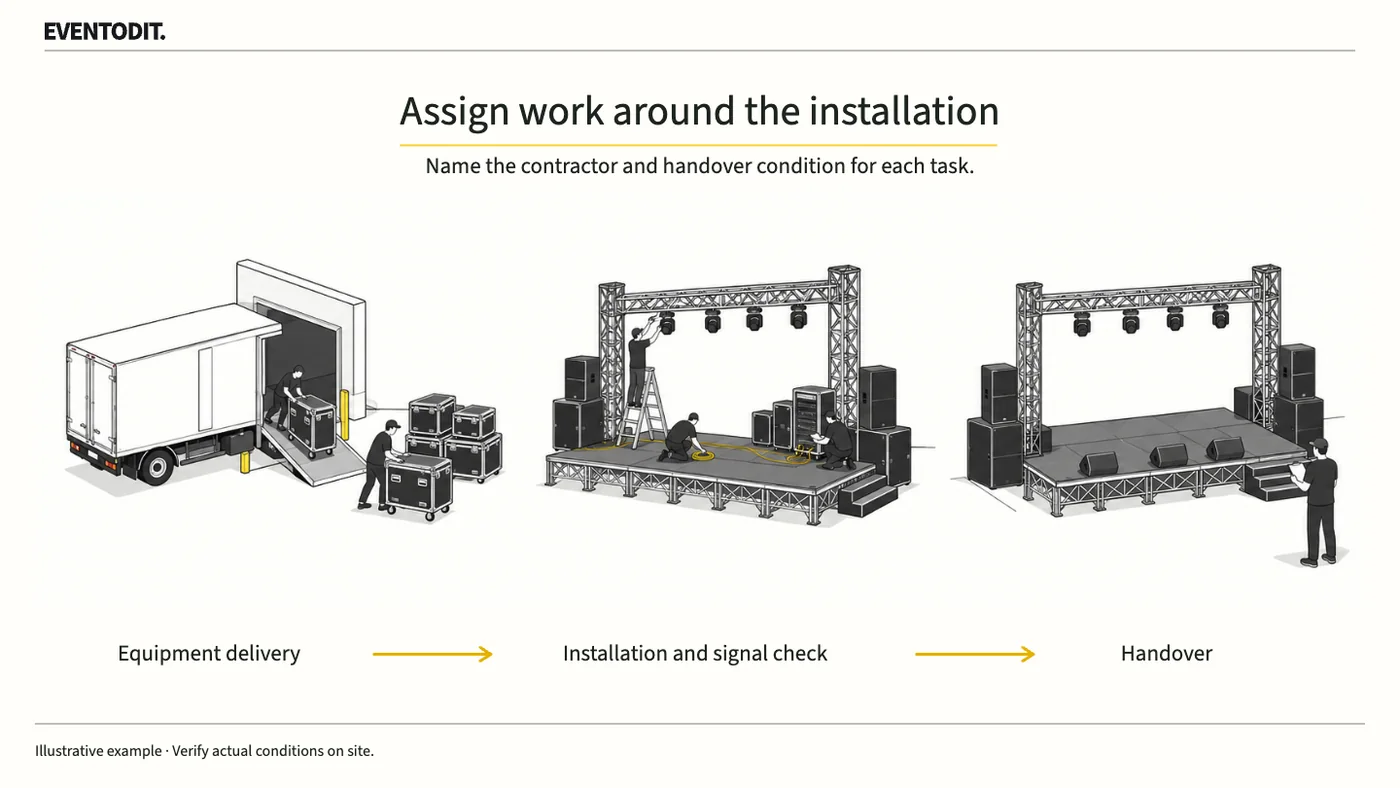
Event Equipment Procurement and Handover
“Equipment installation included” does not assign unloading, power connections, operation or removal. Name the contractor for each task and what they must hand to the next team to expose gaps and duplicate orders.
Read guideHave a correction or additional evidence? Request a correction