Part 1. Planning and operations lead
“Ask whether the mixing-desk reading represents actual audience exposure.”
- Share the programme and audience layout: Tell the audio supplier whether amplified music is included, where the audience and loudspeakers will be positioned, the full running time and the intended audience. For children-focused or long events, ask a qualified specialist to consider a lower limit and cumulative exposure separately.
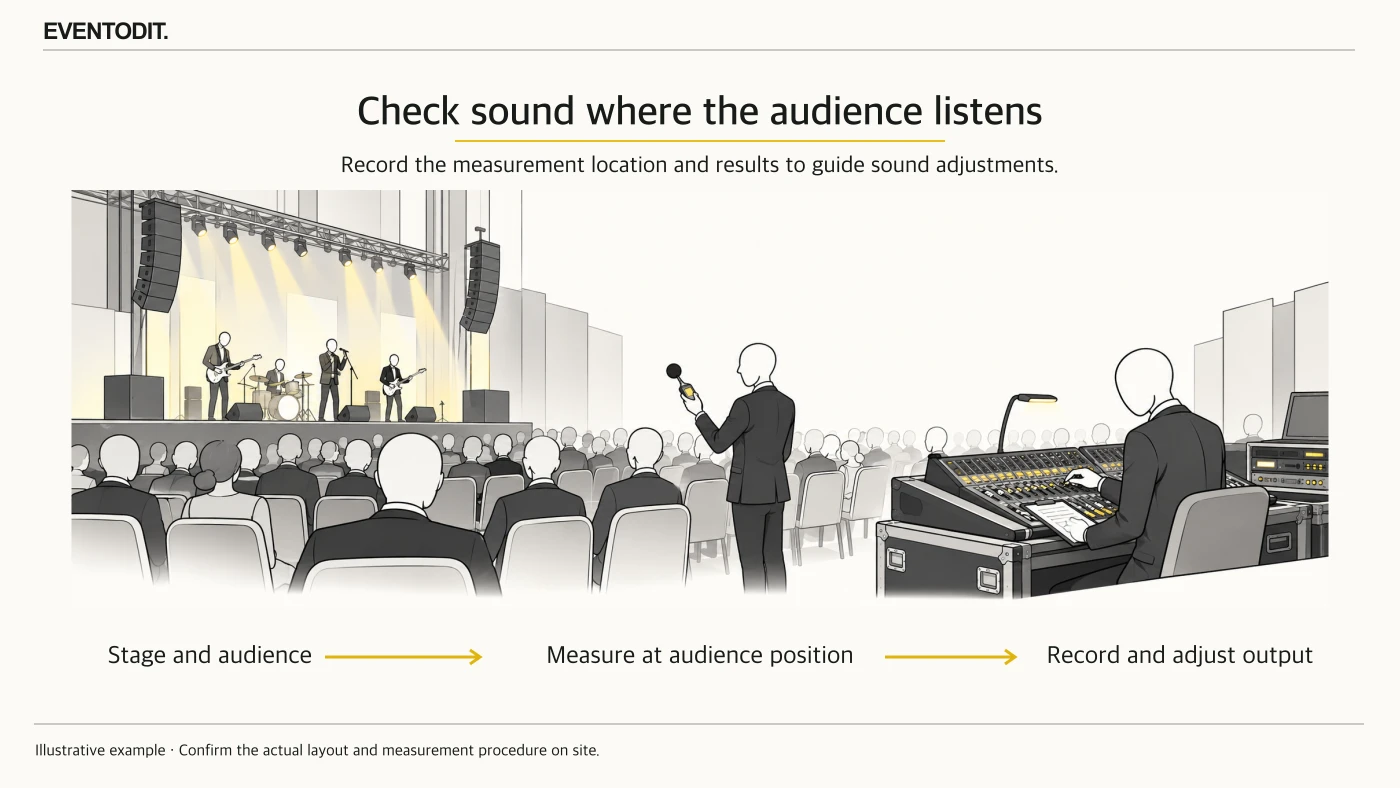
- Agree the measurement and response plan: Before the show, obtain and confirm the audio lead’s plan for the audience reference position, long-term meter location, equipment calibration status, any necessary correction, named monitoring and logging operator, and output-adjustment procedure.
- Check event-specific requirements: Do not present WHO audience guidance as a Korean statutory limit or a guarantee of hearing safety for every listener. Check venue conditions and applicable law separately; ask the appropriate specialist to assess worker exposure against the relevant working conditions.
- Review the log and actions after the show: Receive the original meter record, output-adjustment times and recheck results, then confirm whether the plan was followed.
Part 2. Audio lead and systems technician
“A peak and a 15-minute average are different readings. Check the audience reference and meter locations together.”
- Check the rolling 15-minute limit: WHO recommends no more than 100 dB LAeq,15min at the reference measurement position for an amplified-music event. This A-weighted equivalent level is a continuously updated average over the preceding 15 minutes. It is a recommended upper limit, not a target; assess whether the event needs a lower operating ceiling.
- Select the audience reference position: WHO describes using either the centre of the core audience area or the audience position where the highest level is expected. The centre may represent more listeners but does not guarantee protection at louder locations near loudspeakers. Record the reason for the choice against the audience and loudspeaker layout.
- Compare meter position and correction at rehearsal: If the long-term meter is elsewhere, such as at front of house, compare it with the audience reference position during rehearsal. The audio lead should determine whether correction is needed for the conditions and record the method and evidence. Recheck the relationship if the layout or system changes.
- Monitor with calibrated equipment and adjust output: Verify calibration and monitor and record the rolling average live. As the agreed operating ceiling is approached or exceeded, the designated operator should adjust output under the agreed procedure and record the action and recheck times.
- Manage peaks separately: A 15-minute rolling average does not describe momentary peaks. Check peaks separately against applicable venue conditions and relevant requirements; an average below the ceiling does not establish that peak exposure is acceptable.
Part 3. Audience information and venue operations
“Providing earplugs does not complete sound-level management. Prepare audience information and protection together.”
- Provide hearing protection and instructions: Make earplugs readily available to audience members who may be exposed to high sound levels and explain how to fit them correctly. Earplugs do not replace monitoring or output adjustment.
- Provide a quiet rest area: Arrange a quieter space for audience members experiencing listening fatigue and explain its location and access route.
- Protect staff and hand over: Inform staff in high-level areas, including near loudspeakers, about the risks and protection measures. Provide suitable hearing protection and measures for their working conditions. At shift change, hand over the monitoring operator, adjustment contact, earplug point and quiet-area location.
- Escalate concerns: Refer audience or staff concerns about sound to the audio lead, and tell the operations lead what was done and what follow-up is needed.
Log template and scope
The audio lead can use these files to record the audience reference and meter positions, calibration and correction evidence, rolling averages, output actions and recheck times. The example is fictional; the form does not calculate sound levels or corrections or certify legal compliance or hearing safety.
Final check before use: Before the performance, confirm that the audience reference and meter positions, necessary correction and operating ceiling are agreed, and that the output-adjustment procedure and audience and staff protections are recorded.
Conditions for applying this elsewhere
WHO guidance applies to audiences at amplified-music events and is not a Korean statutory limit or a guarantee of safety. Consider lower limits for events intended for children.
Information not established
Rules and measurements for individual Korean venues and actual hearing outcomes have not been verified.
Reference material
- WHO · Global standard for safe listening venues and events (2022)
- WHO · Full standard, Dutch government archive (2022), pp.16–20, 29–30, 82–85
- WHO · Six recommendations (2 March 2022)
- WHO · Safe listening Q&A (6 March 2026)
- Korea Stage Safety Support Center · Training for safety managers of performances outside registered venues
Have a correction or additional evidence? Request a correction