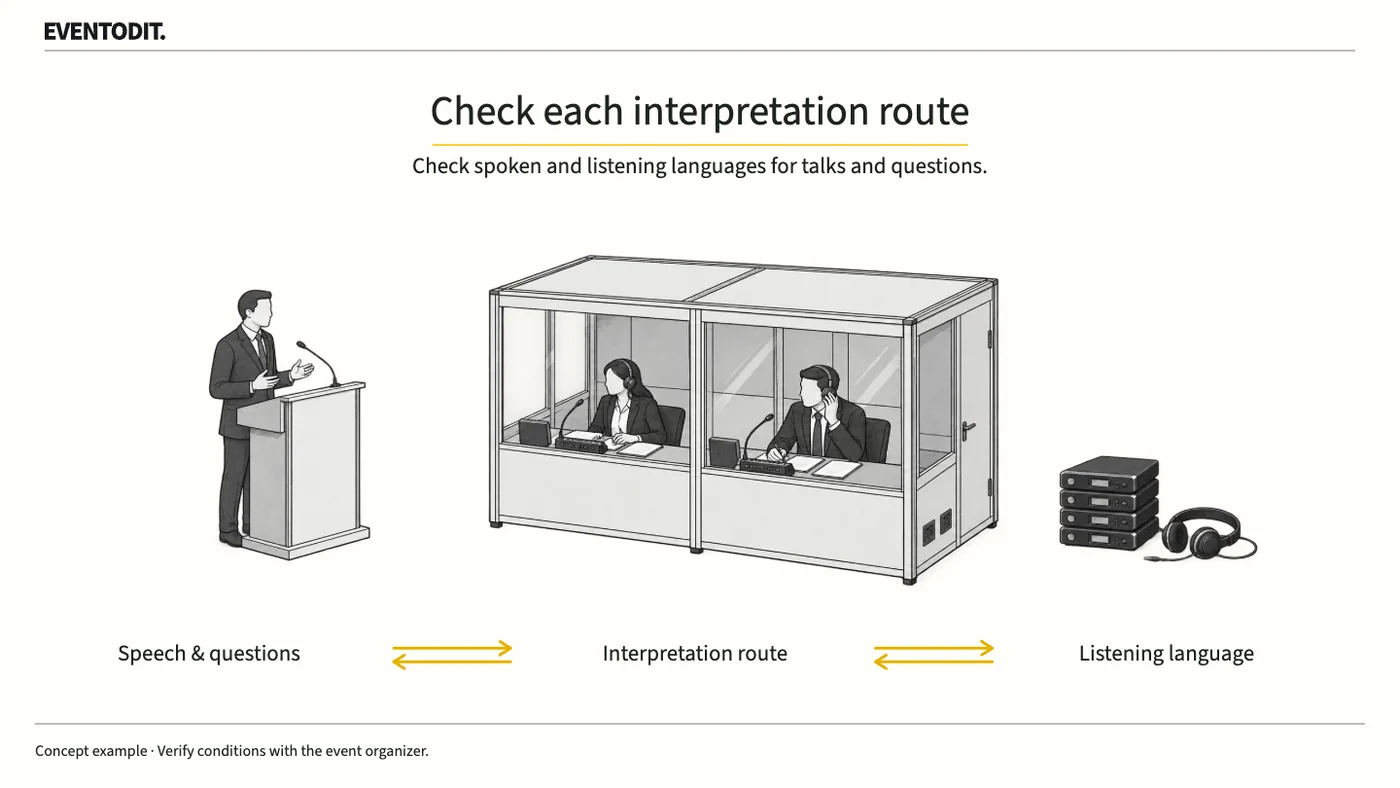
Part 1. Programme and planning lead
“Do not count presentation languages alone. Confirm actual speaking and listening languages through the Q&A.”
- Define speaking and listening languages separately: Record the languages speakers will use and the listening languages offered to participants for each session. The European Commission distinguishes languages an interpreter works from and into. Collect actual speaking and listening needs rather than mechanically counting nationalities, and prepare a session language matrix.
- Include questions and chairing in scope: Even when an English presentation is interpreted into Korean and Japanese, a Korean question needs a route to the English-speaking presenter. Record languages for presentations, questions, answers, chairing and announcements, and decide what is offered in each segment.
- Document and communicate exclusions: Record languages and segments that will not be interpreted. If Japanese questions are outside the service, for example, state that in participant information and the chair’s running plan. Recheck staff and equipment before changing the scope on site.
- Request itemised quotes: Do not infer booth numbers from the number of speaking languages or compare only a single package line. Request separate booth quantities and locations, individual consoles, listening channels, receivers, distribution and return staff, and the staffing plan confirmed by the interpreting lead. Check rooms and times operating simultaneously.
- Manage programme, interpreting and technical provision together: Link speaking and listening languages, available direct and relay combinations, and the booths, consoles, inputs and listening channels in one register. Include confirmed routes, exclusions, change conditions and operating staff in the quote and running plan, then compare approval with actual provision.
The following is a fictional quotation example. Confirm feasibility with the actual interpreting teams.
| Actual speech | Listening outputs offered | Answer needed before the quote |
|---|---|---|
| English presentation | Korean and Japanese | Can each team interpret English directly? |
| Korean question | English and Japanese | Can the Japanese team work from Korean, or does it need a bridge language? |
| English speaker’s answer | Korean and Japanese | Who restores the input changed for the question? |
Scroll sideways if needed to read every column.
Part 2. Interpreting lead and language coordinator
“A receiver channel does not guarantee staffing. Confirm direct and relay routes in advance.”
- Distinguish direct and relay routes: A language channel on a receiver does not establish that staff are available for the required language pair. Relay is indirect interpretation through another interpreter’s intermediate language. The interpreting lead should confirm each team’s direct capability and report any required bridge language and responsible team to the technician.
- Do not impose relay or remove rest arrangements: Planners must not arbitrarily impose relay to cut costs or omit shift and rest conditions. Agree staffing and working conditions with the interpreting lead after reviewing duration, difficulty and language combinations.
- Check sightlines and sound from the booth seat: Do not rely on the layout alone. The interpreting lead should sit at the actual working position and check the view of speakers, questioners and presentation screens. Listen to verify that the sound from any video requiring interpretation reaches the interpreting system.
- Recheck staff and routes after programme changes: When a speaking language changes or a parallel session is added, the interpreting lead must reconfirm available coverage and the technician must test the changed audio routes. The programme lead should relay confirmed exclusions and changes to the chair and registration and information teams.
Scroll sideways if needed to compare the branches.
- Organiser’s programmeActual speaking and listening languages for presentations and Q&A
- Team language combinationsDirect routes and routes that require a bridge language
- Technical provisionBooths, consoles, selectable inputs and listening channels
- Confirm each session’s routesThe interpreting lead and technician check the same language-pair table
- Update the quote and running planThe planner specifies exclusions, change conditions and operating staff
An EVENTODIT planning proposal, not a staffing standard. Confirm staffing and relay feasibility with the assigned team.
Part 3. Technical procurement and on-site review
“A booth on a drawing is not the working environment. Test console inputs and video sound on site.”
- Check booths and individual consoles: The European Commission’s 2026 specifications require at least one booth per interpretation output language and an individual console per interpreter. These are Commission meeting requirements, not statutory quantities for all events in Korea. Confirm booth numbers and positions and console provision with interpreting and technical leads against actual routes and simultaneous sessions.
- Establish console input routing and restoration: Set console inputs using the relay routes confirmed by the interpreting lead. Assign who restores which input when an English answer follows a Korean question and document the procedure.
- Test speaker and question microphones and video sound: Use the actual presentation microphone, audience question microphone and video audio to verify their feeds into the interpreting system. Record unreadable screens or missing inputs and their owners, then recheck corrections before use.
- Review booth safety and preserve detailed checks: Review emergency egress, ventilation and installation suitability with venue and technical staff. Record the session, speaking and listening languages, direct or relay routes, team, channel numbers and actual test results. Compare the approved quote with the equipment and staffing provided on site.
Use the form for the next handover
Use the [Interpretation language-route checks](/en/templates/interpretation-language-route.html) for the records described here. The XLSX contains Blank, Example and Instructions sheets. Write your event in Blank; the fictional example is a guide to what to enter.
Record speaking/listening languages and exclusions for each segment. Map the interpreter lead’s confirmed routes to teams and channels.
The interpreter lead sends routes and exclusions to technical and programme teams. Update moderator notices and channel sheets after changes and confirm receipt.
Final check before use: Before the event, cross-check each session’s speaking and listening routes, booth sightline checks and relay configuration.
Conditions for applying this elsewhere
For multilingual conferences. Confirm staffing, working arrangements, booth configuration and safety with the team and venue.
Information not established
No live quote, installation or interpreting performance was tested. Commission specifications are not general Korean statutory requirements; the language table is fictional.
Reference material
- European Commission: conference interpreting types and terminology; active/passive languages and relay. Accessed 25 October 2026.
- European Commission DG Interpretation: conference-room technical specifications, two-page PDF marked EN2026. Booths, consoles, sightlines and video sound. Accessed 25 October 2026.
After reading, complete the next task
A confirmed session record of languages, routes, teams, channels, exclusions and actual checks
This article’s template
Interpretation language-route checks
Language needs, capable teams and audio routes correspond.
Instructions, examples & downloadsRelated practical guides
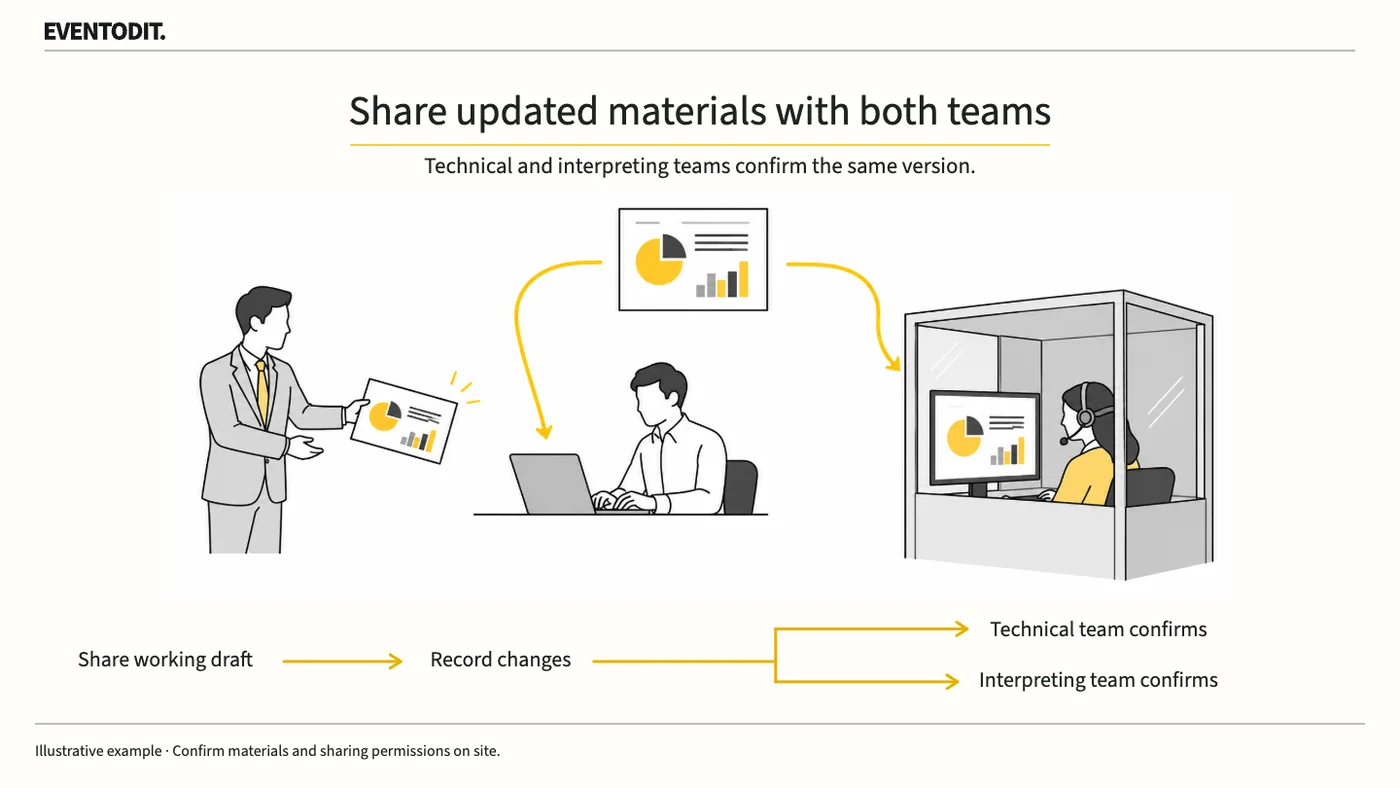
Presentation Changes and Interpreting Handover: A Practical Guide by Role
A last-minute slide change can leave interpreters working with different figures or terminology. Send the same revision to the playback and interpreting teams and confirm that both received it.
Read guideHave a correction or additional evidence? Request a correction