Part 1. Event and ticket operations lead
“Sales and deposits occur at different times. Fix the scope of each record before reconciliation.”
- Separate sale and deposit timing: A paid order does not mean all proceeds have reached the bank. Check refunds, fees and pending payouts separately; do not close the accounts by treating sales and deposits as identical.
- Record and compare query conditions: Document the account, event, period, time zone and currency for orders, processor transactions, payout records and bank statements. Date bases can differ, such as transaction date and payout date. State those differences and obtain the periods needed to connect the records.
- Distinguish a single deposit from complete reconciliation: One confirmed bank receipt does not reconcile all sales. Check outstanding platform balances and pending transactions as well.
- Trace sample orders: Matching totals can still include transactions from another event or account. Trace samples from orders through payment, payout and bank records, documenting many-to-one batches and partial refunds where applicable.
Part 2. Settlement and payment reconciliation
“Choose the report for the task; do not invent an expense to absorb an unexplained difference.”
- Distinguish period balance from payout reports: A review of balance movements during a period and a reconciliation of transactions in one bank payout require different records. Even the same date range can cover different transactions. Confirm the task and each report’s date basis.
- Check reporting by payout method: In Stripe’s example, the automatic payout reconciliation report groups payouts by expected arrival date, which can differ from the actual bank posting date. Stripe cannot identify which particular transactions make up an instant payout, so reconcile it separately. For ordinary manual payouts, Stripe points to the Balance report, with exceptions such as platforms managing connected-account automatic payouts. Confirm current processor instructions and the method appropriate to the account. Stripe’s approach is not a universal ticket-provider rule.
- Preserve transaction signs and fees: Compare payments, refunds, adjustments and fees by transaction identifier. Keep original signs and report definitions, and do not subtract the same fee again from an amount already reported net of that fee.
- Align currencies and units: Match the API’s smallest currency unit with report display units, and distinguish payment currency from settlement currency. Obtain actual exchange rates and conversion costs where applicable; do not book an unexplained balancing expense.
- Separate retained platform balance from costs: A closing platform balance can be funds not yet sent to the bank. Do not treat the entire sales-to-deposit gap as fees or infer a failed payout solely from a remaining balance.
- Separate report readiness from payout status: If reconciliation data is not yet available, distinguish this from an actual failed payout. Record the last check and planned recheck.
This fictional USD example excludes taxes, foreign exchange, disputes and other adjustments; it does not state a fee rate.
| Fictional entry | USD | Reconciliation check |
|---|---|---|
| Opening balance | 0 | Nothing carried into the period |
| Payments | +10,000 | Match orders and payment records |
| Refunds | −500 | Check actual balance deductions |
| Fees | −300 | Avoid subtracting a fee twice |
| Balance before payout | 9,200 | 10,000 − 500 − 300 |
| Bank payout | −8,000 | Match payout to the bank receipt |
| Closing platform balance | 1,200 | Funds still held on the platform |
Scroll sideways if needed to read every column.
Scroll sideways if needed to compare the branches.
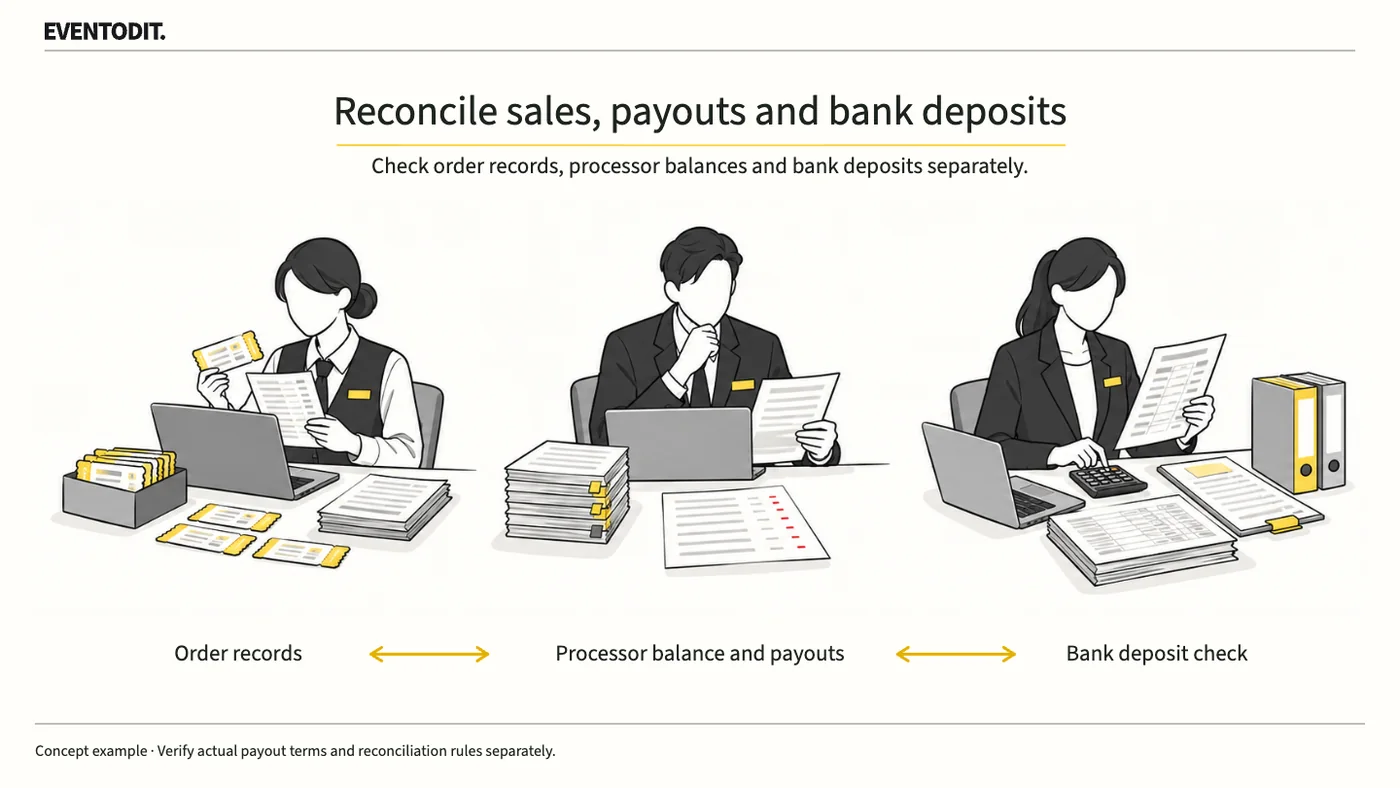
- Orders and salesIdentify the event, items sold and amounts paid.
- Processor activity and balanceExplain refunds, fees, adjustments and the balance after payouts.
- Payouts and bankMatch payout identifiers and amounts to actual receipts.
The fictional $1,200 is a platform balance, not an additional expense or bank receipt.
Part 3. Accounting and finance
“Do not mistake the processor’s net balance for revenue. Record the reason and owner of each unresolved amount.”
- Separate accounting decisions from cash reconciliation: Do not label net settlement proceeds as gross revenue or equate bank receipts with event profit. Report sales, refunds, fees and costs, payouts, and the closing platform balance separately. Accounting staff must assess revenue recognition and tax treatment independently.
- Document mismatches: Record payout identifier, expected arrival date, actual bank posting date, currency and difference. Distinguish transactions missing from the sales ledger from payouts missing at the bank.
- Assign follow-up and a deadline: For items requiring the processor or ticket provider to respond, pass on the query conditions, unresolved reason, owner and response deadline.
- Retain the closeout handover: Keep the query conditions for orders, payments, payouts and bank records alongside matching identifiers, resolved differences and outstanding balances. Give the event and accounting leads the records; do not mark unresolved items as complete.
Use the form for the next handover
Use the [Ticket payout and bank reconciliation](/en/templates/ticket-payout-reconciliation.html) for the records described here. The XLSX contains Blank, Example and Instructions sheets. Write your event in Blank; the fictional example is a guide to what to enter.
Link each report’s scope and transaction-to-payout mapping. Compare processor amounts with cumulative bank credits in matching currency and units.
Settlement hands original mappings and the latest payout reconciliation to accounting. Separately hand over missing credits, differences, platform balances and pending answers.
Final check before use: Before closing ticket proceeds, cross-check the order, processor, payout and bank reconciliation records, outstanding balances and follow-up owners.
Conditions for applying this elsewhere
Requires itemized processor or provider transaction, payout and balance records. Stripe automatic, manual and instant reporting have different scopes; availability and accounting/tax treatment require separate confirmation.
Information not established
No actual event sales, account fees, payout outcomes or Korean account availability were verified. USD amounts are fictional; tax, exchange effects, disputes and other adjustments are excluded.
Reference material
- Stripe Docs · Payout reconciliation report: automatic batches, expected arrival dates and unsettled items (checked 25 October 2026)
- Stripe Docs · Balance summary report: period movements, settlement currency and itemized exports (checked 25 October 2026)
- Stripe Docs · Select a report: transaction-period versus payout-batch timing (checked 25 October 2026)
- Stripe API · Balance Transaction object: amount, fee, net and smallest currency units (checked 25 October 2026)
- Stripe Docs · Receive payouts: available funds, payout schedules and bank processing (checked 25 October 2026)
Have a correction or additional evidence? Request a correction