Part 1. Food and beverage planning and operations lead
“A substituted ingredient changes the dish. Hold the affected dish until its ingredients and preparation conditions have been checked.”
- Hold and check a substituted product: Ask the vendor to compare the actual delivered package with the current recipe, including sauces, dressings and garnishes. Hold the changed dish if evidence is missing or review is incomplete; assign an owner and a deadline for reconsideration.
- Separate original and changed servings: The same dish name can conceal different ingredients. Record which dishes use the new product and from when; agree a physical service method that distinguishes the original and changed servings.
- Update three information channels together: Use the preparation lead’s confirmed information to revise the stall menu, online or QR-linked information and staff references. Open the linked document even if the QR address is unchanged; collect and replace outdated printouts at stalls and information desks.
- Record changes and hand over between shifts: Record the dish, substitute, evidence, affected servings, information updates, owner and outstanding work. Distinguish the time evidence was received from the time the information was updated, and brief incoming staff on the change and responsible contact.
The following fictional examples illustrate the process; they do not establish the ingredients or safety of any actual product.
| Reported change | Evidence for the vendor to check | Work before service |
|---|---|---|
| Sauce replaced | New package ingredients, warnings and recipe | Identify affected dishes and distinguish original servings |
| Garnish added during the event | Ingredients, storage and preparation | Update dish information and staff explanations |
| Dedicated utensils become shared | Preparation lead’s cross-contact assessment | Agree controls and information for customers |
Scroll sideways if needed to read every column.
Part 2. Preparation and catering lead
“A package label alone cannot guarantee the finished dish is safe. Assess cross-contact through utensils and oil as well.”
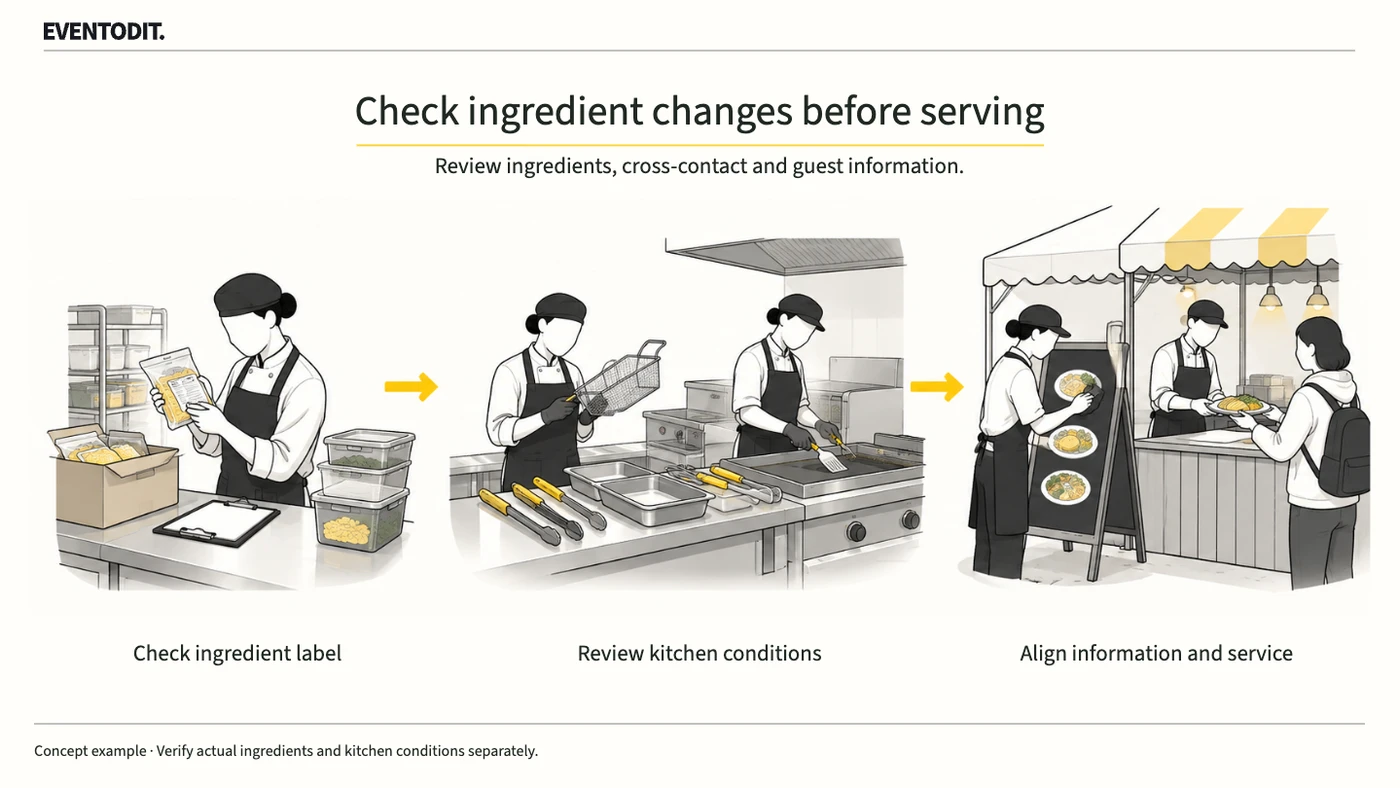
- Compare the delivered package and recipe: The preparation lead should compare the original and actual substitute products’ ingredients and precautionary information, then provide the event team with the dish-specific changes, checking time and responsible person. The organiser should not make the vendor’s ingredient or preparation assessment on its behalf.
- Separate recipe ingredients from cross-contact: Assess ingredients in the recipe separately from potential cross-contact through shared utensils, fryer oil, storage and service. Absence of an ingredient on a package does not establish that the finished dish is free from it. Decide on appropriate separation and cleaning measures.
- Do not substitute blanket warnings for controls: A general allergen warning does not itself manage a risk. The preparation lead should review identified risks and specific limitations to communicate, and pass them to the operations team.
- Respond to individual requests and identify special plates: When an allergy-related request arrives, the preparation lead should assess and respond on whether the ingredient can be excluded and cross-contact prevented. If these conditions cannot be controlled or verified, do not claim the request can be met; explain the limitations to the customer. Where preparation and service teams differ, agree how to identify and hand over the request and finished plate without confusion.
UK Food Standards Agency guidance is used as an operational reference. Do not treat UK labelling duties as Korean requirements; confirm applicable food-business and labelling rules with the vendor and relevant authority.
- Identify the affected dishFood-zone operator: record the product/process change and affected servings
- Receive the vendor’s checkPreparation lead: assess ingredients and cross-contact separately
Missing or unconfirmed
Evidence available
- Update information and staff instructionsCompare stall signs, online information and shift explanations
- Confirm the serving scopeCatering lead: record results, remaining restrictions and effective time
An information handover for vendor review, not an automated food-safety decision or assessment of whether an individual can eat the dish.
Part 3. Service and guest information
“An updated sign does not guarantee a safe meal for an individual. Match the order to the plate and say when information is unknown.”
- Avoid independent safety judgments and share only what is necessary: Do not guess that a dish is safe, or assume a vegan dish is suitable for a particular allergy. Pass the necessary request details to the person responsible for preparing that food and obtain a response; do not distribute health information broadly in an event chat.
- Match the finished dish to the order: Before serving, check that the requested changes and limitations confirmed by the preparation team match the plate. Recheck advance requests against any on-site ingredient or preparation changes.
- Disclose and refer unresolved questions: If an ingredient or preparation condition cannot be confirmed immediately, say so instead of guessing and refer the matter to the food-service lead. A revised information sheet alone does not guarantee suitability for an individual.
- Align stall information and shift handovers: Compare the food actually served with the stall information, and make information available for individual buffet dishes. At shift change, pass on changed dishes, effective times, unresolved issues and the responsible contact.
Use the form for the next handover
Use the [Ingredient-change and information checks](/en/templates/allergen-change-control.html) for the records described here. The XLSX contains Blank, Example and Instructions sheets. Write your event in Blank; the fictional example is a guide to what to enter.
Identify products and batches and mark unreviewed service on hold. Link kitchen findings, limitations and controls to evidence IDs.
The kitchen lead sends findings and limitations to operations and servers. The next shift compares affected batches and current information before acknowledging.
Final check before use: Before serving a dish made with a substitute ingredient, cross-check the preparation lead’s ingredient and cross-contact review and alignment of stall menus, online information and staff explanations.
Conditions for applying this elsewhere
For food-zone and catering change management. Confirm local legal duties and actual food suitability with vendors and relevant authorities.
Information not established
No vendor food-safety test or individual suitability assessment was performed. UK allergen rules are not presented as Korean duties. Scenarios are fictional.
Reference material
- Food Standards Agency: non-prepacked food information best practice, 24 February 2025. Substitutions, current information and preparation-to-service communication. Accessed 25 October 2026.
- Food Standards Agency: allergen guidance, updated 17 July 2026. Buffet dishes, shared utensils/oil and free-from claims. Accessed 25 October 2026.
- Food Standards Agency: precautionary allergen labelling, 4 September 2023. Risk assessment and limits of blanket warnings. Accessed 25 October 2026.
Have a correction or additional evidence? Request a correction