Part 1. Planning and Programme Lead
"Set out the detailed release plan at invitation; do not treat receipt of materials as approval to publish."
- State the release plan in invitation terms: Do not wait until event day to disclose recording and online publication plans. As SIGPLAN recommends early notice of recording plans, describe on-site screening, livestreaming, post-event VOD and promotional excerpts when calling for and notifying invited speakers, panellists and chairs. Specify channels, audiences, publication periods and editing, and confirm required prior consent or another applicable lawful basis.
- Do not substitute one representative's signature for every participant's permission: For joint presentations or sessions with multiple speakers, a single author's submission or representative's signature does not automatically cover every invited speaker, panellist and chair. Check each participant's consent or other applicable basis, and the representative's authority and scope of approval.
- Separate receipt of materials from approval to publish: An email acknowledging receipt of a speaker's slides does not itself permit online distribution or publication of a recording. Do not treat receipt as release approval.
- Manage the on-site original and online revision separately: If unlicensed material requires replacement slides or an excluded segment, agree the replacement schedule and recording-team handover before the presentation deadline. Distinguish filenames and intended uses for the on-site original and online release revision.
- Organise programme materials and rights records: The programme lead should link the session identifier, speaker consent records or other applicable rights basis, embedded-material list and final slide version, then formally hand them to the rights reviewer.
SIGPLAN describes early notice and consent requests for recordings intended for later publication; livestreaming is planned separately. Check consent and other applicable lawful bases separately for each event.
Part 2. Rights and Copyright Review
"Do not treat the speaker's image and voice and third-party works in the slides as one bundle of rights."
- Review speaker and third-party rights separately: Consent to recording a speaker's face and voice does not automatically permit publication of photographs, music or videos embedded in their slides. As RecSys guidance illustrates, manage recording, transcription and reproduction permissions for the speaker separately from documentation of third-party materials.
- Distinguish attribution from legal permission: A source credit alone does not establish permission to use a work or transmit it online. Do not substitute attribution for evidence of the required permission and its scope.
- Map each basis for use to slide numbers and timecodes: Record the permission or licence, covered uses, allowed channels and validity period against each final slide number or video timecode. Do not presume an item unlawful or freely usable merely because there is no consent form; refer insufficiently supported segments to the rights reviewer and hold publication.
- Compare permissions for each channel and use: Using the structure of the ACM HT rights form as an example, check that the permitted scope and duration cover third-party materials in on-site screening, livestreaming, post-event recordings and promotional excerpts.
- Decide on publication and hold unresolved segments: If the basis or scope for a segment is missing or unconfirmed, hold its publication. Arrange a replacement screen, exclusion or further verification, recheck the revised version, and approve only versions whose permitted scope has been confirmed.
- Do not generalise association guidance as Korean legal requirements: ACM HT, RecSys, SIGPLAN and SIGCHI policies are structural references, not universal legal requirements for Korean events. Have a qualified reviewer assess the actual use of works and legal interpretation under the contract and applicable Korean law.
The ACM HT 2024 form is an example separating livestreaming and later distribution, not a universal consent form for Korean events.
| Item | Evidence to connect | Scope to check separately |
|---|---|---|
| Speaker image, voice and presentation | The speaker's consent or another applicable lawful basis | Livestream, VOD and excerpts |
| Embedded photos, music and video | Rights and usage terms for each item | Inclusion in recordings and online publication |
| Jointly created presentation | Documents establishing authority | Scope of the representative's approval |
| Audience question segment | Participant inclusion and handling | Publication of voice or image, or removal |
Scroll sideways if needed to read every column.
Part 3. Video Editing and Publishing Operations
"A recording is not publication approval, and an approval record does not prove editing was completed."
- Control audience questions and audio capture: As the SIGCHI recording policy illustrates, a questioner's voice may be recorded or broadcast even if the camera does not show the whole audience. Check the required consent or other applicable lawful basis separately. Agree audience notices, microphone and camera coverage, and responses to requests not to publish, such as voice alteration or removal. Do not assume alteration is always sufficient; assess the intended disclosure.
- Block unverified segments and recheck the edit: If rights to a slide remain unresolved, obtain approval for a replacement screen or omission before livestreaming. For VOD, give editors the timecodes and removal or replacement instructions, then recheck the revised video against them.
- Identify unscheduled changes and avoid blanket approval: If a speaker adds an unregistered slide or an unplanned audience question occurs, identify and separate the changed recording segments rather than applying approval of the pre-submitted materials to the entire recording.
- Link final delivery metadata and handover: The production or recording team should not deliver a video file alone. Hand the publisher a release record linking the session identifier, final filename, approved channels, editing outcomes for excluded timecodes and reviewer sign-off.
- Cross-check the actual published file against approval: Compare the file uploaded to the platform, access permissions and release period with the final approval list, then record the final public URL and time checked. Confirm both the actual video and its approval record before determining what may be released.
SIGCHI's audience-question policy is an example from that association. Review the legal basis and permitted publication scope for the event separately.
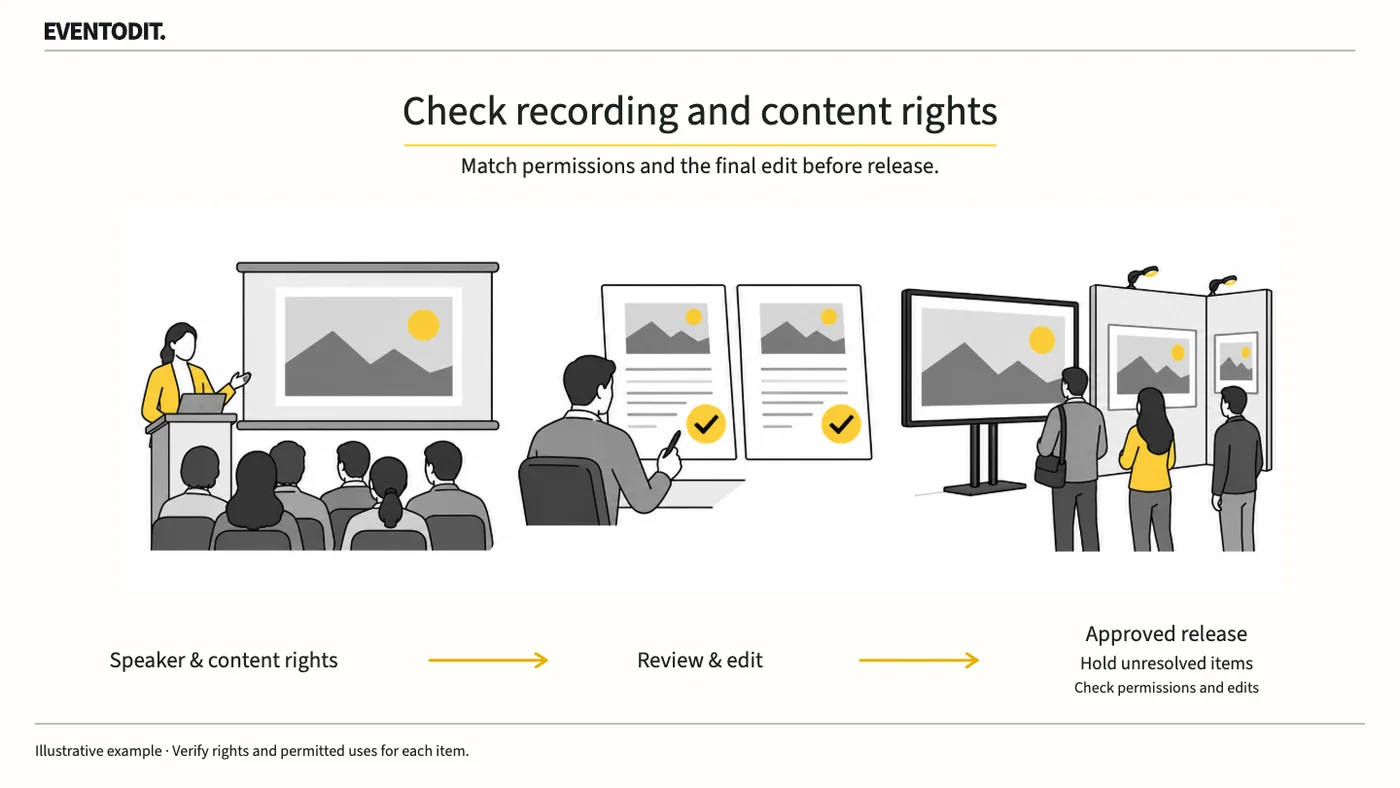
- Collect materials and rights evidenceProgramme lead: link speakers, assets and final slide versions
- Compare intended usesRights reviewer: confirm permitted livestream, VOD and excerpt scope
Missing or mismatched scope
Scope confirmed
- Approve the release versionRelease lead: record allowed segments, file version, channels and duration
Refer material requiring rights interpretation to the reviewer; an unresolved permission is not an automatic approval.
Use the form for the next handover
Use the [Recording rights and release checks](/en/templates/recording-rights-release.html) for the records described here. The XLSX contains Blank, Example and Instructions sheets. Write your event in Blank; the fictional example is a guide to what to enter.
Give people and embedded works separate IDs and record channel scope. Hold unverified uses and identify replacement or excluded segments.
Rights staff send the evidence list and edit instructions to the editor. The publisher retains the final decision and actual published-file record together.
Final check before use: Before externally releasing or publishing presentation recordings, check the speaker's image consent, the permitted use of third-party slide content and the editing of excluded segments.
Conditions for applying this elsewhere
An editorial operating proposal for events that record, broadcast or distribute presentations online afterwards. Confirm actual contracts and rights separately.
Information not established
This article does not verify consent from speakers at a particular event, asset licences, actual releases or editing results. Individual association policies are not universal Korean statutory standards.
Reference material
- ACM HT 2024 — Public Permission and Release Form example, PDF pages 2–3: separate choices for livestreaming and later distribution, and third-party material conditions. A 2024 example, not a standard Korean consent form.
- ACM RecSys 2026 — Camera-Ready instructions, sections 1 and 12: Audio/Video Release, documentation of third-party material, and oral-presentation video submission. Accessed 2026.10.24.
- ACM SIGPLAN — Video Recording Policy: scope for later publication and livestreaming, advance notice and responsibility for speaker consent. Page created 2026.09.05.
- ACM SIGCHI — Live and Recorded Video Policy: rights of questioners and invited speakers, and consent before publication. This association policy was last updated 2018.08.02.
After reading, complete the next task
A release approval record linking session, file version, asset permissions, permitted channels and duration, excluded timecodes and edit verification
This article’s template
Recording rights and release checks
The permitted scope is linked to the actual release file.
Instructions, examples & downloadsRelated practical guides
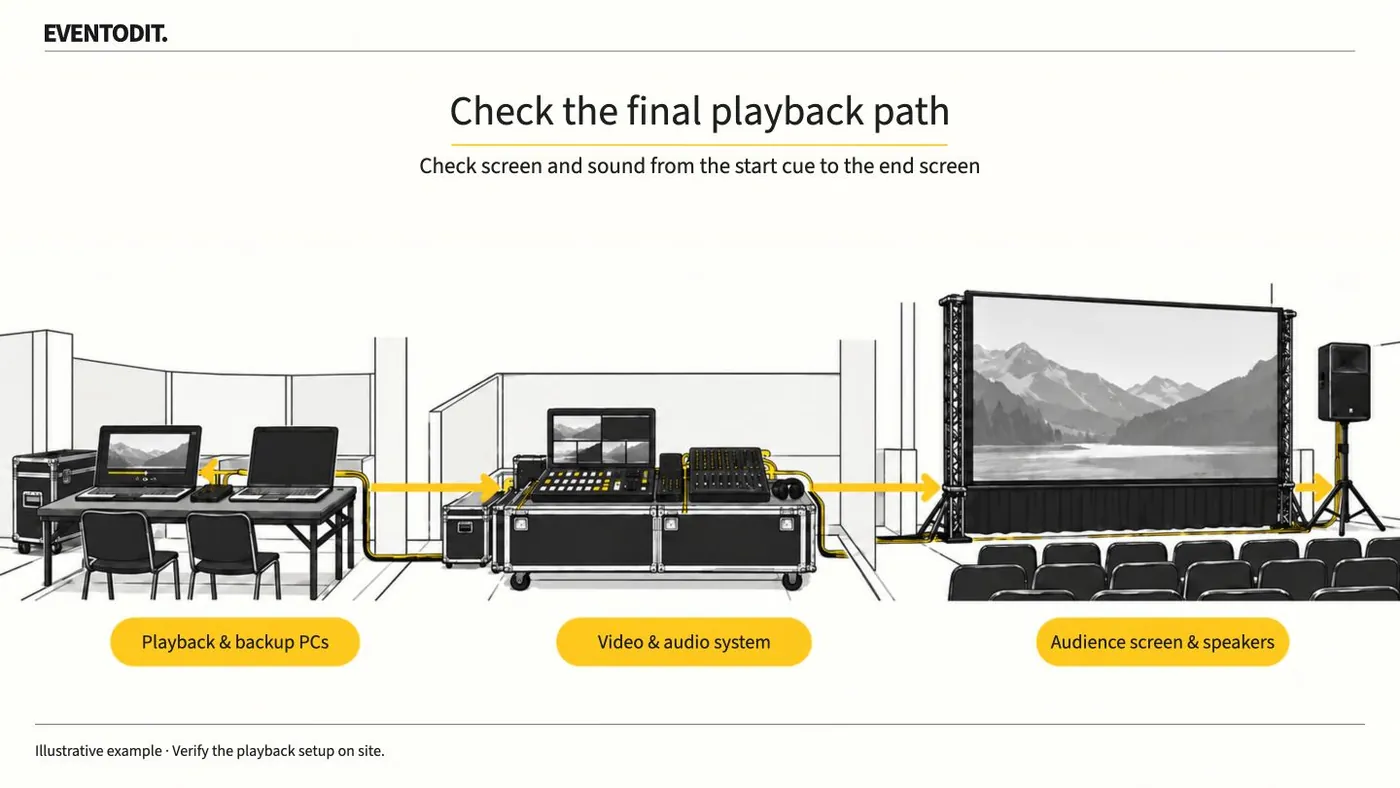
Event Video Acceptance and Playback
Play delivered video on the event PC and check the audience screens and speakers. Test from the start cue through the final screen change, then identify the file approved for playback.
Read guideHave a correction or additional evidence? Request a correction