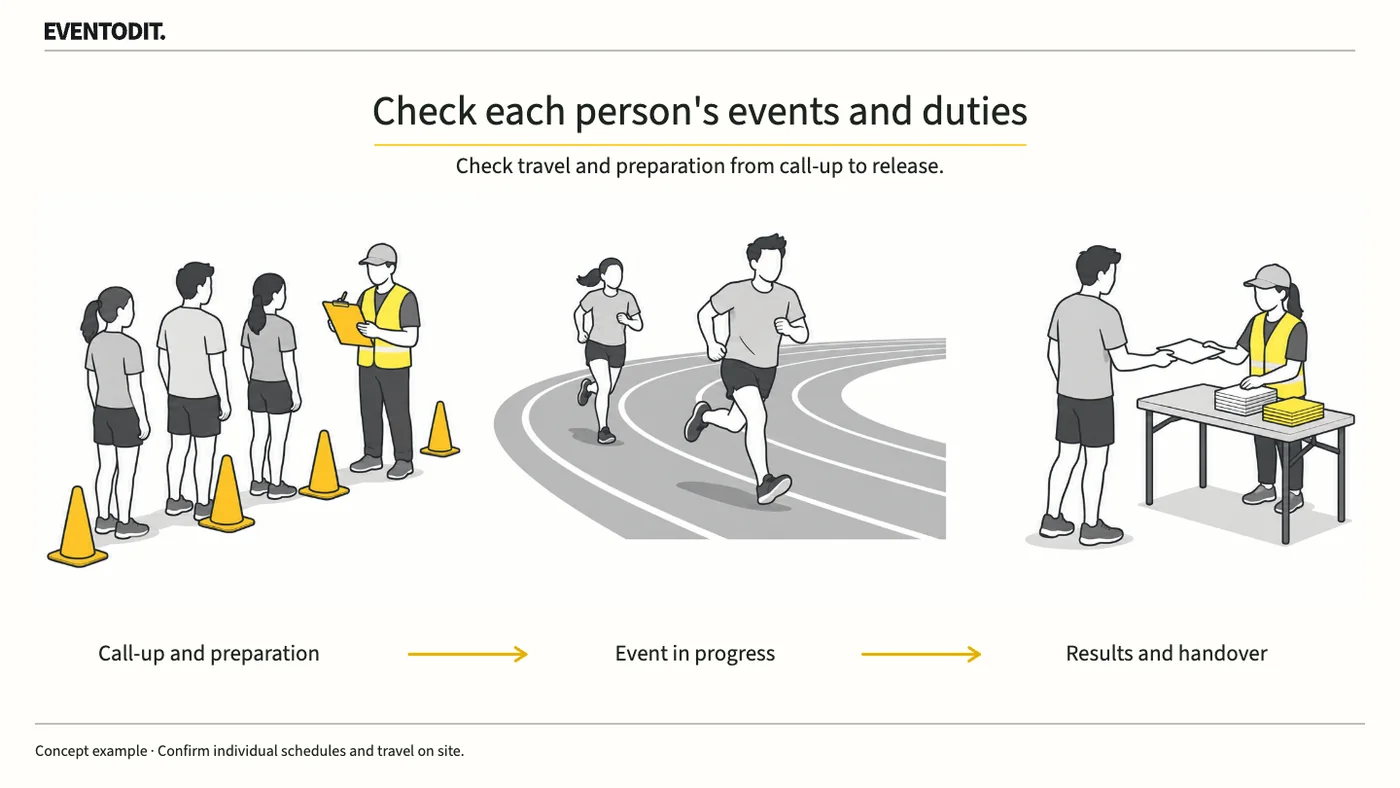
Part 1. Planning and Programme Lead
"A team's break does not mean every individual is free. Compare competition entries and operational roles by participant ID."
- Combine entries by participant ID, not team alone: Do not assume all members are free when a team is resting. Keep team IDs separate from participant IDs so an individual change is not mistaken for a team substitution. Combine each person's sports entries and operational roles, such as scorekeeping and briefings, in one table.
- Distinguish required participants from substitutes: Identify who must compete in each activity and who can be substituted. Use identifying IDs on distributed schedules and have the roster owner securely maintain the separate name-to-ID reference. IDs can still identify people when linked to that reference, so limit distribution.
- Separate simultaneous overlaps from insufficient travel and preparation gaps: Distinguish a time overlap requiring someone in two places at once from a gap that is too short for travel and preparation after the preceding activity. Record the conflict type so the appropriate solution can be found.
- Develop alternatives and recheck their effects: Consider reordering games, substituting participants, replacing an operational role holder or omitting an optional round. If a fixture changes, check its effect on opponents' waiting times and scoring before obtaining final approval.
The following schedule is fictional. The transfer time is an example, not a recommended allowance.
| Fictional participant | Previous and next call–release windows | Conflict to resolve |
|---|---|---|
| P-01 | Relay 10:00–10:15 / ball activity 10:12–10:30 | Required windows overlap by 3 min. Review the next call or a substitute. |
| P-02 | Cooperative activity 10:00–10:15 / relay 10:20–10:40 | Gap is 5 min; a fictional measured transfer of 8 min leaves a 3 min shortfall. |
| P-03 | Competing 10:40–11:00 / scorekeeping 10:50–11:10 | Competition and staff assignment overlap by 10 min. Assign a replacement scorekeeper. |
Scroll sideways if needed to read every column.
Part 2. Competition and Safety Leads
"Look beyond playing time: define the occupied interval from reporting through result confirmation and release."
- Schedule the whole call-to-release interval: Do not calculate availability from game start and end alone. Treat required arrival, rules briefing, preparation, play and result confirmation through permission to leave as one activity window.
- Separate result-check attendance from equipment changeover: Define whether every player or only a team representative must stay for result confirmation. Do not automatically require everyone to wait during equipment resets, or assume players can complete all travel and preparation within that reset.
- Assess physical participation separately: Having enough time to travel does not establish that a person can safely start the next physical activity. A mathematical schedule does not guarantee recovery. The competition and medical leads should independently assess participation in light of activity intensity, individual health circumstances and the day's weather.
- Establish approval authority for rule and eligibility changes: A proposal that changes activity rules or participation conditions is more than an administrative timetable edit. Obtain the relevant competition lead's formal approval and preserve consistent rules.
Suksompong's 2018 study is a mathematical model of game spacing in a single round-robin with one game at a time. It is not a corporate sports day trial or a study establishing recovery time for people participating in multiple activities.
Part 3. Site Operations and Team Information
"Repeated announcements cannot put someone in two places. Synchronise the latest version and track delays on the day."
- Confirm receipt of one approved version and withdraw old copies: Mark the final fixture and role schedules with a version and approval time. Confirm the competition, call and team-information leads all received the latest version, and promptly remove outdated field and team copies rather than changing only the host's announcement.
- Identify affected participants when games run late: If an earlier game finishes late, find those who may miss their next activity or operational duty rather than simply repeating a call. Report the delay promptly to the programme lead so substitutions or resequencing can be considered.
- Hold unconfirmed conditions and assign an owner: Even after resolving an overlap on the checklist, keep approval on hold if the route or required participation assessment is unconfirmed. Name the person responsible; do not treat an unresolved condition as approved.
Scroll sideways if needed to compare the branches.
- Team fixture listGame, zone and call-to-release window
- Individual role rosterGames, scoring and briefing tasks assigned to each person
- Actual travel and preparation timeActual transfer, preparation and activity constraints
- Classify each conflictSeparate simultaneous assignments from short transfer gaps
- Approve the proposed changeRecheck effects of fixture, player or role changes
- Issue one versionConfirm receipt by competition, call and team-information leads
This diagram does not assess fitness to compete or prescribe recovery time. Assign unresolved participation conditions to the relevant responsible lead.
Final check before use: Before approving and using the sports day schedule, check that each participant's call-to-release window and travel and preparation time are sufficient, and that competition, call and team-information leads have all received the same latest version.
Conditions for applying this elsewhere
For corporate sports days with repeat entries across activities or competitors who also hold operating roles. Confirm individual and team entries and actual site-specific transfer and preparation needs; competition rules and fitness to participate require separate checks.
Information not established
No actual event schedule, transfer, participation, recovery or injury outcomes were investigated. All example people and times are fictional. The article specifies no medical recovery duration, Korean safety standard or competition-rule minimum interval.
Reference material
Have a correction or additional evidence? Request a correction