Part 1. Planning and Programme Lead
"The operations team's room reset is not the participants' break. Separate required work from task-free rest."
- Schedule required tasks separately from breaks: Photo uploads, output submissions, moves to another floor and surveys due within a set time are obligations for participants. Putting them all in a break row can make the room reset look like participant rest. Before finalising the schedule, assign separate time for required work.
- Recognise the limits of break research: Albulescu et al.'s 2022 PLOS ONE meta-analysis found small statistically significant effects of micro-breaks on self-reported vigour and fatigue, but no significant overall effect on performance. It did not establish an optimal corporate-workshop break length. Do not claim that a particular break duration will improve decision quality or performance; first check whether required tasks remain in the interval called a break.
- Account for different group routes and do not shorten rest arbitrarily: Groups finishing at the same time can complete required movement at different times because of distance, movement between floors and accessible routes. Check actual routes instead of using the shortest one for everyone. Do not omit needed support or arbitrarily shorten the task-free break to recover a delay.
- Assign authority for missing outputs in advance: Decide who has final authority to proceed with completed agenda items or defer a missing item if required outputs have not arrived before the session. This avoids turning a break into an improvised submission period.
- Record intrusions during the debrief: Do not record only the planned break. Document intervals actually interrupted by required work or delayed movement support and the tasks to move in a future schedule.
Part 2. Facilitator and Session Lead
"Do not open the next session by the clock alone. Compare outputs, room readiness and assembly before deciding."
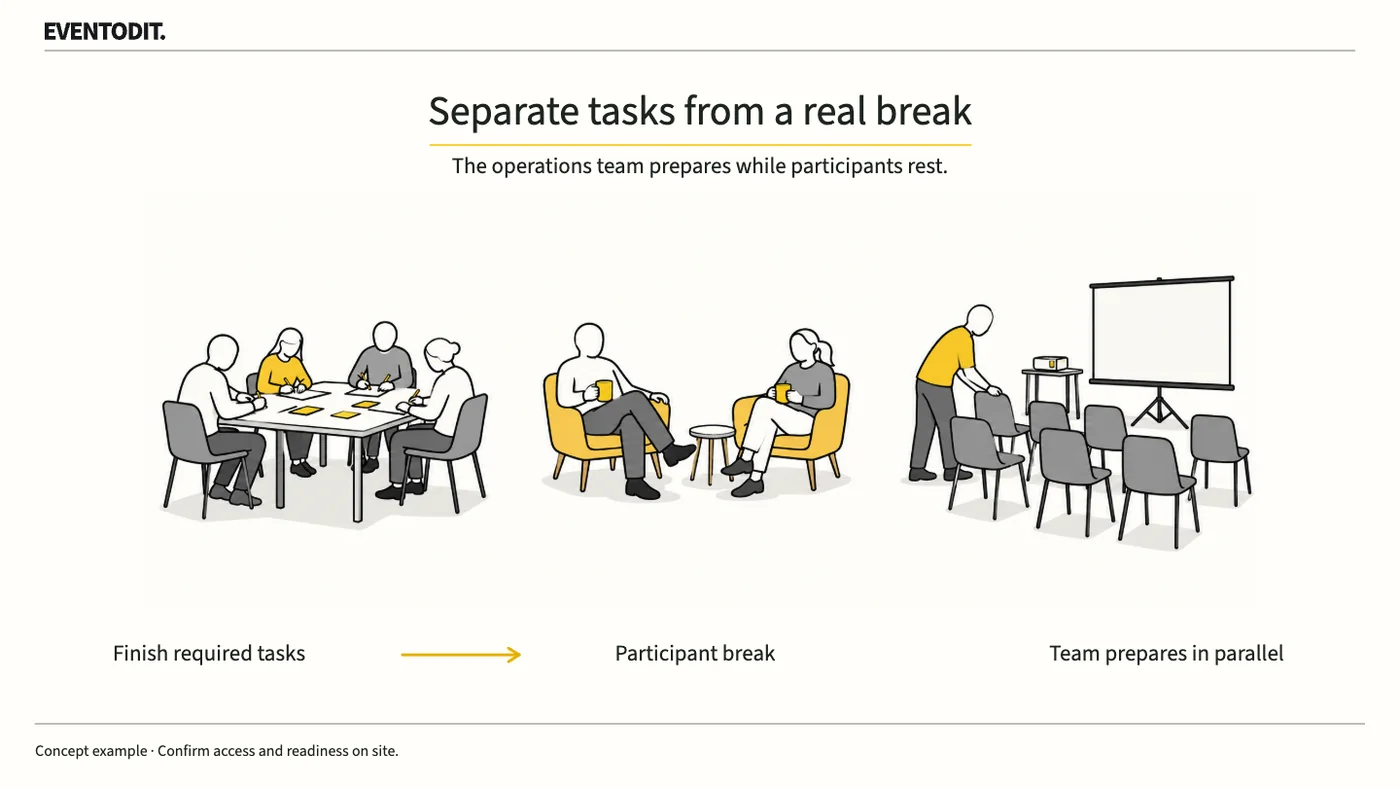
- Check inputs in parallel between sessions: Once the prior session's required work is complete, let participants take a task-free break while the facilitator prepares independently. Check submitted materials for omissions and select the items to address in the next session.
- Decide on the three prerequisites: Do not start merely because the scheduled time has arrived. The session lead first decides whether to defer any item with missing outputs. Then check the essential inputs for the items proceeding, the operations team’s room and screen readiness reply, and the information lead’s participant assembly confirmation before making the final decision to start.
- Distinguish optional participation from obligations: Check that an activity described as optional has not become linked to required submissions or attendance. The labels in participant guidance and operational schedules may differ, but the actual required work must match.
- Compare assembly conditions in scripts and transition plans: Cross-check assembly times and start conditions in the facilitator's script, participant notices and operations room-transition plan to prevent conflicting guidance.
- Schedule participant-dependent preparation: If the next session requires additional participant action or cooperation, put it in a separate mandatory interval instead of implicitly asking for it during their break.
Scroll sideways if needed to compare the branches.
- Participant breakKeep the interval free of additional required tasks
- Facilitator input checkSeparate received outputs, gaps and next agenda
- Operations transition checkConfirm seating, output, entry and support readiness
An operations reset does not automatically count as participant break time.
Part 3. Site Operations and Participant Information
"Record each transition condition separately and activate a dedicated participant-notice contact when plans change."
- Record and hand over each transition condition: For a session continuing in the same room, record submission deadlines, next assembly and any additional tasks. For a move, record actual routes, support between floors and assembly guidance. If outputs are missing, obtain the session lead's decision on items that may be deferred and finalise the handover.
- Check physical access and walking conditions: Before a move to another floor or breakout room, inspect actual routes, including lift congestion, steps and wheelchair access. Record time needed at bottlenecks as well as travel distance.
- Report room and equipment readiness: While participants rest without tasks, operations should reset seating, distribute materials, prepare entry controls and set up the main display, then formally report readiness to the session lead.
- Use one contact for participant notices: Appoint a dedicated participant-information lead in advance. If submission deadlines or the next assembly location change, use that contact to communicate the update promptly and consistently.
- Do not recast a measured interval as a recovery result: The operations log records the actual interval between completion of required work and the next assembly. Without a separate scientific assessment, do not report it as participants' fatigue recovery or session performance.
| Transition | Separate schedule fields | Check record |
|---|---|---|
| Continue in the same room | Submission deadline, next assembly, extra tasks | End of required participant work |
| Move to another space | Actual route, support and assembly guidance | Checked and revised movement conditions |
| Some outputs missing | Essential inputs and items that may be deferred | Session lead's start decision |
Scroll sideways if needed to read every column.
Final check before use: Before the workshop, check that required work is separated from task-free breaks and the facilitator and operations team have received all session-transition readiness conditions.
Conditions for applying this elsewhere
For workshops with output submission, room transfers or group reassembly, using actual task and support requirements.
Information not established
Submission and movement durations and participant support needs require event-specific checks. No recovery or performance effect is calculated for a particular break length.
Reference material
Have a correction or additional evidence? Request a correction