Part 1. Stage and Show Lead
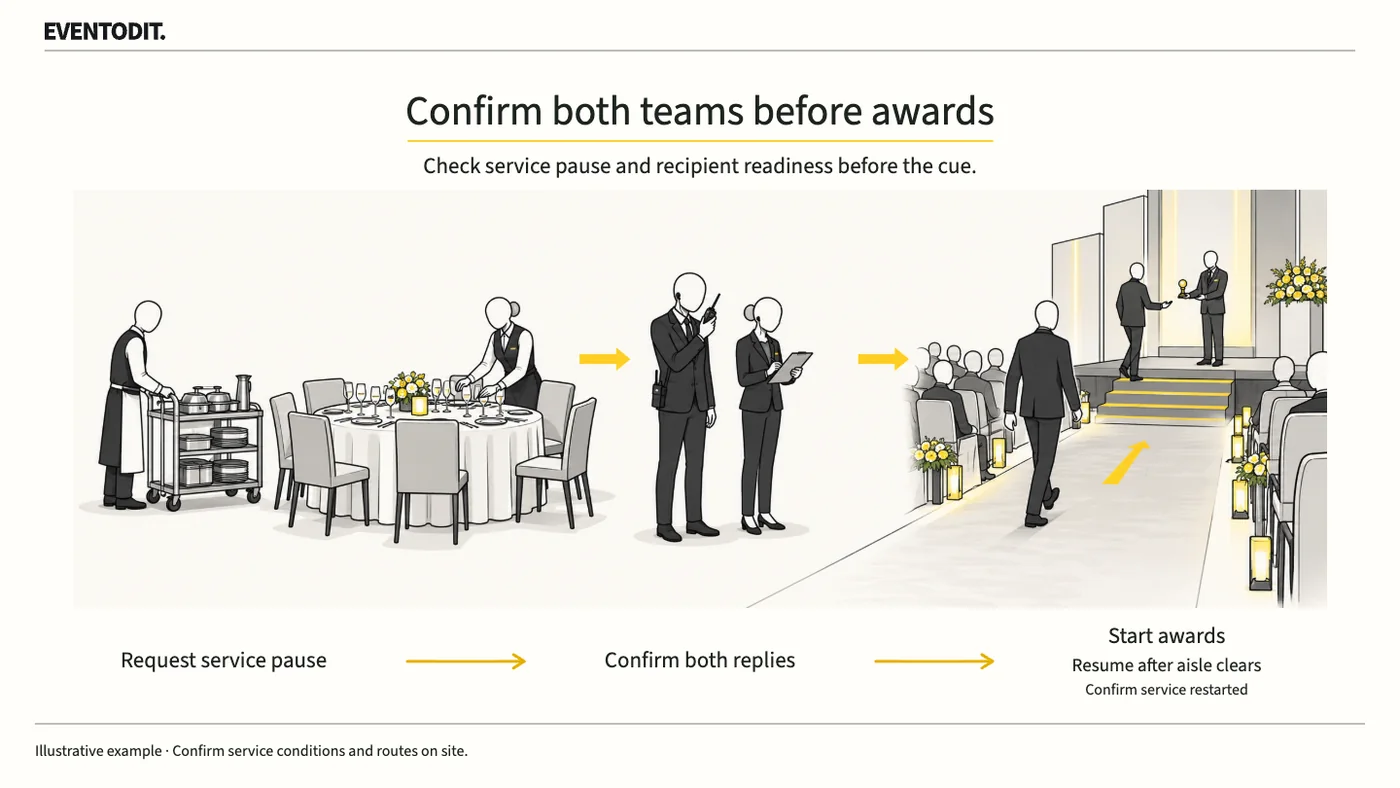
"A request to pause service is not a start signal. Compare the actual hold confirmation before calling the cue."
- Agree specific work and zones rather than issuing a blanket hold: Pair each programme needing attention, such as awards, with the relevant food-service task. Agree in advance which tasks and zones are affected, such as pausing plate clearing in a particular aisle or holding food service.
- Record the hold request and completion reply separately: In the cue sheet, distinguish when the stage manager requested the hold from when the banquet team confirmed it had actually stopped. Do not start the awards by treating the request time as completion.
- Compare both replies before deciding to start: Approve the awards cue only after comparing the banquet lead's confirmation of paused work by zone with the awardee coordinator's separate movement-readiness reply. Hold the next cue if either reply is missing or differs from the agreed conditions.
- Activate an agreed alternative if the awards overrun: Do not keep food service waiting indefinitely. Confirm changed service conditions with the banquet lead, then use a previously agreed alternative—reordering, changing the route or holding the cue—with the organiser's responsible approver's authorisation.
- Send the resume signal and confirm actual execution: Do not close the procedure with an announcement that the awards are over. Confirm that awardees have finished moving through the aisle, send the official resume signal and obtain the banquet team's report that service has actually resumed.
Scroll sideways if needed to follow each role.
- Stage / show lead: Request agreed holdState task, zone and cue ID
- Banquet lead: Report actual statusDistinguish paused, limited and unfinished zones
- Awardee lead: Confirm movement readinessCheck attendance, waiting and route
- Stage / show lead: Start or keep on holdCompare both replies before the cue
- Awardee lead: Confirm route releasedReport movement clear of service route
- Stage / show lead: Send resume cueCall release after route-clear reply
- Banquet lead: Confirm executionBanquet lead records actual service restart
- Stage / show leadRequest agreed holdState task, zone and cue ID
- Banquet leadReport actual statusDistinguish paused, limited and unfinished zones
- Awardee leadConfirm movement readinessCheck attendance, waiting and route
- Stage / show leadStart or keep on holdCompare both replies before the cue
- Awardee leadConfirm route releasedReport movement clear of service route
- Stage / show leadSend resume cueCall release after route-clear reply
- Banquet leadConfirm executionBanquet lead records actual service restart
Columns identify roles. Read steps from top to bottom; arrows show the handover direction.
Assign the sender of the resume cue and the person confirming execution in advance.
Part 2. Banquet and Food Service Lead
"Actual work status takes precedence over the printed schedule. Report the available work zones and food-service conditions clearly."
- Check and share actual service progress: Even if the cue sheet says “dinner after awards”, identify tables already served, tables still waiting and aisles where clearing is under way. Tell the stage team the actual status at the relevant time.
- Determine what can pause and the release conditions: Identify tasks and zones that can pause according to the service style and food preparation and holding conditions. Tell the stage team where a hold is impossible or quality may deteriorate and what limits apply.
- Promptly confirm hold status by zone: When the stage team calls a hold, distinguish zones where work has actually stopped, zones operating with restrictions and zones where the hold is incomplete. Report the status promptly to the stage and show lead.
- Report service options if awards are delayed: If a delay changes food holding or service conditions, proactively tell the operations lead how long waiting remains possible and which alternative services can currently be provided.
- Resume on the designated signal and record the result: Do not rely on a general announcement from the stage. Resume after receiving the designated sender's signal, record the actual restart in the operations sheet and report it back.
FIU's event manual distinguishes the agenda from the run of show with its cues and recommends discussing the effects of banquet service on the programme with the catering team. A pause during remarks is an institution-specific example, not a universal rule. Qualified venue personnel must determine whether food can be safely held and served under the actual conditions.
Part 3. Awardee and Floor Movement Lead
"Keep serving carts and awardees from converging in the aisle; verify that the route is clear through the end of movement."
- Check awardee and service routes for conflicts: Compare the routes awardees take to and from the stage with banquet carts and plate and waste clearing routes on the plan and in the on-site rehearsal.
- Confirm awardee readiness and the route: Check that awardees are present, standing by and have a clear route, then send the stage and show lead a separate movement-readiness signal.
- Use an alternative route when movement conflicts: If a service delay or route conflict prevents access, hold movement, notify the show lead of the previously agreed alternative route, and apply it after the required approval.
- Link movement completion to service restart: Once awardees are safely seated and have completely finished using the aisle, promptly tell the show lead the route is clear so the banquet team can resume under the agreed procedure.
| Situation | Immediate check | Decision record |
|---|---|---|
| No completed-hold reply | Actual task status from banquet lead | Hold the start; assign the next reply |
| Awardee and service routes conflict | Route use in that zone and period | Approved alternative route or order |
| Service conditions change | Options still available to the banquet team | Change, approver and affected cue |
Scroll sideways if needed to read every column.
Final check before use: At the event-day rehearsal, test not only the signals but also whether the awards are held when completion is not confirmed and whether the actual execution report returns after the resume signal. If the programme changes, check that stage, banquet and awardee coordinators all have the same version of the checklist.
Conditions for applying this elsewhere
For events combining awards or remarks with food service, after the venue agrees which work can pause and under what service conditions.
Information not established
Actual layout, service style, permissible pause scope, food-service conditions and execution remain event-specific checks.
Reference material
After reading, complete the next task
Cue ID, zone, request, reply, movement, release, delay option and version check
This article’s template
Awards and Banquet Service Hold/Resume Cue Sheet
A shared service hold/resume sequence for the show caller, banquet captain and stage team.
Instructions, examples & downloadsRelated practical guides
Event Cue Sheet Changes and Reapproval
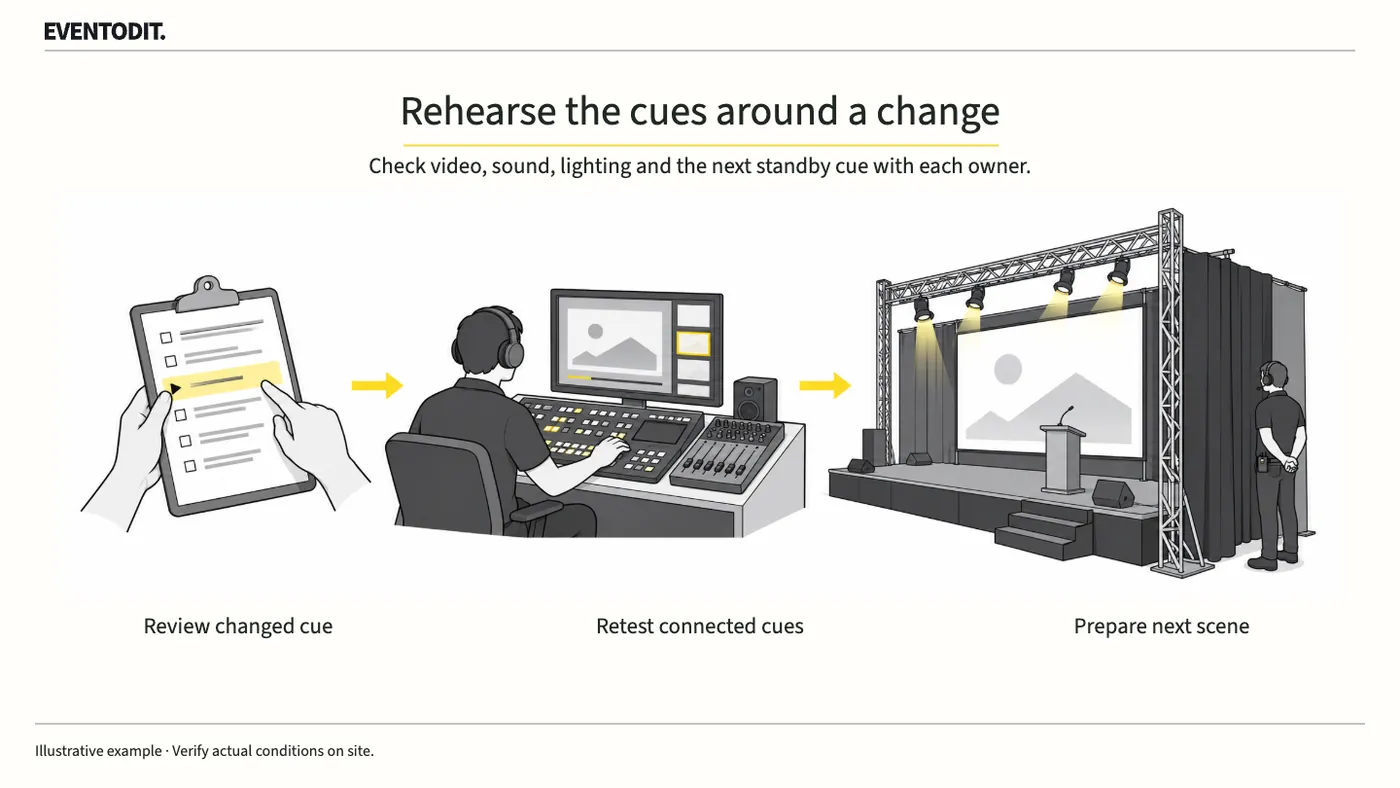
Changing a video’s length or a performer’s order can affect sound, lighting and standby calls. Ask the affected teams to check, rehearse the transitions around the revised scene, then distribute the approved cue sheet.
Read guideHave a correction or additional evidence? Request a correction