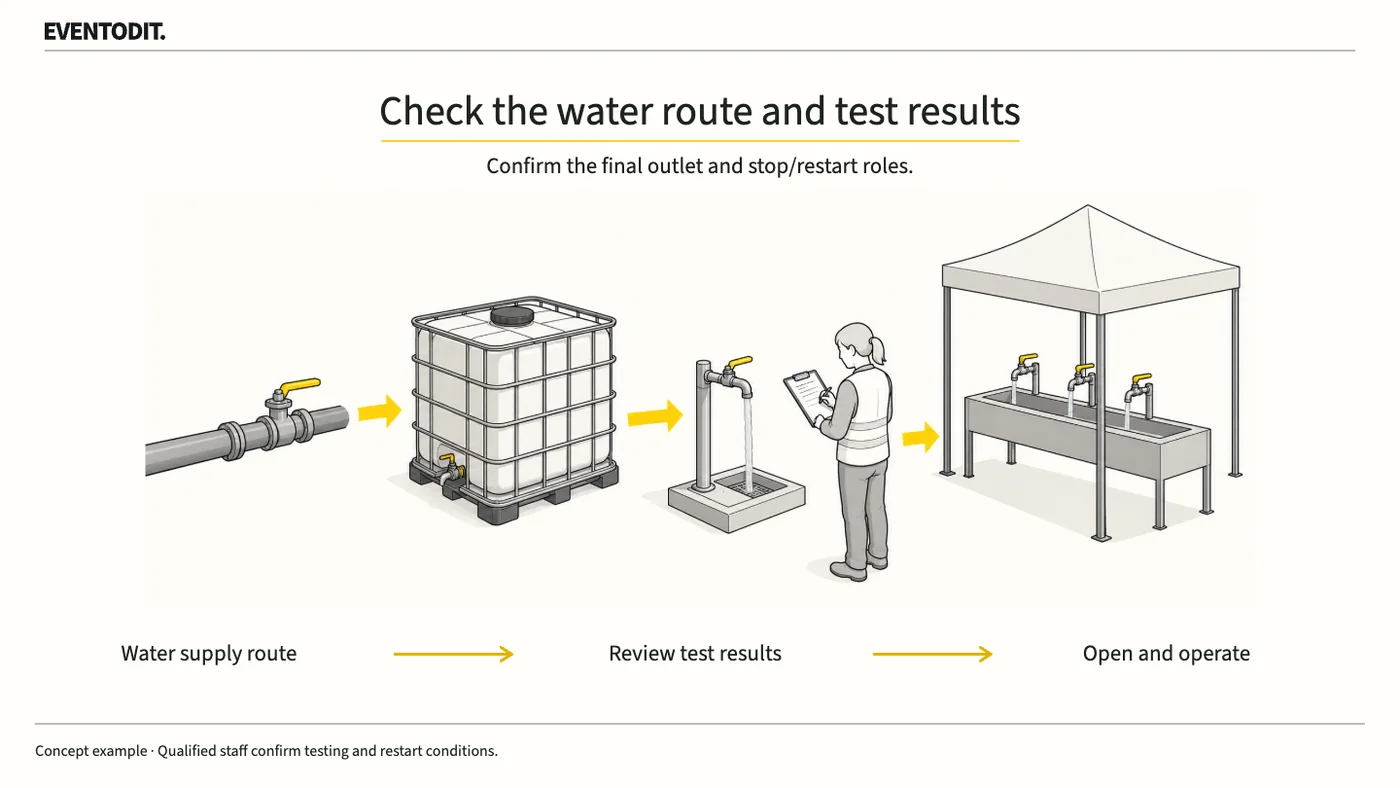
Part 1. Planning and Operations Lead
"Flowing water alone does not justify opening. Agree when results will arrive and who can close and reopen each point."
- Work backwards from the results deadline: Do not schedule installation immediately before opening with results arriving afterwards. Allow time for sampling, transport, laboratory analysis, the report and any remedial work before visitors are admitted.
- Plan supplies by use without double counting: Review visitor drinking points, caterers' cooking and handwashing water, and water for toilets and cleaning separately. A visitor drinking point does not resolve caterers' supply needs. Agree allocations in advance so the same tank capacity is not counted for multiple uses, creating shortages or pressure loss.
- Specify shutdown, alternative supply and reopening authority: Before opening, decide which points to restrict and who receives a report if taste, smell or turbidity changes or supply fails. Name who supplies replacement water, the final decision-maker and reporting chain. Site staff must not independently judge water quality or authorise reopening. The designated authority decides after review by facility and competent personnel and relevant authorities where needed.
Part 2. Water Supply, Facilities and Quality Inspection
"Clear-looking water is not a test. Check the complete route through to the final outlet and the results."
- Verify the whole route to the final outlet: Do not infer that water is fit to drink from a facilities manager's verbal assurance or a mains connection alone. Compare the drawings with the installed route through temporary hoses, storage tanks and distribution equipment to the final tap used by visitors.
- Match the test report to the installation: Obtain a report identifying the checked points, sampling and inspection times, parameters, findings and outstanding actions. Compare its covered supply route with the installed pipework. If pipework or storage conditions change after installation, do not simply reuse the previous result; obtain a competent person's recheck.
- Document alternative supply and evidence of recovery: If supply fails or water quality is in doubt, identify the affected neighbouring facilities and caterers sharing the line. Flow returning alone does not justify reopening. Report the corrective actions and evidence of remaining-risk review to the operations lead in writing.
Confirm whether testing is required, the sampling points, parameters, testing method and reopening requirements with the facility, competent personnel, local authority and testing body according to the installation, supply arrangement and risk assessment. Obtaining results before opening is this guide's operational plan; it does not mean identical testing obligations apply to every temporary drinking point. Results apply to the sampled time, point and parameters; they do not guarantee safety at every outlet or throughout the event. Do not import foreign thresholds or procedures as universal Korean requirements.
Part 3. Site Operations and Visitor Information
"The area around the tap is part of the installation. Check access and drainage regularly."
- Inspect access and the surrounding infrastructure: Check that wheelchair users and other visitors can reach the mapped location. Verify clear drinking-water signs, night lighting and drainage so spilled water does not pool in walkways or create a slip hazard.
- Observe and report without making an unauthorised judgement: Record the water point's appearance, pressure and surrounding cleanliness at agreed intervals. If a visitor reports unusual taste, smell, colour or an interruption, do not decide independently that it is acceptable. Immediately restrict use of the affected point and call the responsible person through the agreed chain. Do not taste water of uncertain quality to check it.
- Provide alternative drinking water and retain the operating record: Mark closed points clearly and distribute bottled drinking water at the designated alternative location. Record the affected point and time, restrictions, alternative supply, visitor notices and retest results in the operating log.
Scroll sideways if needed to follow each role.
- Supply and inspection team: Hand over findingsSupply route, checked points, results and outstanding actions
- Site operator: Confirm readinessReport signs, access, drainage and ability to manage the point
- Operations lead: Approve opening scopeConfirm verified points, operating hours and fault contacts
- Site operator: Log fault and restrict useClose the affected point under the plan and call the responsible team
- Supply and inspection team: Report cause and recheckProvide required actions and evidence for safe reuse
- Operations lead: Decide replacement or reopeningConfirm and record notices, alternative supply and reopening conditions
- Supply and inspection teamHand over findingsSupply route, checked points, results and outstanding actions
- Site operatorConfirm readinessReport signs, access, drainage and ability to manage the point
- Operations leadApprove opening scopeConfirm verified points, operating hours and fault contacts
- Site operatorLog fault and restrict useClose the affected point under the plan and call the responsible team
- Supply and inspection teamReport cause and recheckProvide required actions and evidence for safe reuse
- Operations leadDecide replacement or reopeningConfirm and record notices, alternative supply and reopening conditions
Columns identify roles. Read steps from top to bottom; arrows show the handover direction.
Inspection, shutdown and reopening authority and criteria must be confirmed against site requirements and competent technical review.
Use the form for the next handover
Use the [Temporary drinking-water handover log](/en/templates/drinking-water-handover.html) for the records described here. The XLSX contains Blank, Example and Instructions sheets. Write your event in Blank; the fictional example is a guide to what to enter.
Record use and the complete route to each outlet. Check the place, time and scope of reports and link the opening decision.
Facilities hand original inspection records and route changes to operations. Information staff receive matching water-point and alternative-supply notices.
Final check before use: Before opening the drinking points, cross-check that the supply route, water-quality results handover, emergency alternative supply, and shutdown and reopening authority have all been confirmed.
Conditions for applying this elsewhere
For advance coordination and operational handover at outdoor festivals and performances using temporary water supplies or refill stations. Confirm thresholds, tests and authority separately against requirements applicable in Korea.
Information not established
This article does not verify water quality, installations, supply volumes, test results or statutory compliance at a particular Korean festival. Foreign outlet counts, testing thresholds and permit systems are not presented as Korean standards.
Reference material
- UK Drinking Water Inspectorate — Festivals and temporary events: source-specific risk assessment, sample transport and analysis schedules, and inspection by competent personnel. Accessed 2026.10.24.
- UK Cornwall Council — Health and safety for large events, Drinking Water section: potable supply, access, signs, night lighting and drainage. Accessed 2026.10.24.
- Australia, City of Greater Geelong — Water management planning: demand, supply, storage and drainage by use, including separate caterer supply. Updated 2026.03.30.
- Northern Ireland Public Health Agency — Temporary Drinking Water Supplies PDF: existing and new supply checks, pipework overview, backflow risks and responsibilities. The cover is dated 2016.06.14; this historical guidance is not current Korean regulation.
- Korea Law Information Center — Rules on Drinking Water Quality Standards and Inspection: confirm requirements for the facility and responsible party
After reading, complete the next task
A handover record linking supply routes, final outlets, test and inspection results, opening scope, management responsibilities, fault restrictions and replacement supply
This article’s template
Temporary drinking-water handover log
The route, evidence and opening decision are linked.
Instructions, examples & downloadsRelated practical guides
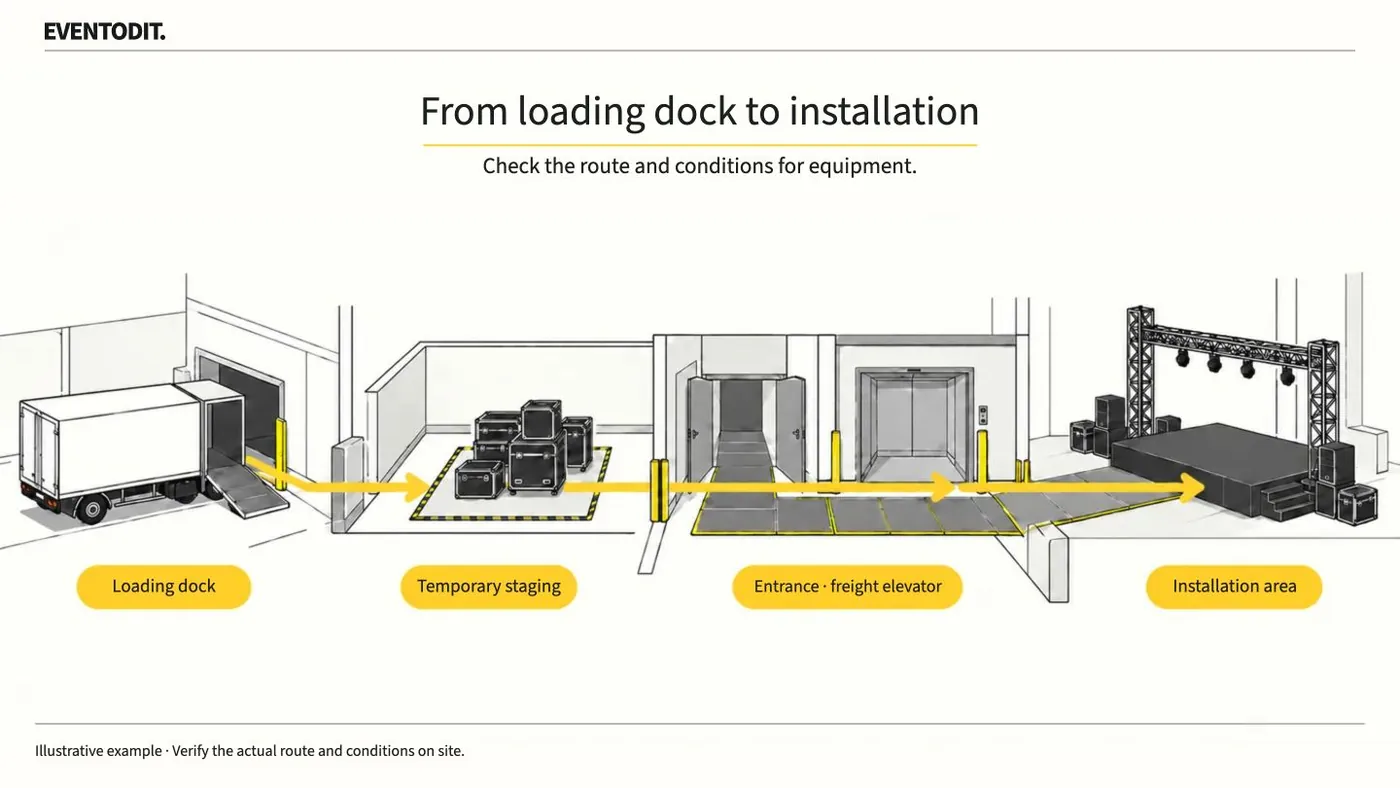
Venue Survey and Load-in
Check the route equipment will actually travel and the routes visitors will use. Mark questions for the facilities and technical teams on the plan and assign a person and deadline to resolve each one.
Read guideHave a correction or additional evidence? Request a correction