Align the comparison conditions first
For each option, record who will participate, what each person will receive and for how long, and the period covered from preparation through the final follow-up delivery. If an option runs in two sessions, distinguish the number in each session from the number of distinct people served. The same people attending twice and different people attending once represent different scales and should not be treated as equivalent.
Check whether participation is possible. An option is not viable, however cheap it is, if the audience's availability, required support, staff assignments, or preparation deadline cannot be met. Record “not yet confirmed” separately from “confirmed unavailable.” The first requires more checking. The second means the option needs to change or be removed.
Assess money and effects separately
Use the same cost scope for every option. Check that venue, facilitation, materials, preparation, dismantling, and follow-up delivery are all covered. Record burdens that do not appear as cash costs, such as employees' time, separately rather than leaving them out.
Separate the change you hope to achieve from the evidence currently available. A reply saying someone intends to attend is not evidence of actual attendance. A record of successful activity during an event is not evidence that a customer later performed better at work. Do not invent growth rates or probabilities of success without evidence.
Check the questions that could change the decision first
Not every question needs the same level of checking. Start with those that could change the result. In the example below, the key question was whether the same target group could be divided between the morning and afternoon sessions. That answer mattered more than decoration or detailed programming.
Tell the person checking exactly what to confirm, which participant list and times to use, and when to reply. Decide in advance which decision will be put on hold if the reply is late.
Record the selection reason and remaining uncertainty together
A decision record needs more than the selected option. Include why it was chosen and what remains unconfirmed. Simply writing “Adopt A” can be read as a claim that A is more effective. The actual reason may be that it preserved a comparable audience and passed the budget and staffing review.
Record the maximum amount, target number of people, configuration, and effects that remain expectations. State clearly that contract review may proceed, while signing, advance payment, and notices confirming participation remain on hold until separately approved.
Fictional example: one option adopted, one on hold
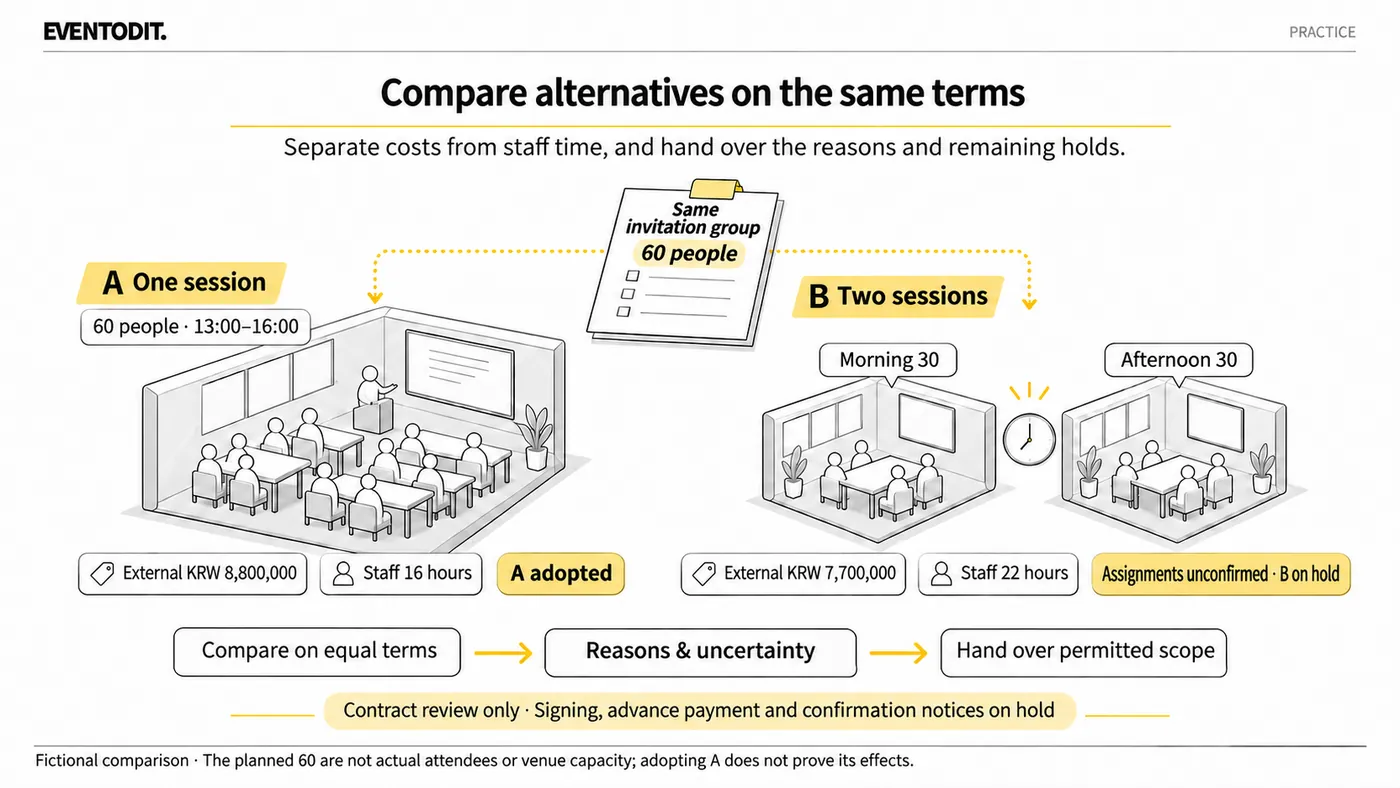
The following is a fictional corporate customer workshop record created for explanation. All dates, numbers of people, amounts, replies, and authority are assumptions. The 60 people are the planned invitation group, not actual attendees or an approved venue capacity.
| Alternative | People and time | Total external payments and internal staff time | Current status |
|---|---|---|---|
| A: One concentrated session | 60 people, 13:00–16:00 | KRW 8,800,000; 16 internal staff hours | Adopted. External contract review only; signing and notices confirming participation remain on hold. |
| B: Two separate sessions | 30 in the morning and 30 in the afternoon. The same target group of 60 must be divided between the two sessions. | KRW 7,700,000; 22 internal staff hours | On hold. No reply confirming session assignments for the same target group by 12:00 on 11 January. |
Scroll sideways if needed to read every column.
Notice that B was not selected automatically because it was cheaper. It remained unconfirmed whether the same target group of 60 could be assigned across the two sessions. Filling the places with other people would change the comparison, so an option that changes the list needs a new review.
At 14:00 on 11 January, the decision maker adopted A as the outcome of the business case review and kept B on hold. This did not establish that A's effects were certain. A was selected because it preserved the conditions for comparing the same audience and passed the budget and staffing review. The applicable version was sent at 15:00 on 11 January, and receipt was confirmed at 15:20. Handover ended at 15:40 when the contract, operations, and communications staff replied after comparing their documents and identifying where the holds remained in place.
Check that documents still mean the same thing after handover
After the decision, check that the receiving staff's documents express the same conclusion. Make sure the draft contract does not exceed A's number of people, time, or total amount. Check that communications do not present B's sessions or unconfirmed effects as settled facts.
An acknowledgment of receipt is not enough. Handover ends only after a reply identifies which document version was checked, what was corrected, and where the hold remains recorded.
A later reply about B does not automatically replace A. A new decision is required. Also pass on what to pause and whom to ask for a new review if the list, quotation, operating hours, or funding responsibility changes.
Practitioner checklist
- Are audience size, participation time, and what is provided recorded on the same basis for every option?
- Are included and excluded cost items recorded on the same basis for every option?
- Are intention to attend and actual effects recorded in separate fields?
- Have unconfirmed conditions been kept separate from confirmed ones?
- Does the decision record include the selection reason, maximum amount, and remaining uncertainty?
- Do signing, advance payment, and notices confirming participation remain on hold until separately approved?
- Have replies confirmed that the received documents express the same conclusion and the same scope of holds?
Conclusion
A business case review is not an exercise in choosing the cheapest option. It determines under what conditions and with what burdens the same objective can be delivered. Align the comparison conditions, separate money from effects, and check the questions that could change the decision first. Passing on the selection reason and remaining uncertainty together lets the next person understand exactly what they may promise.
*This workshop's dates, numbers of people, amounts, replies, authority, and decisions are fictional examples created for explanation.*
Conditions for applying this elsewhere
An editorial method after operating plans, schedules, costs and payment checks are available. UK public-sector guidance and APM definitions inform principles, not mandatory Korean event procedures. Every workshop date, people count, amount, time, reply, authority and decision is fictional, not venue capacity, market pricing or actual research.
Information not established
No actual event effects or work outcomes were validated. Actual organisational records determine authority, tax and funding conditions. The fictional comparison memo is neither a contract nor an effects guarantee; it offers no automated form decision or new downloadable file.
Reference material
- APM, What is a business case? — options, benefits, costs, risks and decision reviews (checked 5 Nov 2026)
- HM Treasury, The Green Book 2026 — evidence, unmonetised impacts and uncertainty (updated 28 Oct 2026; checked 5 Nov 2026)
- Government Project Delivery, GovS 002 v2.1 — section 4.3, decision making (checked 5 Nov 2026)
After reading, complete the next task
A dated comparison memo, cost/payment/staffing evidence, option decisions and an outcomes-check plan, the decision and acknowledgment/document-comparison records for the applicable version
Related practical guides
Event budget management: check costs, funding and payment dates together
Separate each cost into its pre-tax amount, tax and total payment, then compare available cash with planned receipt and payment dates. Record funding that will not be available when due and any outstanding conditions before seeking approval or releasing spending.
Read guide
Event feasibility: consider income, costs and payment timing together
Projected income can exceed costs while cash is still unavailable when payments fall due. Separate confirmed amounts from conditional costs and compare whether each option can be delivered.
Read guideHave a correction or additional evidence? Request a correction