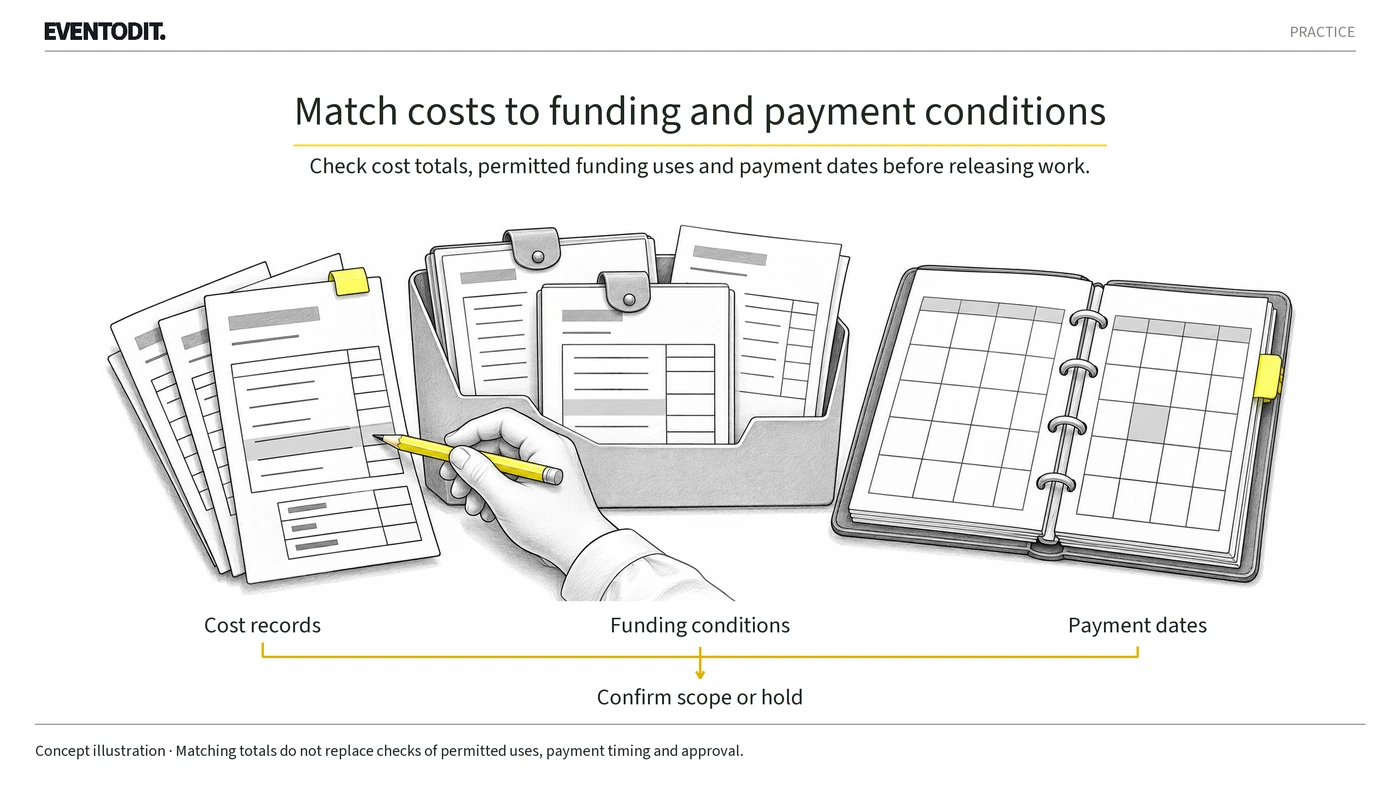
Set the reference date and assign responsibilities first
An event budget needs to show which funds will cover each cost and when payment is due. The budget owner gathers the latest scope, quotes, budget proposal, grant and sponsorship commitment letters, and actual cash records, then aligns their reference dates and versions.
The production or operations lead checks the work needed from preparation through teardown and delivery of the results. The finance lead checks restrictions on the use of funds and the tax treatment.
Give each cost an ID so it can be found later. If installation staff are included in the venue fee, do not add them again under staffing costs. If it is unclear who will pay a cost, keep it as an open question instead of leaving it out.
Check tax and the total payment separately
Each quote should show how the amount is made up. Check the pre-tax amount, tax, and total amount payable separately. Adding tax again to a quote that already includes it will make the amount incorrect.
Even if tax can be reclaimed later, do not deduct it in advance from the money needed for the payment. The finance lead checks any reclaimable amount separately. If an amount has not been confirmed in a reply, mark it as unconfirmed, not KRW 0.
Record the status and permitted uses of each funding source
Do not combine own funds, ticket sales, sponsorship, and grants in a single field. For each funding source, distinguish between money actually received, money only promised, and funding still being applied for.
Ticket sales before fees and refunds are deducted do not equal the amount that will reach the bank account. Do not add in-kind sponsorship, such as furniture provided free of charge, to the cash balance. Instead, record separately who will receive it, when, and any costs incurred in connection with it.
Work through a fictional budget
The following fictional corporate forum illustrates the process. All amounts, taxes, commitments, and dates are assumptions, not actual market rates or grant rules.
| Cost | Amount (pre-tax amount + tax = payment) | Funding to allocate | Planned payment date |
|---|---|---|---|
| B1 Venue and basic operations | 2,000,000 + 200,000 = KRW 2,200,000 | Own funds | 1 Dec |
| B2 Technical services and transport | 3,000,000 + 300,000 = KRW 3,300,000 | Own funds | 10 Dec |
| B3 Accessibility support and post-event delivery | 1,000,000 + 100,000 = KRW 1,100,000 | Grant commitment F1, restricted to this cost | 18 Dec |
Scroll sideways if needed to read every column.
The total amount payable is KRW 6,600,000. Own funds of KRW 5,500,000 have been confirmed. Grant F1 has a commitment letter but has not yet been received; its expected receipt date is December 24. The KRW 1,100,000 sponsorship under discussion is not treated as confirmed funding.
In this table, B3 must be paid on December 18. Since the grant is expected later, there is a shortfall of KRW 1,100,000. The totals match, but the dates do not.
Put spending on hold if funds are insufficient
If funds will be insufficient on a payment date, put that payment on hold. The budget owner should not remove B3 at their own discretion, but should reconfirm the required accessibility support and its conditions with the operations lead. The finance lead replies to confirm whether additional own funds will be available by the deadline and whether the vendor has agreed to revised payment terms.
This example assumes that no reply arrived by the deadline. The decision-maker therefore puts spending under the first version of the budget proposal on hold and decides to review it again after receiving the finance lead's reply. This is a fictional decision and does not mean that any actual approval or payment has taken place.
Obtain separate approval for the budget ceiling and the scope of orders permitted
Submit the cost table, supporting evidence, allocation by funding source, planned payments, outstanding conditions, and alternatives together as one approval request. The decision-maker determines both the total amount and which work may be ordered from which date.
Even if additional own funds are approved, do not count the same money again alongside the grant as new income. If sponsorship terms, taxes, quantities, or schedules change, update the relevant quotes, funding allocations, planned payments, and scope of approval together.
Use both templates and review the payment forecast separately
In the Blank sheet of Confirmed and Potential Additional Costs, record the cost ID, work item, current status, confirmed or conditional amount, and evidence. The fictional budget above has not been released for spending, so do not reclassify B1–B3 as approved orders. Using the pre-tax basis shown in the Example sheet, the three amounts are KRW 2,000,000, 3,000,000 and 1,000,000. Record their taxes of KRW 200,000, 300,000 and 100,000 and total payments in “Condition causing the cost and its effect” and the supporting file. Do not compare the pre-tax total of KRW 6,000,000 with the payment total of KRW 6,600,000 as though they were the same basis.
The Calculation sheet compares approved budgets, confirmed orders and possible extra costs. Use one currency and tax basis throughout, and do not invent an approved amount for an unapproved proposal in “Original approved budget.” Leave an unknown approval amount blank and retain the “Check inputs” status and a separate reason for the hold.
In the Funding status, receipts, payments and available cash log, enter only actual available cash and actual receipts and payments as numbers. If the verified own funds of KRW 5,500,000 in this fictional case are recorded as opening cash, do not add them again as a receipt. Put the unreceived F1 commitment of KRW 1,100,000, the KRW 1,100,000 sponsorship under discussion and the planned B1–B3 payment dates in “Planned receipts/payments and conditions,” separately from actual movements. Enter zero only where no actual receipt or payment has been verified; leave unknown amounts blank.
Neither template automatically allocates funding to costs or calculates shortages by future date. In a separate payment-forecast note, link the cost ID, tax-inclusive payment and due date, allocated funding and use restrictions, receipt status and expected date, and the owner and deadline for outstanding checks. Comparing the planned payments above in date order leaves KRW 3,300,000 after 1 December, KRW 0 after 10 December and a projected shortfall of KRW 1,100,000 on 18 December. These are forecast checks, not balances after actual payments. The budget owner sends the note, both records and finance replies about bridging funds or revised payment terms to the decision-maker, retaining the hold until those replies arrive.
Practitioner checklist
- Does each cost show its ID, quote breakdown, tax, and total amount payable?
- Does each funding source distinguish between money received, commitments, and applications in progress?
- Have you checked whether any costs will lack sufficient funds on their payment dates?
- Have you avoided counting the same money under two costs or two funding sources?
- Is in-kind sponsorship excluded from the cash balance?
- Have unconfirmed amounts been kept from being changed to KRW 0?
- Does each item on hold have conditions for releasing the hold, a responsible person, and a deadline?
Conclusion
A budget becomes usable when the timing of incoming and outgoing money aligns, beyond simply having totals that add up. Link each cost to its funding source, line by line, and put a payment on hold if funds will be insufficient on that date. Budget work is complete only when the next person responsible can understand the reason for the hold and the conditions for releasing it in the same way.
Continue with the budget and conditional cost guide to distinguish confirmed and potential costs, or the event feasibility guide to review funding and the decision to proceed.
*The amounts, taxes, grant commitment, dates, and decisions for this forum are fictional examples for illustration.*
Conditions for applying this elsewhere
An editorial practical method. All amounts, taxes, resources, dates and decisions in the fictional corporate forum are illustrative, not actual prices, agreements or funding rules. The foreign institutions' 2025 programme conditions are not general Korean requirements.
Information not established
Finance must verify tax recovery, grant eligibility, accounting recognition, restrictions and delegated authority against the relevant agreements. Neither template automatically allocates funding, forecasts shortages by future date or authorises orders. Review planned payments and receipts in a separate forecast note, apart from actual cash.
Reference material
- APM · Cost planning, agreed budgets and actual/forecast costs · Publication date not shown; checked 4 November 2026
- British Council · Biennials Connect Grants Budget Guidance · Updated 20 June 2025 · Cost units, cash/in-kind and funding status · PDF pp. 2–4
- Arts Council Malta · General Budget Guidelines · Funding Schemes 2025 · Funding status, eligible costs and VAT · Checked 4 November 2026
After reading, complete the next task
Cost records, funding-allocation/payment-forecast notes, actual cash records, and approval/hold/handover records
Related templates
Confirmed and Potential Additional Costs
A budget showing confirmed costs, possible additions and decision deadlines.
Use this for: Start with the initial budget and update it when new requests, orders or approved changes arise. Keep previous entries as history for the same cost ID.
Instructions, examples & downloadsFunding status, receipts, payments and available cash log
Evidence-based actual cash records with planned funding and payment conditions shown separately
Use this for: Use when reviewing event scale or deposits and whenever funding or payment timing changes.
Instructions, examples & downloadsRelated practical guides
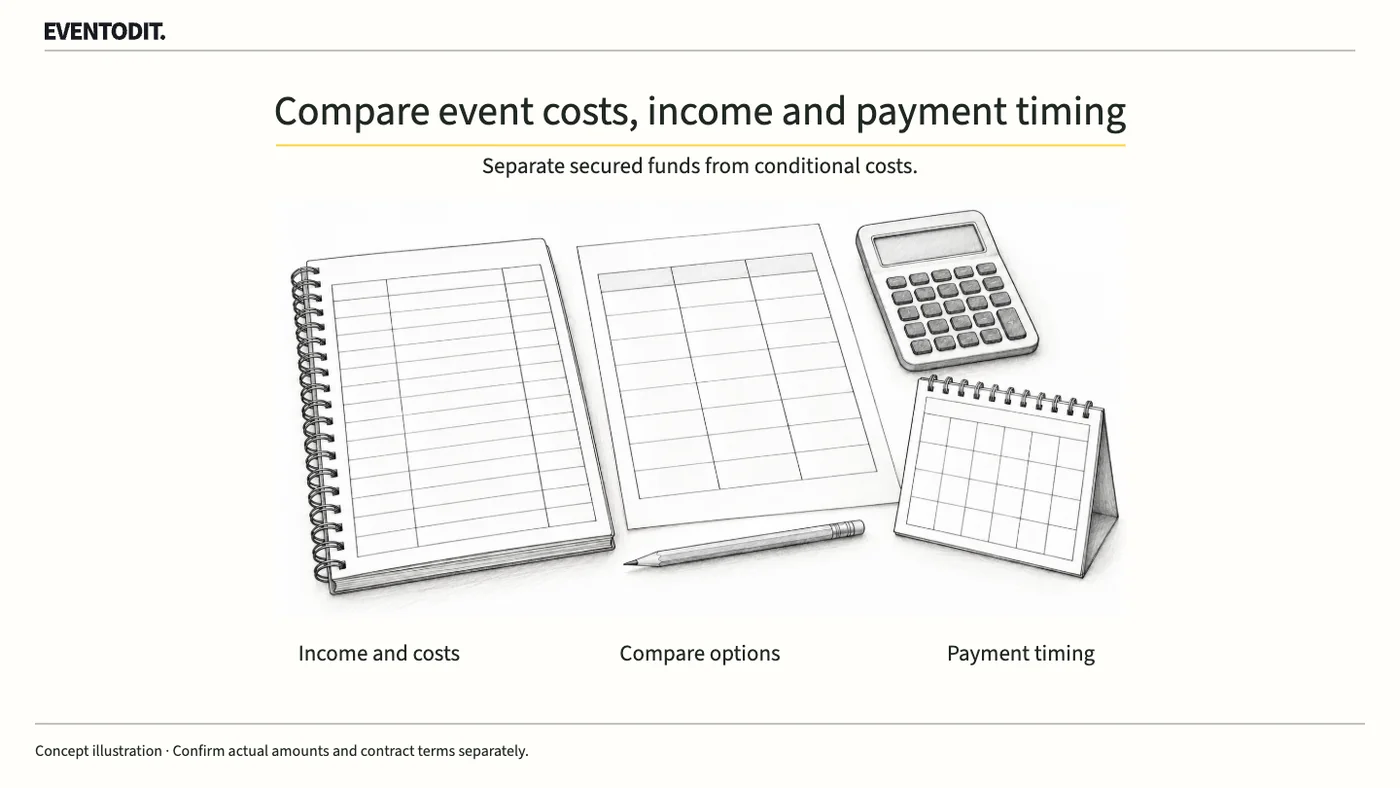
Event feasibility: consider income, costs and payment timing together
Projected income can exceed costs while cash is still unavailable when payments fall due. Separate confirmed amounts from conditional costs and compare whether each option can be delivered.
Read guide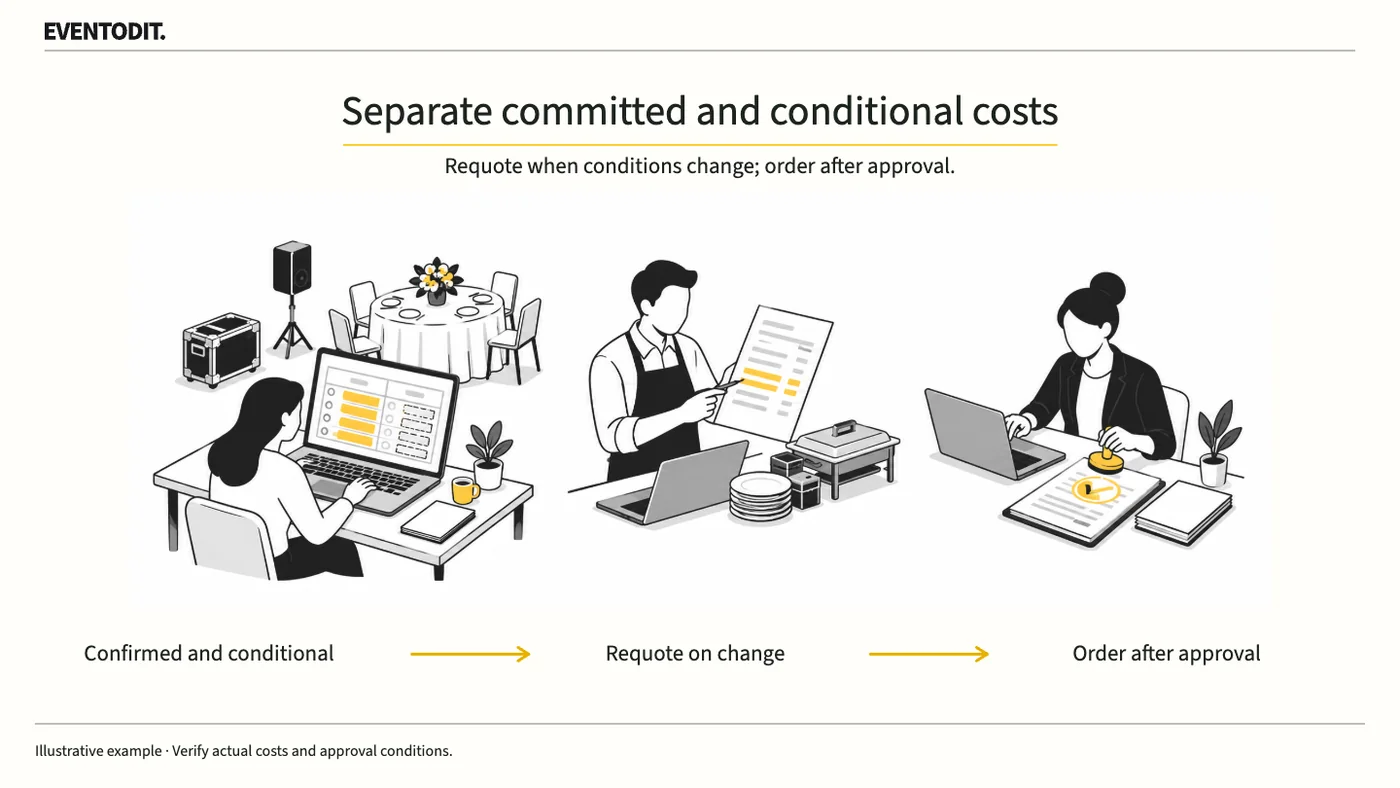
Event Budget and Conditional Cost Management
An event budget contains both committed costs and amounts that depend on decisions still to be made. Mark the difference and update the forecast whenever those conditions change.
Read guideHave a correction or additional evidence? Request a correction