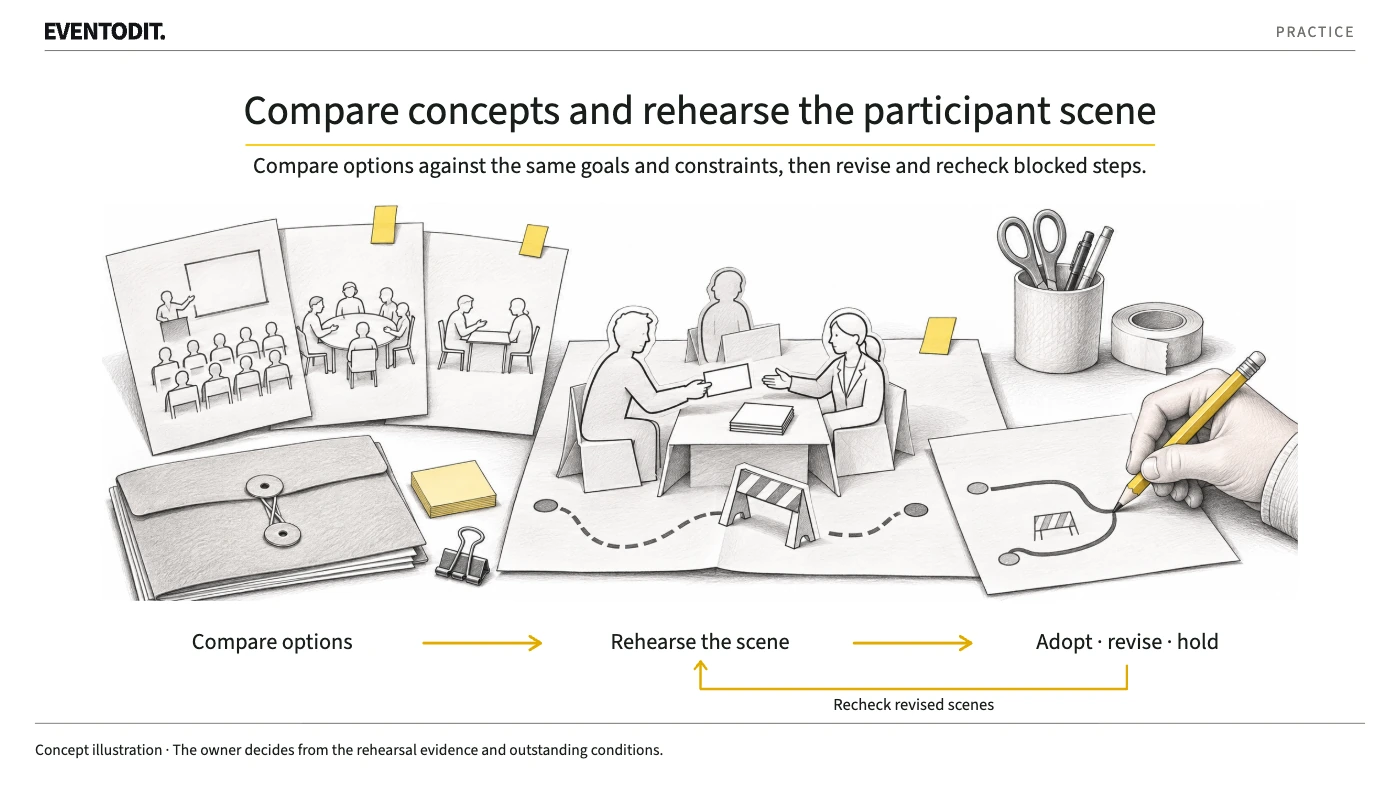
Compare proposals under the same conditions
First, bring together the purpose, participant needs and confirmed conditions, such as the venue, budget and preparation period. Mark unverified needs and resources as assumptions. Then develop two or three proposals under those same conditions, with different activities for participants.
Proposals that differ only in name and stage colour do not offer a meaningful comparison. Each should give participants a different way to receive information, try something, ask questions and decide on their next action. Record the experience each proposal provides, what it does not provide, and the facilitation, materials and support it requires. If one proposal has more staff or time, make that difference visible in the comparison too.
The table below compares proposals for a fictional forum about the conditions for applying a product.
| Candidate | What participants do | Conditions that distinguish the choice |
|---|---|---|
| A: Presentation followed by spoken questions | Listen to an explanation, then raise a hand to ask a question | People who do not want to speak publicly have no way to ask a question |
| B: Fictional case and question cards | Choose conditions from a case, ask a question and identify the response route | Readable case materials and both spoken and written question routes must be prepared |
| C: Individual company consultations | Explain their company's circumstances to a consultation counterpart | Consultation counterparts and information-handling conditions are still unverified, so this proposal is excluded from the current selection |
Scroll sideways if needed to read every column.
Explain the choice in sentences: which conditions led to it and what is being given up. A total score is less useful than that explanation. Do not use scores to conceal an unverified essential condition.
Check the most uncertain scene first
Before polishing a preferred proposal, identify the scene whose failure would undermine the promise made to participants. For a case-based question activity, the scene to check is not simply that question cards are handed out. It is whether participants can form a question using conditions they may disclose and understand where that question will go.
Design the task without giving away the answer. Asking “Do you like this format?” may produce a polite yes. Instead, request an action, such as “Choose one implementation condition from this case and ask a question about it.” The facilitator records where the participant became stuck and what help was provided. The observer records the behaviour separately from their interpretation of it.
An internal walkthrough with colleagues can help preparation, but it cannot serve as evidence that participant needs have been checked. When involving actual or prospective participants, explain the purpose and recording method first, and prepare the language and information-access arrangements they need.
Record blocked actions, not just successful explanations
Present instructions in the order participants will actually use them. Do not supply the answer when someone does not understand. If a participant finished only after the facilitator added an explanation, do not record that they completed the task using the materials alone. Doing so hides what needs to change.
Record the check date, participant role, proposal version, task, observed behaviour, required changes, and the owner and deadline for checking again. Internal role-play, checks with prospective participants and tests of actual equipment establish different things, so record them separately. Do not infer the preferences of the entire audience from a few people's reactions.
If a proposal requires participants to disclose sensitive customer information, first consider using fictional conditions that can be shared publicly or providing a separate question route. Also record the limitation that fictional materials cannot reveal every problem that may arise in real situations.
Use fictional records to distinguish revision from hold
The following fictional records concern a product application forum planned for 10 December 2026. The planned attendance of 60 is not a statement of venue capacity. Every date, role, reply and simulated result is illustrative and is not an actual research finding.
| Record | Scene checked | Fictional result | Action |
|---|---|---|---|
| D1: Internal check on 12 November, draft v1 | A participant starts a question using their own case | The wording asks for an actual customer's name | Put that wording on hold. The planner prepares v2, in which participants choose fictional conditions |
| T2: Check with a prospective participant on 13 November, draft v2 | Choosing conditions, asking spoken or written questions, and identifying the response route | The participant asked a question using fictional conditions and identified who would follow up on a question that could not be answered | Adopt this question flow for operational review. Do not generalise the result into a preference of the whole audience |
| T3: Subsequent operational check | The actual microphone and operating-cost conditions | The microphone test is incomplete; receipt of the quotation and cost approval are unverified | The technical lead and planner must reply by 17:00 on 17 November. Keep external guidance on hold until then |
Scroll sideways if needed to read every column.
The key distinction is between adopting the question flow in T2 and checking the operating conditions in T3. Even if the question flow works, guidance for the event cannot yet be confirmed if the microphone is not ready.
Version 2 lets participants choose conditions without disclosing customer information. The facilitator separates questions that can be answered immediately from those requiring follow-up. The proposal removes any promise to resolve every question on site or provide company-specific advice.
Define the scope of adoption and hold
The planner presents the comparison notes and observation records to the person responsible for the decision. Explain which participant actions the selected proposal provides and what it gives up compared with the rejected proposals. State whether adoption covers only the question flow or an operational proposal that may also be communicated externally.
Revision means identifying the wording, materials and facilitation actions to change, along with the scene that must be checked again. If the core action remains impossible, put that promise on hold and decide on an alternative or a time to reconsider it. Even when reducing the format to a presentation, check again whether the promised opportunity to ask questions is preserved.
Transfer the selected proposal to the operational form and compare it
Enter the selected proposal in the [Participant actions, format and programme operating plan](/en/templates/programme-format-design.html), one programme item per row. In the fictional example above, record a “Case-based questions” programme planned for 14:00–14:40 on 10 December and label 60 attendees as a planning figure. Do not enter A, B and C together as though all three proposals will be operated.
In the objectives and target audience fields, record the question and response route. In the selection rationale field, refer to v2, the comparison table and the check records. In the language, access support, staffing and equipment fields, distinguish Korean-language materials, question cards and spoken questions, and the incomplete microphone test. In the final field, record who must reply, the deadline and whether external guidance remains on hold.
Entering a proposal in a form does not verify the event. Check that facilitation, technical and information staff read the same content in the same way. If the materials or facilitation method change, recheck the affected scenes.
Practitioner checklist
- Does each concept state, in one sentence, what participants do at the start, during the activity and at the end?
- Do the proposals differ in participant actions, rather than only in their names and stage appearance?
- Was the most uncertain scene checked first?
- Does the check task request an action without giving away the answer?
- Are blocked actions and help provided by the facilitator recorded separately?
- Are the scope of adoption, items on hold, owners and deadlines recorded?
Conclusion
A good concept is one that shows what participants will do in a concrete scene. Compare proposals under the same conditions, check the most uncertain scene on a small scale, and hand over a clear distinction between what works and what cannot yet be promised.
*Reference note: This article is an edited revision based on the editorial team's original structure and procedures. Consult the original Design Council, GOV.UK and Korea Tourism Organization materials for their detailed guidance. All forum dates, attendance figures, replies and check results are fictional examples.*
Conditions for applying this elsewhere
Use after purpose, audience needs and scope are established. Distinguish internal role-play from checks with actual or likely participants and technical or safety acceptance. Verify capacity and resource allocation separately.
Information not established
An editorial event method informed by UK design and digital-service guidance. No event effectiveness or whole-audience preference has been verified. Every document, reply, date, role and walkthrough result in the 60-person product-application forum is fictional, not verified capacity or a recommended standard. KTO guidance concerns ESG in 2022. The reused form records programme conditions; no dedicated observation template or new completed-example download is provided.
Reference material
- Design Council · The Double Diamond — develop alternatives, test at small scale and improve (publication date not shown; checked 3 Nov 2026)
- GOV.UK Service Manual · Making prototypes — purpose and appropriate prototype level (published 18 Oct 2016; checked 3 Nov 2026)
- GOV.UK Service Manual · Using moderated usability testing — neutral tasks, observation and dummy-data limitations (published 21 Feb 2017; updated 3 Oct 2017; checked 3 Nov 2026)
- Korea Tourism Organization · ESG Operating Guide for Sustainable Development of the MICE Industry 2022 — ESG programme planning (published Jun 2022; printed p.66/PDF p.62; relevant pages read 3 Nov 2026)
After reading, complete the next task
Concept comparison, version-specific tasks, observations and revisions, selected programme conditions, holds, owners and deadlines
Related templates
Participant actions, format and programme operating plan
A design record connecting participant actions, operating conditions and unresolved ownership
Use this for: Use when turning objectives into a programme and checking deliverability with teams.
Instructions, examples & downloadsRelated practical guides
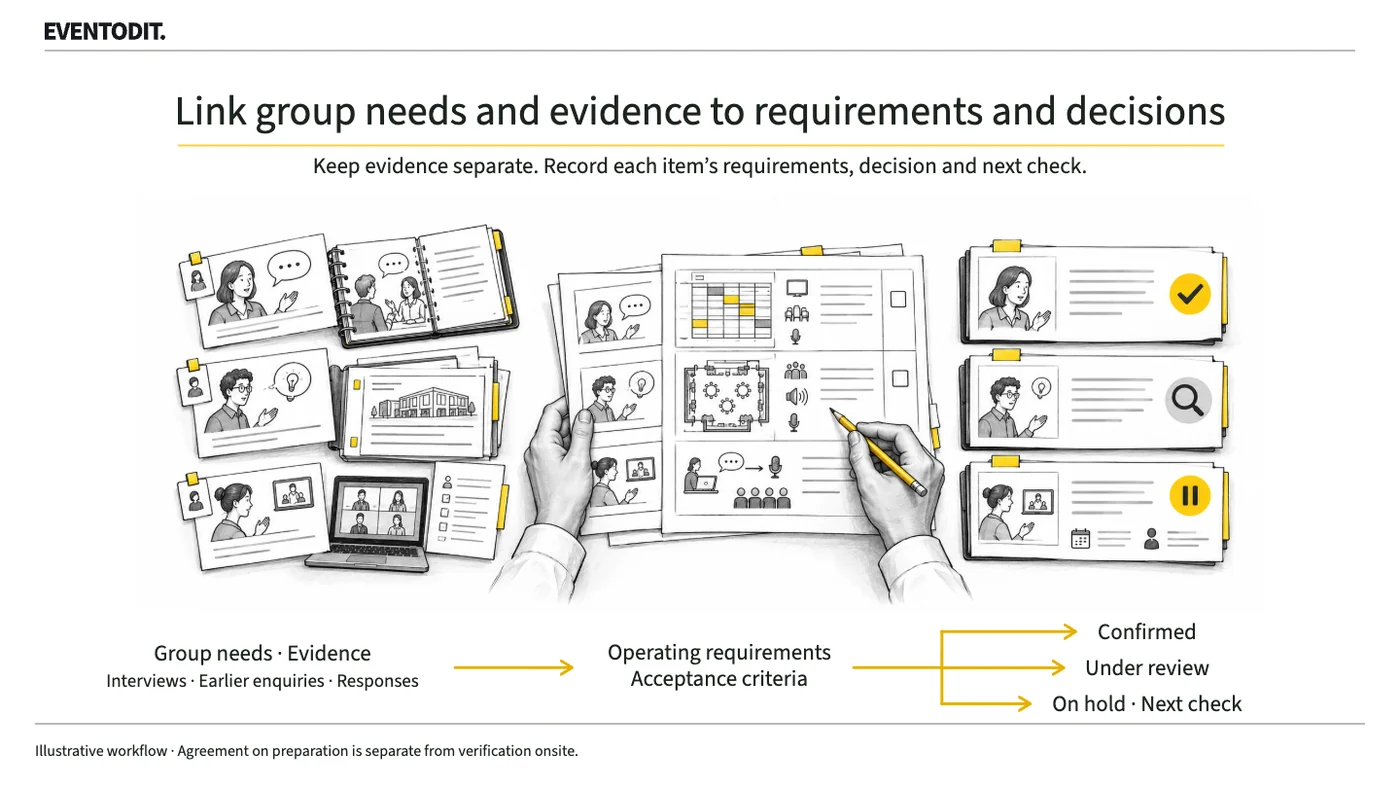
Evidence for each group turns participant needs into operating conditions
Turn participants’ requests into conditions that programme, space, technical and information teams can prepare and check.
Read guide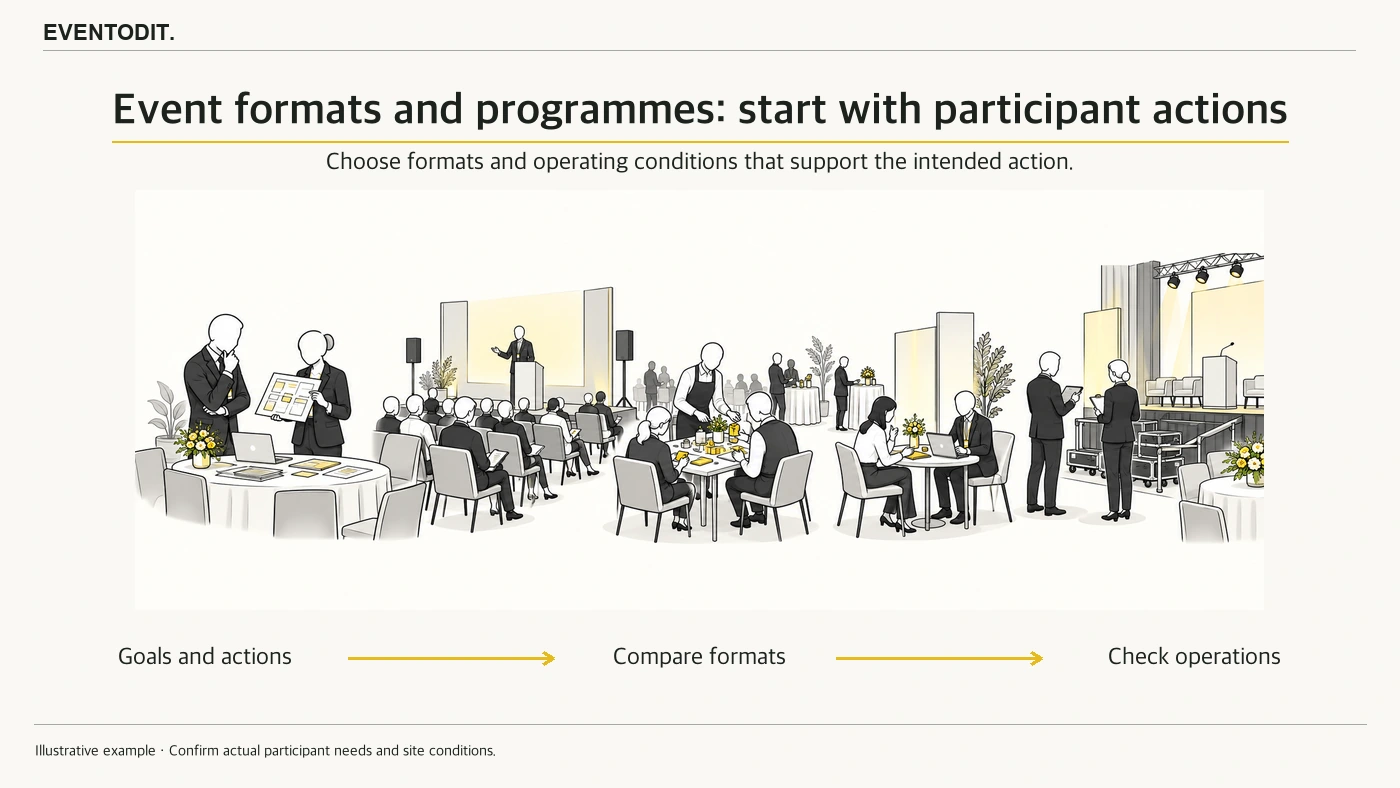
Choose the event format and programme around participant actions
Do not combine talks, activities, meetings and online or in-person participation by habit. Start with the objective and participant actions, then compare space, staffing and costs.
Read guideHave a correction or additional evidence? Request a correction