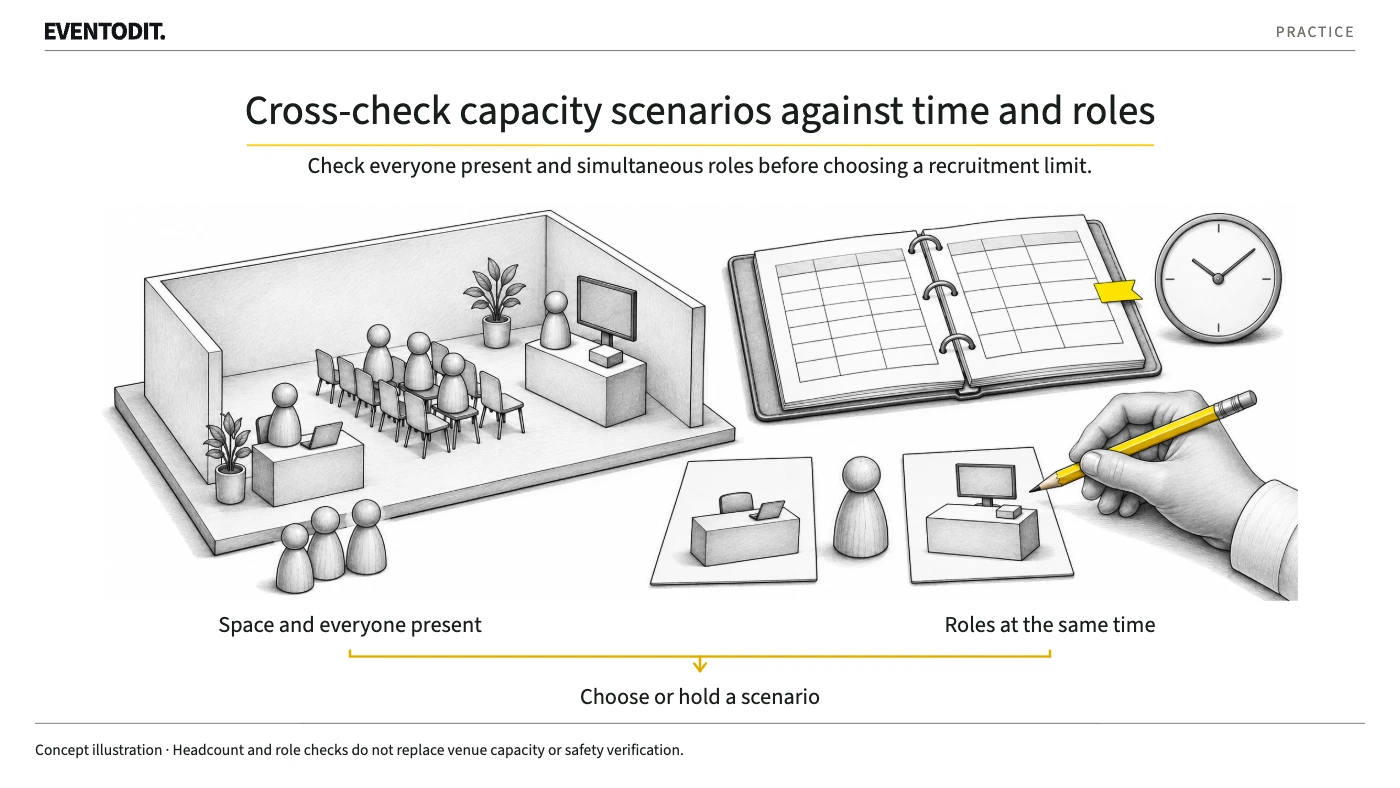
Start with the busiest period
When comparing attendance options, first identify the period with the greatest occupancy or the most overlapping work, rather than looking at the whole day. Record who will be in the space during that period. Include participants, speakers, employees and contractors, and establish whether the information desk is inside or outside the hall.
Cumulative registrations and daily visitor totals are not occupancy figures. The same person may enter more than once, and people attending at different times are added together. A venue's published capacity also varies by layout, so confirm the actual layout and conditions of use with the venue contact.
Rewrite the operating arrangements when scale changes
Increasing participant numbers may change how the programme is delivered. Small-group exercises need more groups, and therefore more facilitators, materials and equipment. Changing only the total attendance while copying the existing staffing figure leaves delivery conditions unresolved.
Distinguish two figures. Required staffing is the number of roles needed to operate the activity. The number of distinct people actually assigned is how many individuals will fill those roles. Eight roles do not mean eight people have been secured. Conversely, one person holding two roles is not automatically a problem. Check whether both roles need continuous coverage at the same time and whether they require movement between different locations.
Record staff not yet secured as “included in the required operating arrangement; assignment unconfirmed”. Do not remove missing staff from the calculation to make it appear that the occupancy condition has been met.
Match the timetable to individual assignments
The operations lead links each role's start time, end time, location and assignee to the timetable. Mark periods when someone must remain in position, from preparation until release. Then check whether the same person is assigned to two places at the same time.
Having someone's contact details is different from confirming their availability for that role at that time. When assignments overlap, check with the responsible lead whether they can actually be combined. Before transferring a role to someone else, check that their existing work will remain covered and that they have the required skills and time to move between locations.
Fictional example: moving the 60-participant option from hold to adoption
The following association practitioner forum is fictional and is provided for explanation. It takes place on 18 December, and all times are Korea time. From 14:00 to 14:40, participants discuss application questions in groups, with one facilitator for every ten people. This is a design assumption for this fictional activity, not a recommended staffing ratio. The hall occupancy condition of 90 is also hypothetical and is not an approved figure for an actual venue.
| Attendance option and review time | Total planned occupancy | Conditions checked and decision |
|---|---|---|
| 60 participants, 26 Nov at 10:00 | 60 participants + 2 speakers + 8 required staff = 70 people | Eight staff are needed, but only seven distinct people are assigned. One person is assigned to facilitation and roving support at the same time. Hold confirmation of recruitment |
| 80 participants, 26 Nov at 10:00 | 80 participants + 2 speakers + 10 required staff = 92 people | Exceeds the hypothetical condition of 90, and only six facilitators are confirmed. Keep the expansion option on hold |
| 60 participants, 26 Nov at 16:00 | 60 participants + 2 speakers + 8 required staff = 70 people | A separate roving support person was confirmed at 15:00, resolving the role overlap. After comparing the venue and operations replies, adopt recruitment for 60 participants |
Scroll sideways if needed to read every column.
The 60-participant option moves from hold to adoption because people have actually been assigned to the required roles and the time conflict has been resolved, not because attendance has been reduced. The 80-participant option remains on hold because it exceeds the space condition and lacks facilitators.
Here, 70 is a planning figure for the required operating arrangement. It is not a measurement of actual occupancy when only seven staff are assigned. At 16:15, the planner sends the recruitment lead the limit of 60 participants and its conditions. The recruitment lead checks that speakers and staff have not been mixed into participant capacity and that the hypothetical figure of 90 is not displayed, then records receipt at 16:30.
Check again when staffing changes
If someone becomes unavailable, assignments overlap or the layout changes, report the attendance option in use and the changed conditions to the operations lead. Until replacement staffing and handover are confirmed, put preparation for the affected activity and further recruitment on hold. Review the necessary information and alternatives for participants whose places are already confirmed.
Do not automatically calculate that 50 participants can be accommodated because one facilitator has dropped out. First establish which activity is affected and whether it can be delivered in another way.
On site, follow the observation, communication and stop procedures agreed in advance. Do not delay necessary protective action to complete a record. This guide describes how to cross-check scale before recruitment; it does not replace on-site observation or specialist safety review.
Practitioner checklist
- Has the busiest period been identified, together with everyone who will occupy the space then?
- Does each attendance option include a total occupancy plan covering participants, speakers and staff?
- Are required staffing and the number of distinct people actually assigned recorded separately?
- Is the same person assigned to multiple roles at the same time?
- Are staff not yet secured still marked “assignment unconfirmed”?
- Has the recruitment screen been checked to ensure speakers, staff and hypothetical space conditions are not presented as participant capacity?
- After a change, are the applicable version and confirmation of receipt recorded?
Conclusion
A scale review does not end with deciding how many participants to recruit. Check together whether the full group fits the space, whether the required roles have people assigned to them and whether anyone is expected to be in two places at once. Complete the review by carrying the adopted recruitment limit and the expansion option on hold into the timetable, assignment records and recruitment information under the same conditions.
*Reference note: This article is an accessible revision based on the editorial team's original structure and procedures. Consult the original COEX Magok facility information and UK HSE materials for their detailed figures and guidance. All forum dates, attendance figures, replies and assignment results are illustrative fictional examples.*
Conditions for applying this elsewhere
Use after defining the event purpose and participant activity, before confirming recruitment scale or changing attendance, timing or layout. Obtain responsible-party confirmation of actual venue, safety and access conditions.
Information not established
The method is an editorial proposal. The fictional 18 December forum’s 60/80 attendees, totals of 70/92, L2 condition of 90, one facilitator per ten attendees, dates and replies are explanatory assumptions. They are not actual venue capacity, recommended staffing ratios, approvals or onsite results. Overseas guidance is not Korean law.
Reference material
- COEX Magok Convention Center · 5F meeting rooms — facility information by layout (checked 3 Nov 2026)
- UK HSE · Set clear roles and responsibilities — roles and communication (updated 4 Apr 2025; checked 3 Nov 2026)
- UK HSE · Managing an event — phased coordination, competence and review (updated 12 Oct 2024; checked 3 Nov 2026)
After reading, complete the next task
Option-specific staffing and individual timing checks, layout conditions and replies, selection/hold decisions, and recruitment information and receipt records
Related templates
Attendance measures, scale scenarios and venue conditions
A scale review that distinguishes demand assumptions from actual layout restrictions
Use this for: Use before confirming recruitment scale and after changes to space, sessions or layout.
Instructions, examples & downloadsRelated practical guides
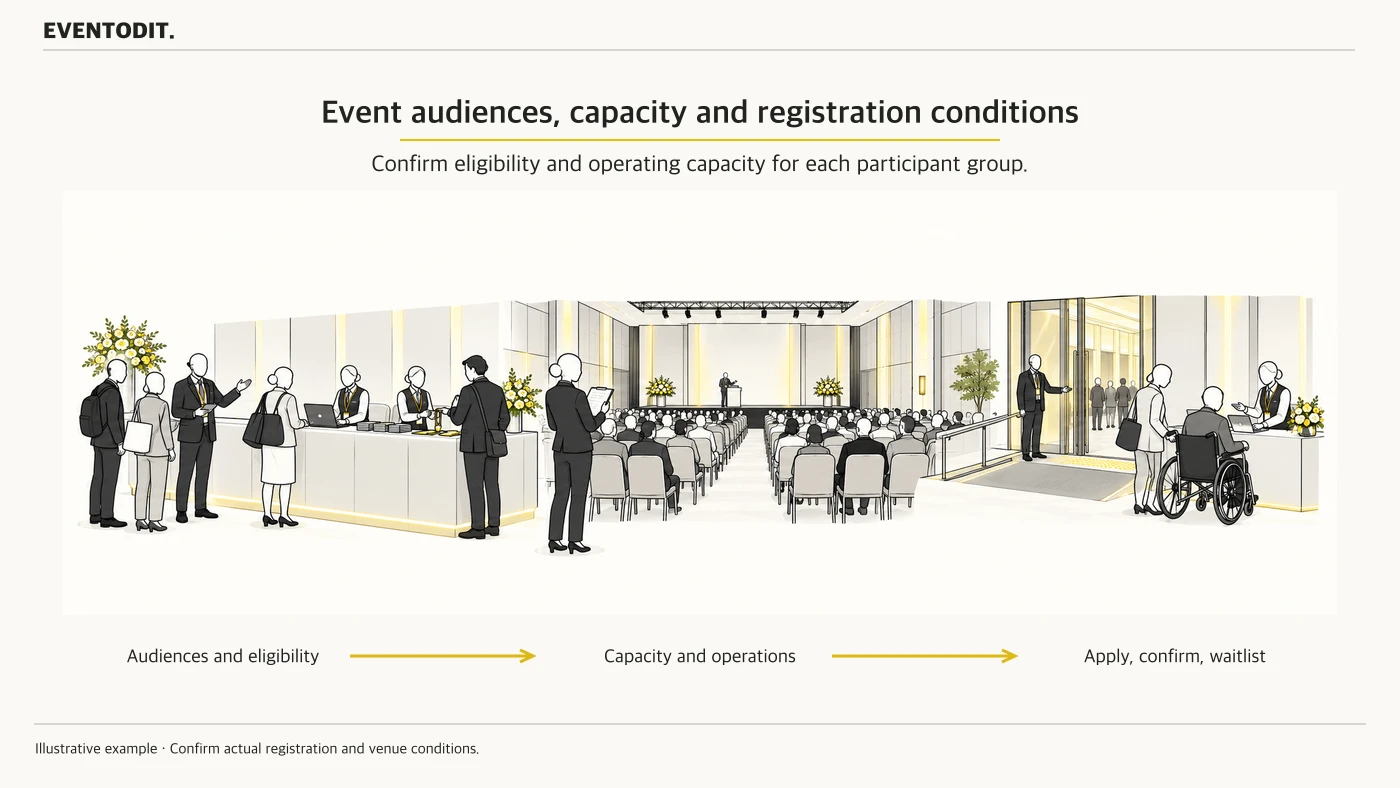
Event audiences, capacity and recruitment conditions
General attendees, buyers, speakers and exhibitors attend for different reasons and need different support. Set eligibility and registration routes for each group, then check workable capacity, waiting-list and accessibility arrangements.
Read guide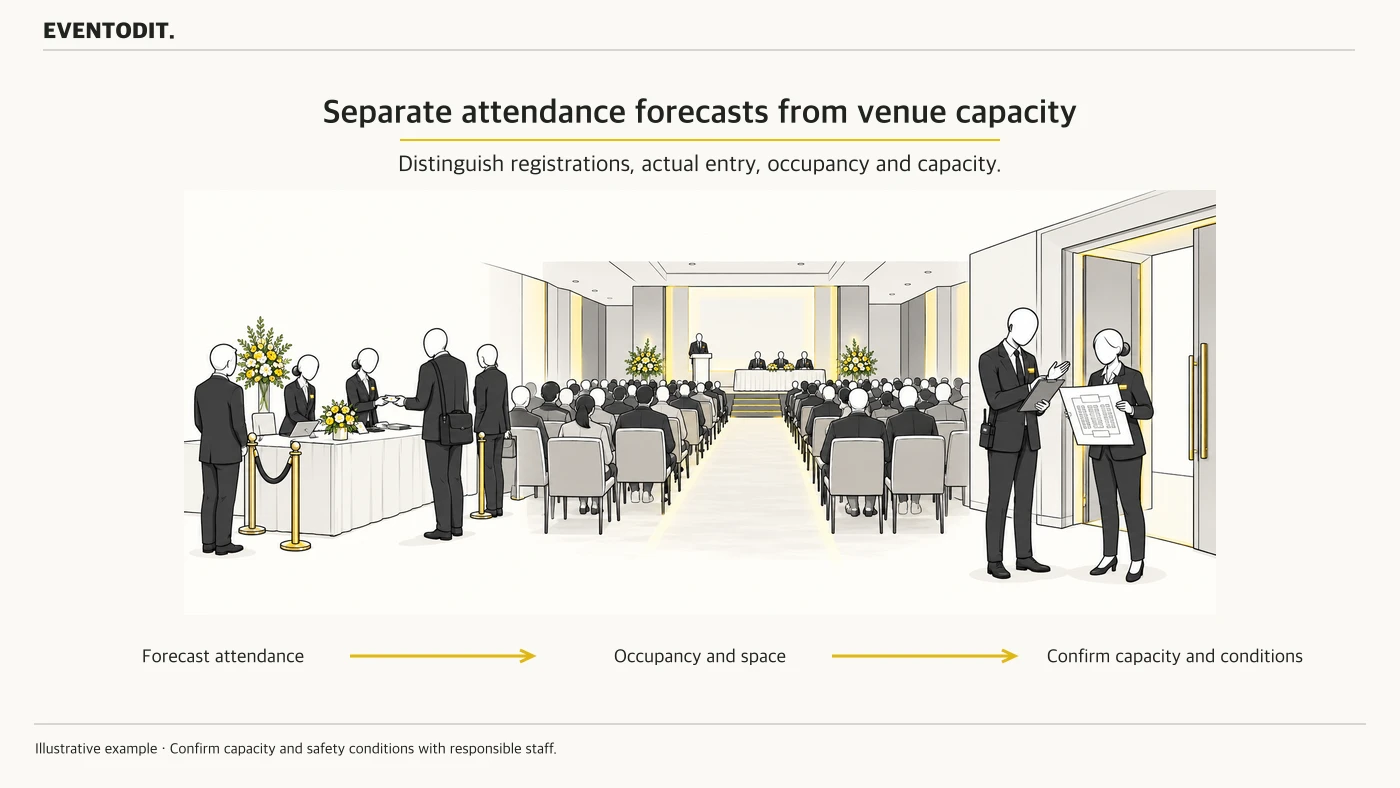
Separate attendance forecasts from venue conditions when planning event scale
Registrations, people present on site and venue capacity figures for different layouts are not the same measure. Compare evidence-based scenarios and confirm the actual operating conditions.
Read guideHave a correction or additional evidence? Request a correction