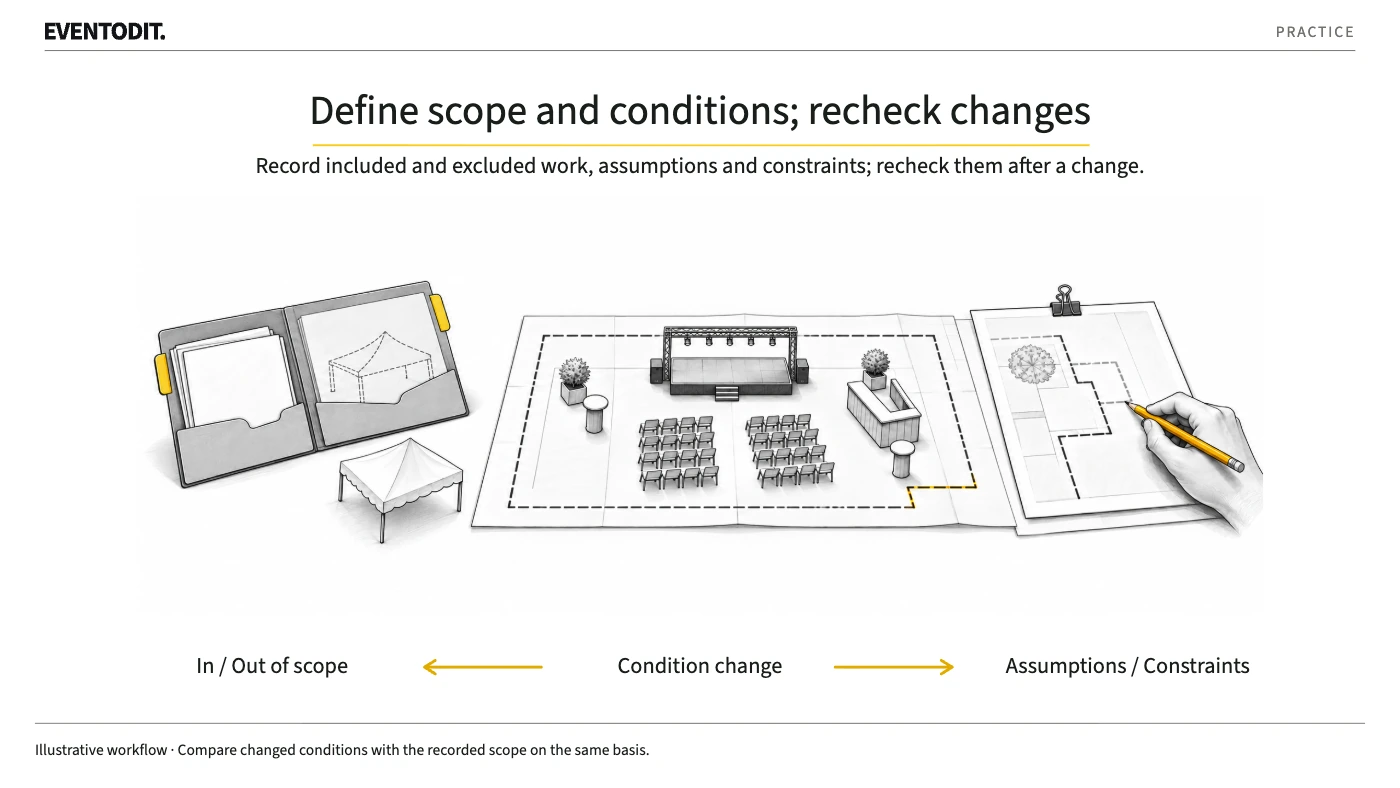
Gather the proposed work and establish the reference documents
The planner brings together the purpose, participant needs, latest programme, venue conditions, proposed work and quotations, and replies to requests. Record the date and version of each document. If documents disagree, do not choose whichever is convenient as the reference. Check which is current, then record the differences.
Follow one programme activity from the source of its preparation materials, through the person processing them, to the state in which they pass to the next person. This reveals missing work. For example, if a quotation says only “registration operations” but the programme allows additional on-site registration, record a question about who will handle it. One owner does not have to do everything. However, work between two owners must not be left unassigned.
Use one row for one task or deliverable
Broad terms such as “all event operations” hide different boundaries. Use one row for one task or deliverable. Work may share a row when its subject, location, starting conditions, period and completion criteria are the same. Split the rows when the owner or handover point differs.
For presentation materials, decide whether responsibility ends when files are received or extends to handing over an aligned list and version of the PDFs to be shared with participants. Also specify the recipients, delivery channel, deadline and what the receiving owner will compare. A single line saying “production complete” does not identify how far the responsibility extends.
Recording only the public event hours is insufficient. Check which stages the task spans: preparation, load-in, live operations, breakdown and post-event delivery. UK HSE guidance also treats event scale, audience, venue and duration as planning conditions and addresses load-in and build-up separately from breakdown and load-out. Confirm local working hours and site conditions separately with the venue and the relevant work owner.
Record scope decisions and agreement status in separate fields
Record the scope decision as included, excluded or undecided. Record agreement status separately as agreed, under review or on hold. A proposal to include something is not an agreement if the owner has not replied with the conditions for providing it. Conversely, work may not yet have begun even after agreement. Agreement status must not be read as on-site completion status.
Separate assumptions from confirmed constraints too. An assumption is a temporary premise used for planning. If the assumption is that no people will be added after the roster closes, name who will confirm it and by when. A confirmed constraint is a limit supported by evidence, such as the permitted hours in a venue reply. Record the confirmation date and supporting document. An unanswered item is unconfirmed, not “no constraints”.
Excluded work still leaves related responsibilities
Excluding a task does not make it disappear. If accommodation booking is excluded, participants need to be told to arrange it themselves, and someone must provide the venue address and travel information. Do not state that another party will take over excluded work without their reply.
Check whether an exclusion leaves a gap in the participant journey. If someone requests accommodation support, do not close the matter simply because it is excluded. Have the relevant owner review and record the information and alternatives that can be provided. A reply saying there is no budget is different from a record showing that the participant's need was considered. The Korea Tourism Organization's 2022 ESG operating guide also proposes checking whether travel, facility use or access to information prevents participation. Applicable safety, accessibility and personal-information requirements do not disappear because a scope register marks something excluded. Confirm them separately with the responsible owner.
Use a fictional forum to distinguish agreement from hold
The following corporate forum is fictional and is provided for explanation. It is scheduled for 10 December 2026. The planned attendance of 240 is not venue capacity. Every reply and status is fictional, and the review point is 24 November at 16:00 Korea time.
| Task | Scope decision and agreement status | Defined boundary and outstanding checks | Next owner and deadline |
|---|---|---|---|
| S-01 On-site registration and entry verification | Included; agreed | Venue reply permits use of the lobby only from 10:00 to 11:00. Name corrections are allowed; changes to the total headcount are excluded. Do not start printing before receiving the final roster | Registration lead: roster closes on 9 December at 16:00. Operations lead: takes over unresolved enquiries after entry processing |
| S-02 Accommodation booking and payment service | Excluded; agreed | A reply confirms that no budget is available for the service. The information lead provides the venue address, travel guidance and enquiry handling | Information lead: draft the notice on 26 November. Send it on 27 November after the planner reviews it and receipt is confirmed |
| S-03 Bundle of presentation PDFs for participants | Undecided; on hold | File list, permission to share and delivery channel for the additional request remain unconfirmed. Delivery on 15 December at 18:00 is a proposal, not an agreed commitment | Presentation-materials lead: reply by 27 November. Hold the start of production and distribution until the reply |
Scroll sideways if needed to read every column.
S-01 has an agreed scope, but the on-site work has not actually finished. It is a plan to perform that work after the roster closes. Printing must not begin if the final roster has not been received. Record the point at which operations takes over enquiries left after entry processing, so that they are not abandoned when the registration desk closes.
S-02 excludes only the booking and payment service. The notice has not yet been reviewed, so it is sent after the planner reviews it and receipt is confirmed. S-03 is not a promised delivery simply because someone requested it. When the presentation-materials lead replies, the production owner compares the file list, intended recipients, channel and deadline before reaching a new agreement.
Review connected work when conditions change
When agreeing scope, distinguish permitted corrections from changes that require a new review. In the example above, name corrections are allowed only while the total headcount remains the same. A request to increase attendance from 240 to 270 is not a correction. Registration checks the impact on the roster, registration method and staffing; operations checks the venue, timing and participant information. Whether the increased number can be accommodated requires a separate review.
The person receiving the request records the existing conditions, new request, affected tasks and unanswered questions together. Continue unaffected preparation within the agreed conditions, and hold only the work that needs review. Align not only the scope register but also the proposed work, quotation, schedule and participant information that are actually affected.
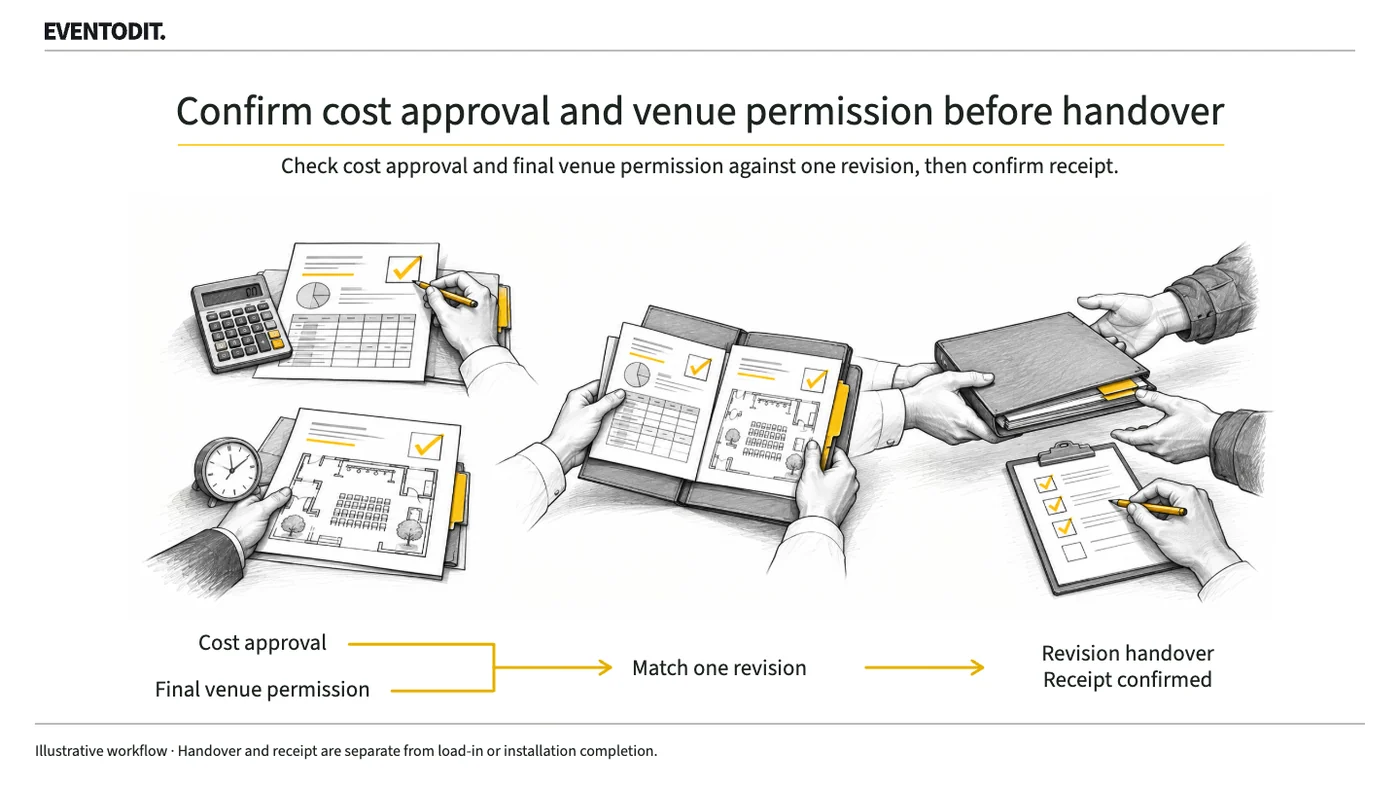
Treat handover as accepted after the recipient cross-checks it
The writer traces the programme and proposed work back to the scope register to find missing tasks. Conversely, compare included work with its supporting documents and check that no unrequested promises have appeared. Every row needs the conditions under which the next owner can begin preparation and the state they will accept at handover.
The receiving owner compares their starting conditions, the handover state and outstanding holds, then records receipt. An email transmission record alone must not be marked as completed acceptance.
Practitioner checklist
- Are included, excluded and undecided recorded separately from agreed, under review and on hold?
- Does each task specify its subject, location, period and the state that marks completion?
- Are both the delivery owner and receiving owner identified?
- Does every excluded task have an owner for related information and enquiries?
- Are assumptions and confirmed constraints recorded with evidence and confirmation dates?
- Does every unconfirmed item identify the next action, owner, deadline and work to hold in the meantime?
- Are the documents and conditions to recheck after a change identified?
Conclusion
Defining scope does not end with choosing which work to take on. It must also establish where the work starts, the state in which it ends and who will review changed conditions. The next owner must receive and compare the applicable version, with assumptions, constraints and unconfirmed items distinguished, so that the team shares the same understanding of assigned work and promises not yet made.
*Reference note: This article is an accessible revision based on the editorial team's original structure and procedures. Consult the original GovS 002, HSE guidance and Korea Tourism Organization ESG guide for their detailed provisions. The dates, replies and statuses in the 240-person forum are fictional examples provided for explanation.*
Conditions for applying this elsewhere
Use after purpose and audience needs are established, when dividing detailed work across briefs, quotations and schedules. Distinguish scope agreement from actual performance, delivery and safety acceptance.
Information not established
The procedure and working categories are editorial proposals informed by official principles. Every record, reply, date and status in the 240-person corporate forum is fictional, not an actual event, contract or result. The 240 is a planning figure, not venue capacity. Foreign standards and the 2022 document’s legal discussion are not applied to determine current Korean obligations; actual contractual, safety, accessibility, privacy and rights conditions require separate checks.
Reference material
- Government Project Delivery · GovS 002 v2.1 — outputs, assumptions, constraints, changes and unfinished-work handover (published 1 Sep 2025; modified 29 Mar 2026; checked 2 Nov 2026)
- HSE · Getting started — event scale, scope, audience, location, duration and planning (updated 11 Oct 2024; checked 2 Nov 2026)
- HSE · Managing an event — build-up, load-in, breakdown and load-out (updated 12 Oct 2024; checked 2 Nov 2026)
- Korea Tourism Organization · ESG Operating Guide for Sustainable Development of the MICE Industry 2022 — movement, facility use and information access (published Jun 2022; printed p.89/PDF p.85; checked 2 Nov 2026)
After reading, complete the next task
Work and deliverable boundaries, agreement states, evidence for assumptions and constraints, open-item owners and deadlines, permitted changes, applicable versions and receipt records
This article’s template
Event work scope, assumptions and constraints register
A scope baseline linking each inclusion decision, agreement state and condition requiring another check
Instructions, examples & downloadsRelated practical guides
Decisions can be acted on when authority and replies align
Record one request from stakeholder identification through multiple-decision checks, holds, clarification and receipt of the revised plan.
Read guide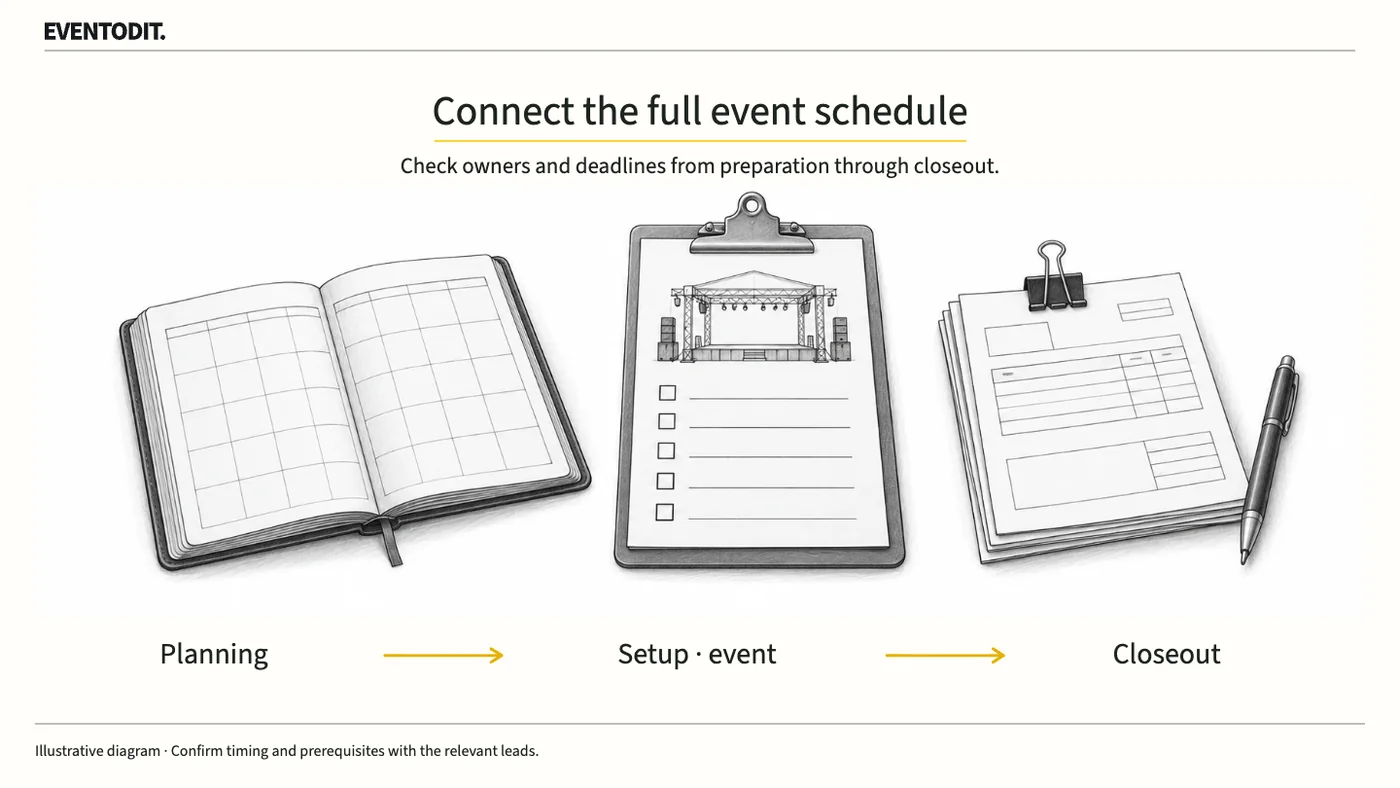
Build an event master schedule from preparation to closeout
Build an event master schedule covering preparation, setup, live operations and closeout. Record task owners, prerequisites and reply deadlines, using the fictional example and schedule log.
Read guideHave a correction or additional evidence? Request a correction