First confirm the budget baseline and who controls contingency funds
The budget coordinator gathers the approved baseline budget, current orders and contracts, actual payment records, the latest cost forecast, and records of contingency allocations. Record the version and reference time of each document, and give each change a reference number.
First check whether the contingency is included within the overall approved limit or is separately approved funding. Without this distinction, the same money could be used twice. Organisations place contingency funds and approval authority in different parts of their budgets. Do not apply a standard percentage across the board or assume that any remaining money is immediately available to spend.
Production and operations staff check whether the revised conditions are workable. Procurement staff check the differences between quotations and contracts. The budget owner decides whether to accept the change and how much contingency may be used. Even when one person holds several roles, record the role under which each check or decision was made.
Check why a quotation changed before comparing its total
Separate a price increase from a change in quantity, time, or venue conditions, or work that was omitted from the original quotation and identified later. Also distinguish changes that have already been confirmed from risks that have not yet occurred. For example, a confirmed change to the move-out time needs to be addressed now. The possibility that another vehicle may be needed is a conditional forecast.
Compare the same work before and after the change. Record costs that disappear, costs that remain, and new costs separately. Adding a new package price that includes labour directly on top of the existing order may count the same cost twice. Conversely, removing equipment does not remove production costs already incurred or cancellation charges. Do not deduct those costs as well. Record unsupported amounts as unconfirmed rather than zero.
The change note records the cause, supporting documents, affected work, quotation expiry, and decision time. Receiving a quotation and authorising an order are different events, so keep separate records.
Compare each alternative's price and conditions for going ahead
Do not compare alternatives on additional cost alone. Also check what must be in place for each option to work and when that must be confirmed. If a cheaper option depends on venue consent or essential support, keep it on hold until those conditions are confirmed.
The following is a fictional corporate forum example created for explanation. All dates, amounts, replies, and decisions are assumptions, not actual prices or tax rules. All amounts are assumed to be total amounts payable, including tax.
| Alternative | Additional total amount payable | Checks required before proceeding |
|---|---|---|
| A: Move everything out the same day with additional staff and transport | KRW 1,500,000 | Confirm provision of the same scope of work, staff, and transport. Quotation expires at 12:00 on 26 January. |
| B: Store some items and collect them the next day | KRW 900,000 | Obtain venue consent for storage. Confirmation deadline: 15:00 on 25 January. |
Scroll sideways if needed to read every column.
If venue consent has not arrived by 15:00 on 25 January, keep option B on hold. A lower price does not permit you to leave items at the venue. An option made cheaper by removing essential safety support is also not an alternative covering the same scope.
Allocate contingency funds for a defined purpose and up to a stated limit
The existence of contingency funds does not mean the changed work has been approved. An approval request includes the evidence for the change, comparison of alternatives, reasons for the choice, contingency amount to be used, amount remaining after allocation, and remaining risks. If the request adds a new feature or expands the event's scope, check again whether it fits the original purpose of the contingency.
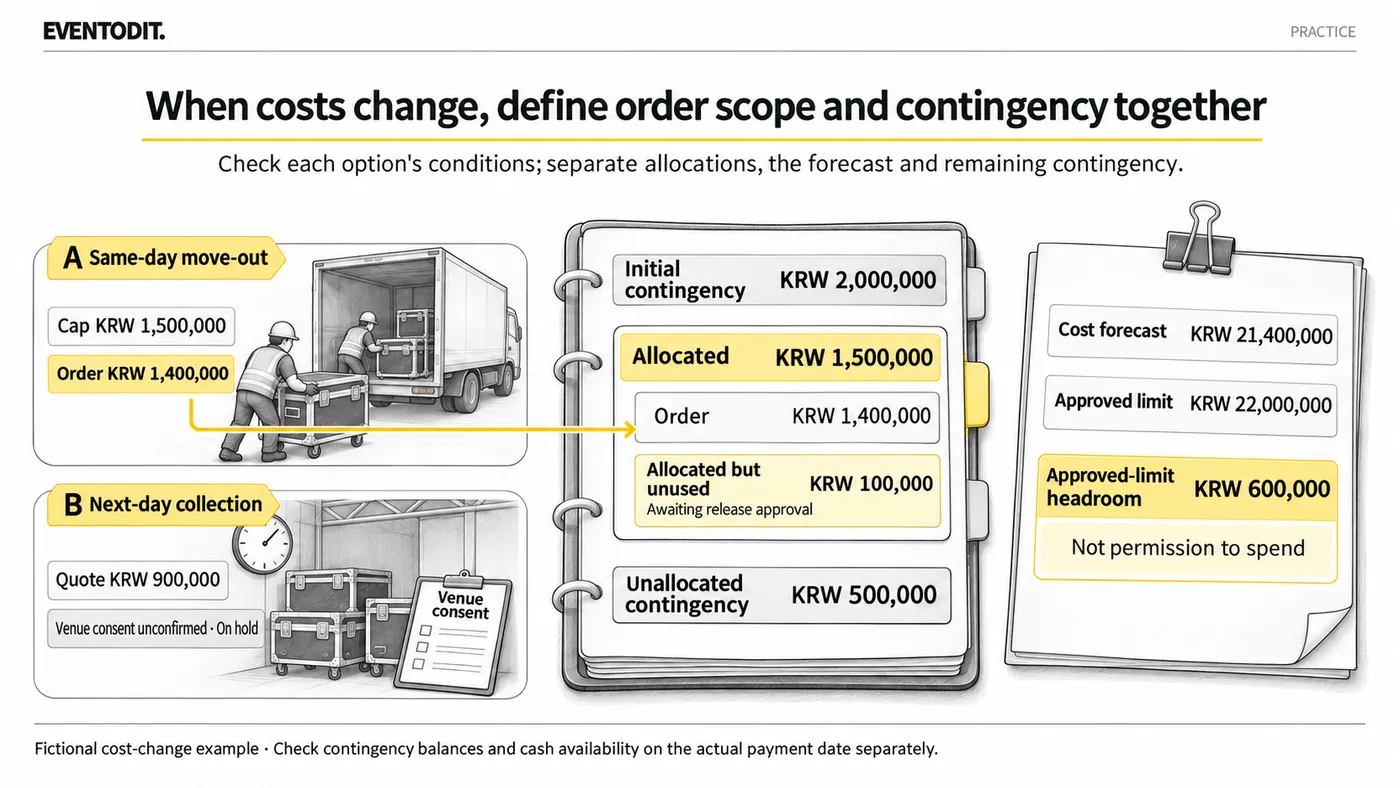
In the fictional example, assume that at 10:00 on 26 January the budget owner allocates up to KRW 1,500,000 to the same scope of work under option A. The approval permits an order only if the scope, resources, and schedule remain unchanged and the operational review is passed within that limit. If the amount exceeds the limit or the scope or quotation conditions change, the procurement coordinator stops the order and requests a new decision.
These conditions are assumptions used in the fictional example. GovS 008, the UK government's commercial standard, requires supporting grounds, prior approval, and records for contract changes. Follow your own organisation's rules and contract terms for the procedures required for domestic contracts and contingency use.
Update the current cost forecast and remaining contingency separately
Assume that the final quotation is KRW 1,400,000 and the additional order is placed at 11:30 on 26 January. Do not enter both the KRW 1,500,000 estimate and the KRW 1,400,000 order in current costs. Retain the earlier quotation and decision as records, but use only the new amount in the current figures.
| Position at 14:00 on 26 January | Amount | How to read it |
|---|---|---|
| Cost forecast including existing work and the additional order | KRW 21,400,000 | Existing KRW 20,000,000 + additional KRW 1,400,000 |
| Difference between the overall approved limit and the cost forecast | KRW 600,000 | KRW 22,000,000 − KRW 21,400,000. This does not authorise contingency use. |
| Unallocated contingency | KRW 500,000 | Original KRW 2,000,000 − allocated KRW 1,500,000 |
| Allocated but unused amount | KRW 100,000 | Not available for new contingency use until its return is approved |
Scroll sideways if needed to read every column.
Assuming a separate approval is required to return an allocation, ask the budget owner to decide by 10:00 on 27 January whether to return it. Until then, do not change unallocated contingency to KRW 600,000.
Include amounts already paid and amounts still to be paid once each in the cost forecast. In this example, KRW 6,000,000 already paid plus KRW 15,400,000 still to be paid totals KRW 21,400,000. Even if the contingency balance is correct, check separately whether cash will be available on each payment date.
Request a new decision when replies are late or conditions change
For each alternative, record who must confirm what, the reply deadline, and what happens if that deadline passes. If option A's quotation expires or the final additional amount exceeds the approved limit of KRW 1,500,000, keep work that has not yet been ordered on hold. Obtain a new quotation and review it again. If any work has already been ordered, first check the remaining obligations and the terms for changes or cancellation. Do not switch automatically to unconfirmed option B.
If an urgent on-site hazard arises, do not continue dangerous work while waiting for a budget reply. First follow the site's stop-work and reporting procedures. Keep separate approval and settlement records afterwards for the cost of emergency action.
Practitioner checklist
- Does each change record its cause, supporting documents, and affected work?
- Is each additional amount identified as a current order or a conditional forecast?
- Have the same costs been kept from appearing in both the baseline budget and the additional amount?
- Does each alternative list the checks required before proceeding and the reply deadline?
- Are original contingency, allocations, unallocated balance, and return approval status recorded separately?
- Are quotation expiry and decision time recorded?
- Have procurement and operations staff checked the same version and the scope of work on hold?
Conclusion
When costs change, do more than enter the additional amount. Decide together which alternatives can proceed and under what conditions contingency funds may be used. Update allocations, the current cost forecast, and contingency still available as separate figures, and record when a new decision is needed if conditions no longer match. This review ends when the next person understands the same scope of what may be ordered and what must wait.
Conditions for applying this elsewhere
An editorial procedure for changed costs or delivery conditions after baseline approval. Dates, roles, quotations, gross amounts including tax, replies and decisions in the fictional forum are illustrative, not actual rates or operating results. UK government standards are not applied as Korean requirements.
Information not established
Check actual organisational and contractual rules for contingency purposes, allocation/release authority, contract changes/cancellation, emergency actions and payment availability. The form does not automatically determine contingency availability, approval, release or switching. No new separate completed-example file is offered.
Reference material
- APM · Cost planning and control: actual and forecast costs against an agreed budget · publication date not displayed · directly checked 5 Nov 2026
- APM · Change control: capturing, evaluating and deciding changes to an approved baseline · publication date not displayed · directly checked 5 Nov 2026
- APM · Risk management: causes, events, effects and response ownership · publication date not displayed · directly checked 5 Nov 2026
- UK Government · GovS 008 Commercial v2.2 · updated 14 May 2026 · §§1.2 and 5.4.5–5.4.6 · checked 5 Nov 2026
After reading, complete the next task
Change evidence and option notes, allocation/release approval records, current cost table, order/hold and handover records
Related templates
Confirmed and Potential Additional Costs
A budget showing confirmed costs, possible additions and decision deadlines.
Use this for: Start with the initial budget and update it when new requests, orders or approved changes arise. Keep previous entries as history for the same cost ID.
Instructions, examples & downloadsRelated practical guides
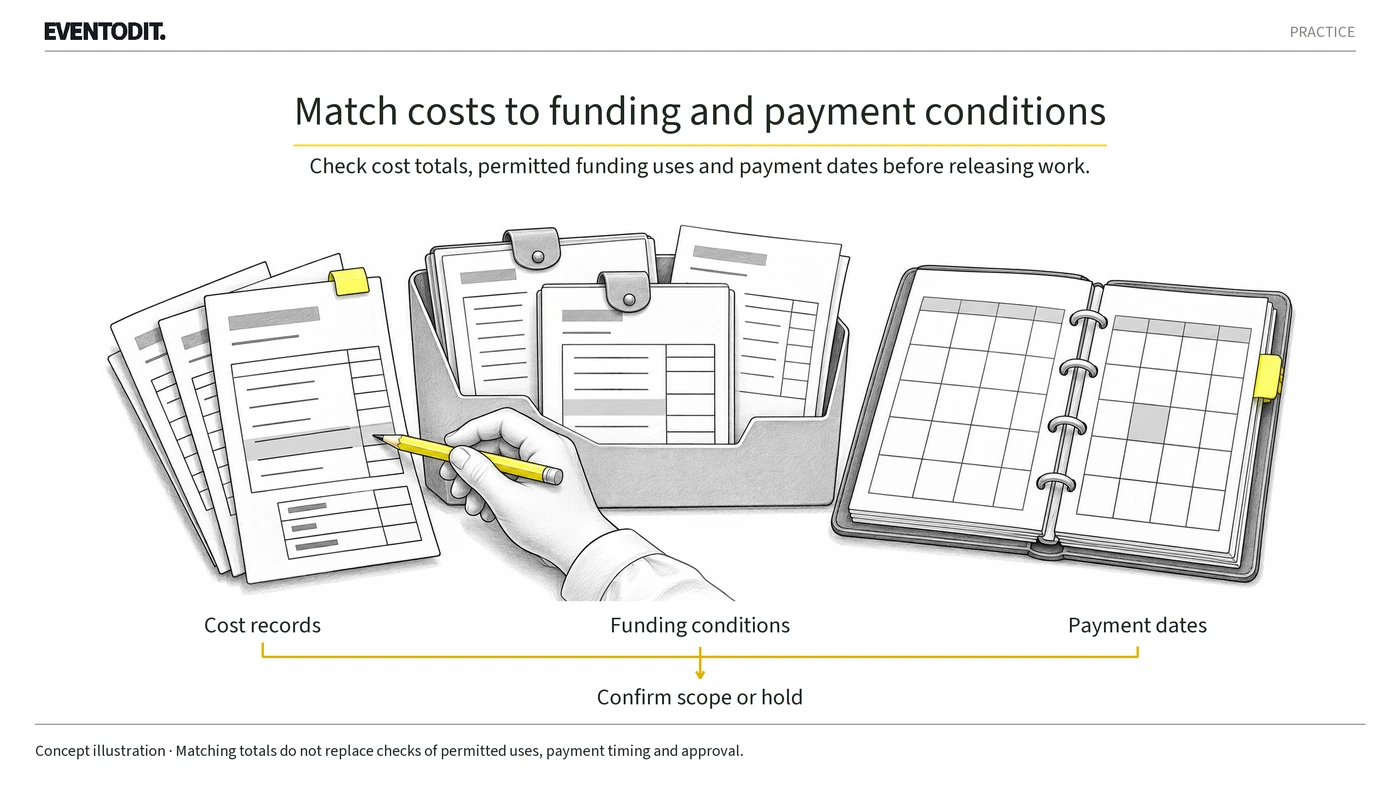
Event budget management: check costs, funding and payment dates together
Separate each cost into its pre-tax amount, tax and total payment, then compare available cash with planned receipt and payment dates. Record funding that will not be available when due and any outstanding conditions before seeking approval or releasing spending.
Read guide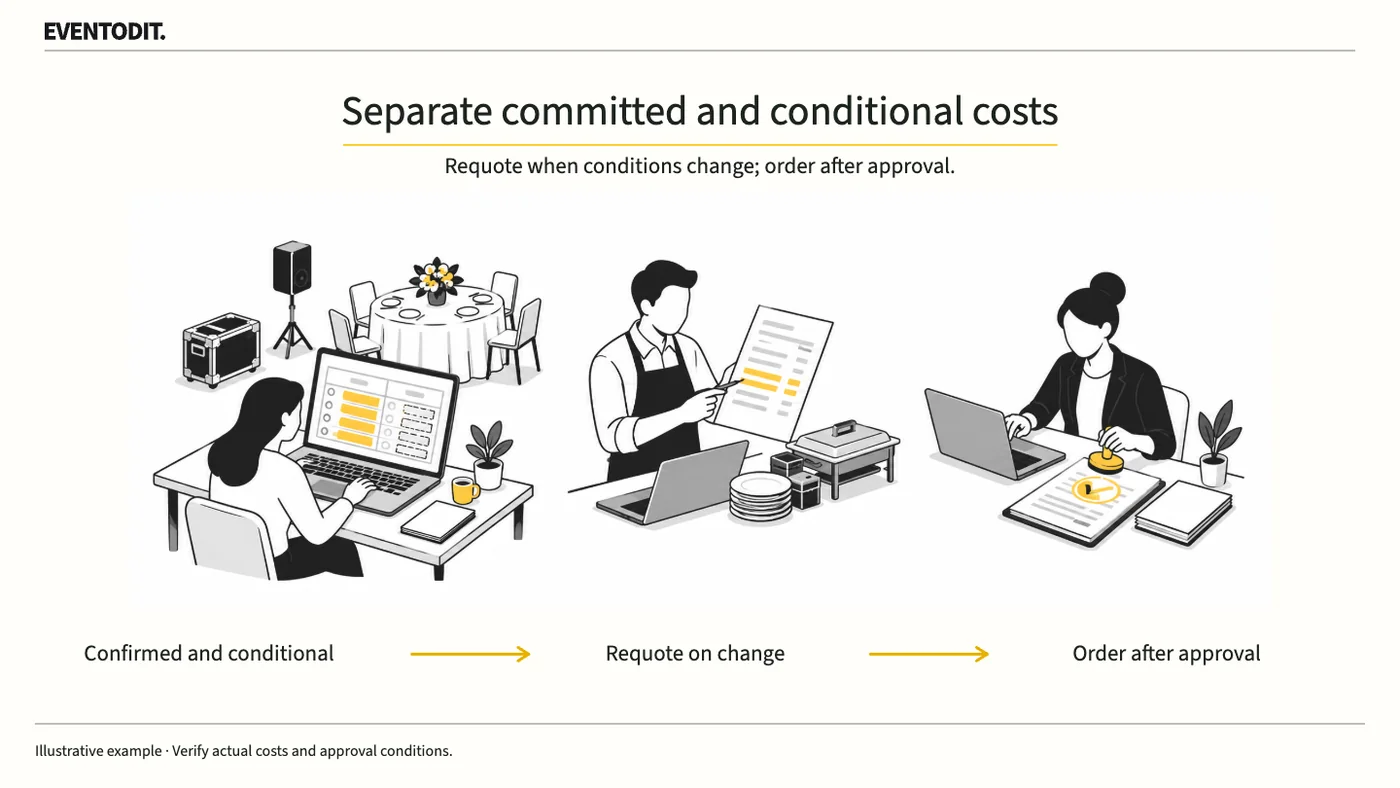
Event Budget and Conditional Cost Management
An event budget contains both committed costs and amounts that depend on decisions still to be made. Mark the difference and update the forecast whenever those conditions change.
Read guideHave a correction or additional evidence? Request a correction