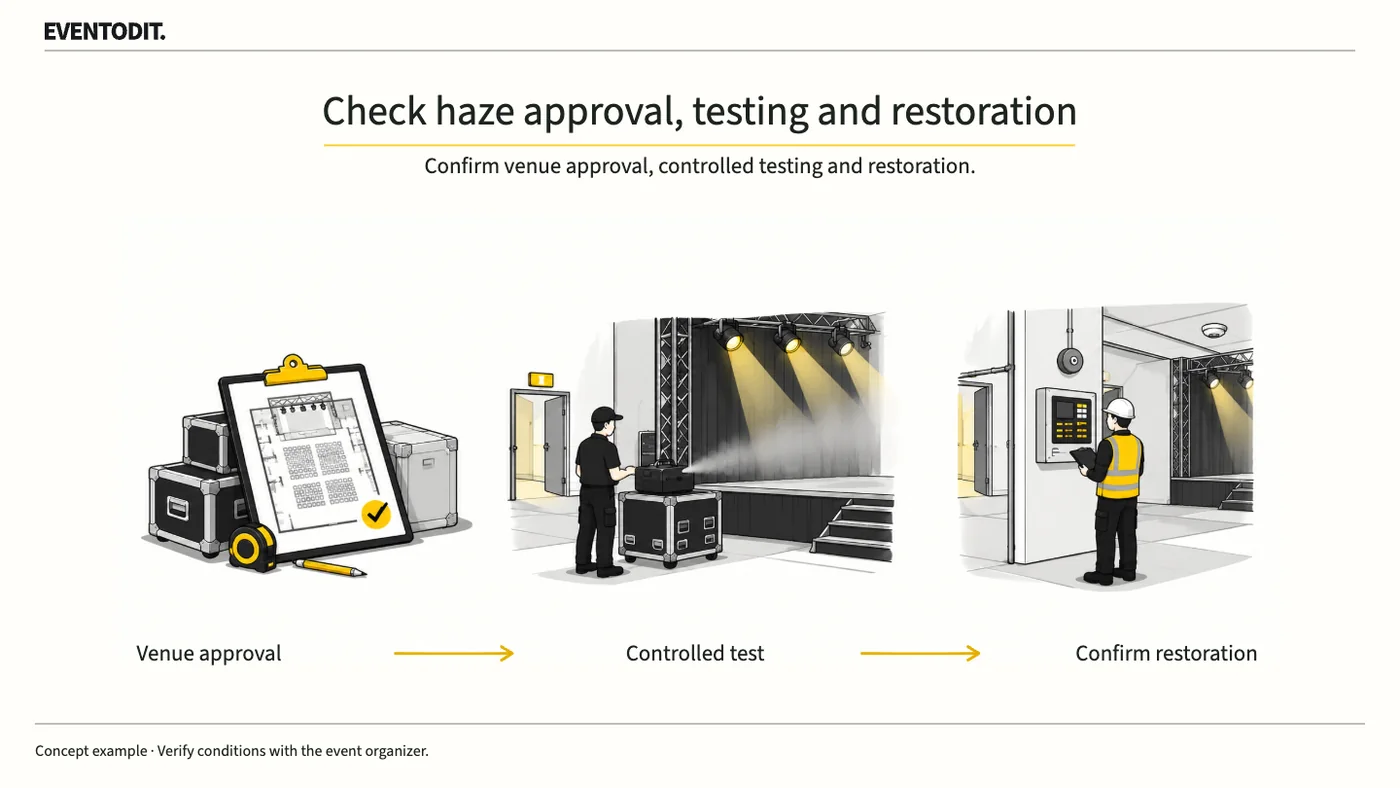
Part 1. Planning, creative and stage management
“A supplier owning a machine does not constitute venue approval. Secure permission and a fallback cue before ordering.”
- Check venue rules and written approval: Before ordering haze equipment, send the venue’s technical and safety teams the proposed effect and cues and obtain prior written approval under its procedures. Outernet London requires equipment, operator, test schedule, layout and emergency-stop information and prior written consent. Do not assume another venue has the same conditions.
- Prepare a no-haze alternative: If the venue’s safety conditions prohibit the effect or approval remains on hold, prepare lighting looks and cues that work without haze.
- Provide substance and exposure information: With reference to HSE ETIS3, give the contractor and venue the fluid safety data sheet, discharge position and direction, cue durations, and performer, crew and audience locations. A visually suitable density does not establish safe exposure; a competent person must determine whether exposure assessment or further monitoring is needed.
- Check exit routes and signs: Stage management and lighting should check the visibility of exit signs and indicators, movement routes and floor slip risks during the test. Stop discharge if haze reaches an unauthorised area or obscures safety signs, and review the position and cue.
- Separate discharge-end and system checks: Receive the contractor’s discharge-end report separately from the venue’s confirmation of any required detection-system restoration. Record end time, residual haze, floor condition, the system-check owner and confirmation time.
- Control show cues and changes: Carry the tested and approved machine, fluid, position, cues and audience information into the show plan. Notify the venue and contractor of changes to equipment, fluid, location or discharge duration for renewed review; hold effects without approval or assigned protection and restoration responsibilities.
Part 2. Special effects and technical production
“Verify the specified machine-and-fluid combination. Prevent assumed compatibility and unauthorised use.”
- Review the machine and fluid together: Submit the precise machine model, fluid product, manufacturer’s instructions and safety data sheet. Rosco’s V-Hazer manual describes that machine and its specified fluid as a system. Do not infer compatibility from a shared brand or a water-based description; verify the actual machine’s manufacturer specifications.
- Check each venue’s fluid restrictions: Outernet London does not permit oil-based haze. Do not assume the same prohibition or permission applies elsewhere; verify the actual venue’s rules and the approved fluid combination.
- Follow agreed tests and emergency stops: The effects contractor must not schedule a test independently. First agree approved positions, settings, attendance and protective conditions with the venue. Know the stop method and halt discharge immediately if a problem appears.
- Prevent fluid accumulation and slips: Check whether fluid condenses on floors or equipment. If the floor becomes wet or a slip risk appears, stop discharge and review nozzle direction, use and ventilation with the responsible teams.
- Hand over settings and abnormalities: Record actual settings, discharge times and durations, abnormalities and actions for stage management and venue staff. An alarm not sounding does not establish that every test condition was met.
The following role allocation is an editorial application for the test. Agree actual responsibilities and procedures with the venue.
| Role | Check during the test | Record separately |
|---|---|---|
| Effects operator | Approved machine, fluid, position and stopping method | Actual settings and abnormalities |
| Venue fire/facilities personnel | Detection impact and agreed protection | Permission conditions and system state |
| Stage management and lighting | Cue, movement and exit-sign visibility | Adopted cue and changes |
| Front of house | Audience notice and haze reaching seats | Notice wording and escalation contact |
Scroll sideways if needed to read every column.
Scroll sideways if needed to follow each role.
- Production/stage manager: Submit the proposed useProvide cues, layout, machine, fluid and test time.
- Venue fire/facilities: Confirm test conditionsConfirm permission, protective arrangements and venue attendance.
- Effects operator: Test the agreed effectUse the approved combination and stop discharge if problems occur.
- Production/stage manager: Compare cue and access conditionsCheck visual results, signs, movement and audience spread with the responsible teams.
- Venue fire/facilities: Confirm the final system stateReport completion of any required restoration and its confirmation time.
- Production/stage managerSubmit the proposed useProvide cues, layout, machine, fluid and test time.
- Venue fire/facilitiesConfirm test conditionsConfirm permission, protective arrangements and venue attendance.
- Effects operatorTest the agreed effectUse the approved combination and stop discharge if problems occur.
- Production/stage managerCompare cue and access conditionsCheck visual results, signs, movement and audience spread with the responsible teams.
- Venue fire/facilitiesConfirm the final system stateReport completion of any required restoration and its confirmation time.
Columns identify roles. Read steps from top to bottom; arrows show the handover direction.
Only authorised competent personnel may adjust or restore fire detection, under the venue’s procedures.
Part 3. Venue fire, facilities and front-of-house staff
“Check ventilation and neighbouring detection zones, then hand over the system state after the test.”
- Check ventilation and adjacent detection zones: Winston Churchill Theatre’s technical pack explains that altering some zones does not change the whole building; haze can reach other zones through air handling or open doors and trigger an alarm. Venue staff should review ventilation paths and detection zones for the actual site.
- Do not cover or switch off detectors independently: Production and effects contractors must not tape over detectors or disconnect them themselves. Under applicable law and venue approval, authorised competent fire or facilities personnel must decide whether adjustment is necessary and permitted, establish alternative safeguards, and perform any required work.
- Review the site and arrange monitoring where needed: As in the University of Kentucky example, review the location, effect method, duration and relationship to exits and detectors. The venue and responsible authorities must agree required monitoring and safeguards under local rules; overseas examples do not provide domestic permission or a universal obligation.
- Follow the official procedure for unexplained alarms: Do not assume an alarm was caused by haze, ignore it or reset it independently. Follow venue response procedures to check for actual fire danger.
- Control adjustment time and confirm restoration: English theatre fire-safety guidance calls for controlled detector-isolation scope and time and reactivation when haze has cleared. Venue staff must perform any required restoration under the site’s approved procedures and safety conditions, then report its completion and confirmation time to production.
- Check audience spread and information: Observe haze reaching audience areas during rehearsal. Agree the audience notice and the contact responsible for handling and escalating queries or safety issues before the show.
Use the form for the next handover
Use the [Haze permission, test and restoration log](/en/templates/haze-clearance-restoration.html) for the records described here. The XLSX contains Blank, Example and Instructions sheets. Write your event in Blank; the fictional example is a guide to what to enter.
Link equipment, fluid, position and cue to venue conditions. Test with the agreed facility personnel and record settings, time and issues.
Effects staff send test/end records to the stage manager. Facilities send their own check/restoration response and operations receives both.
Final check before use: Before a haze test or live effect, cross-check venue approval, machine and fluid compatibility, detection-system protection and post-test restoration responsibilities.
Conditions for applying this elsewhere
For indoor haze and smoke machines. Authorised competent personnel handle any detection changes and restoration under venue procedures. Foreign guidance does not provide Korean legal permission.
Information not established
No specific Korean venue approval, detection layout, exposure level or test result was verified. The Winston Churchill Theatre pack is a 2022 example.
Reference material
- HSE · Smoke and vapour effects used in entertainment · ETIS3(rev2), 09/17; reviewed 27 October 2026
- Outernet London · Special Effects; reviewed 27 October 2026
- Rosco · V-Hazer Fog Machine User Guide v1, 2018; reviewed 27 October 2026
- Winston Churchill Theatre · Technical Information Pack · 13/05/2022, p.9; reviewed 27 October 2026
- University of Kentucky Fire Marshal · Smoke and Haze Use; reviewed 27 October 2026
- UK Government · Fire safety risk assessment: theatres, cinemas and similar premises · 2006, pp.49,61; reviewed 27 October 2026
After reading, complete the next task
Approved equipment/fluid/layout/cues, test conditions and owners, abnormalities and corrections, end-of-test and system-state records
This article’s template
Haze permission, test and restoration log
Actual pairing and test conditions match the permission record.
Instructions, examples & downloadsRelated practical guides
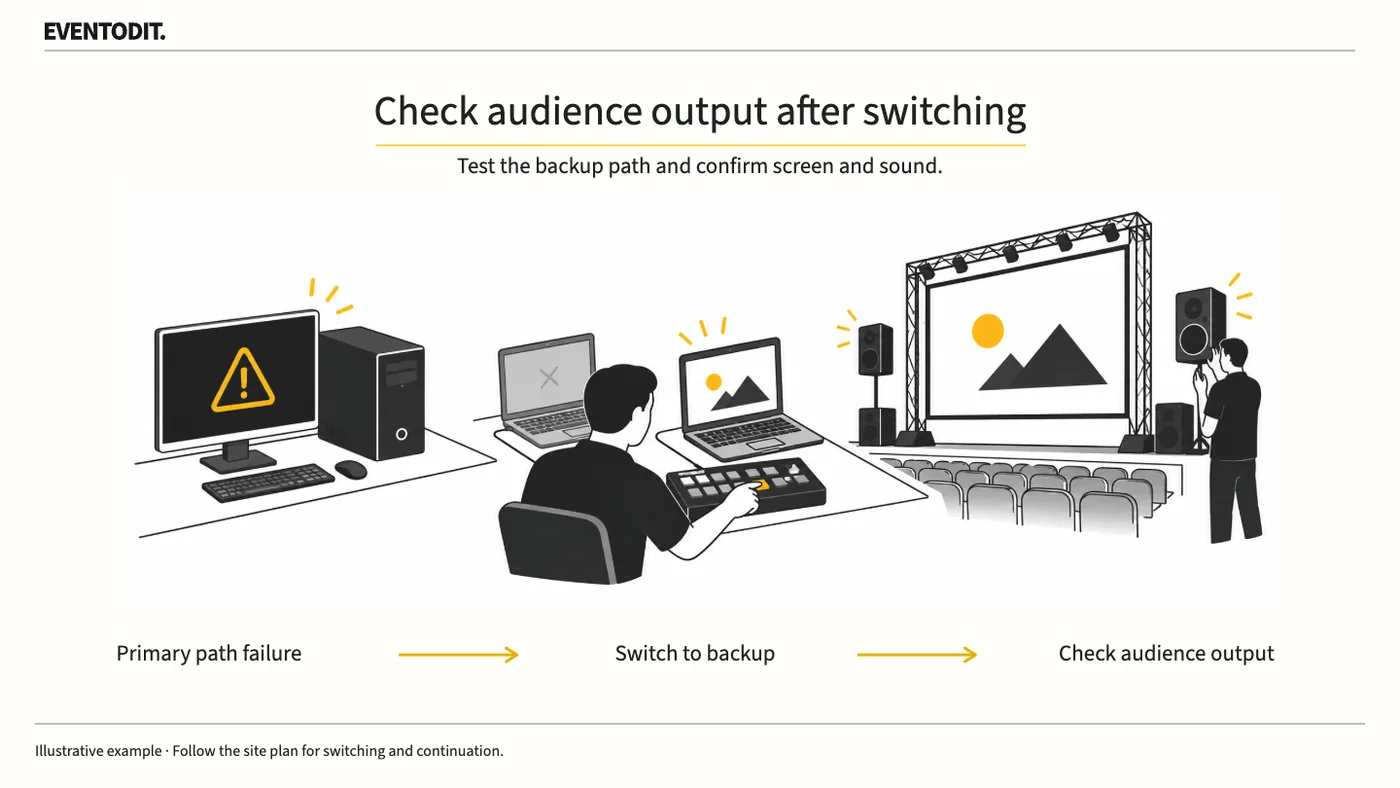
Event Technical Rehearsal and Failure Response
Separate picture, sound and lighting checks do not test the response to a fault during the show. Rehearse who calls the fault and who switches to backup equipment or holds the programme.
Read guideHave a correction or additional evidence? Request a correction