Part 1. Exhibitor and exhibition operations lead
"A 24-hour power order does not guarantee supply throughout the event. Confirm the schedule for all three periods."
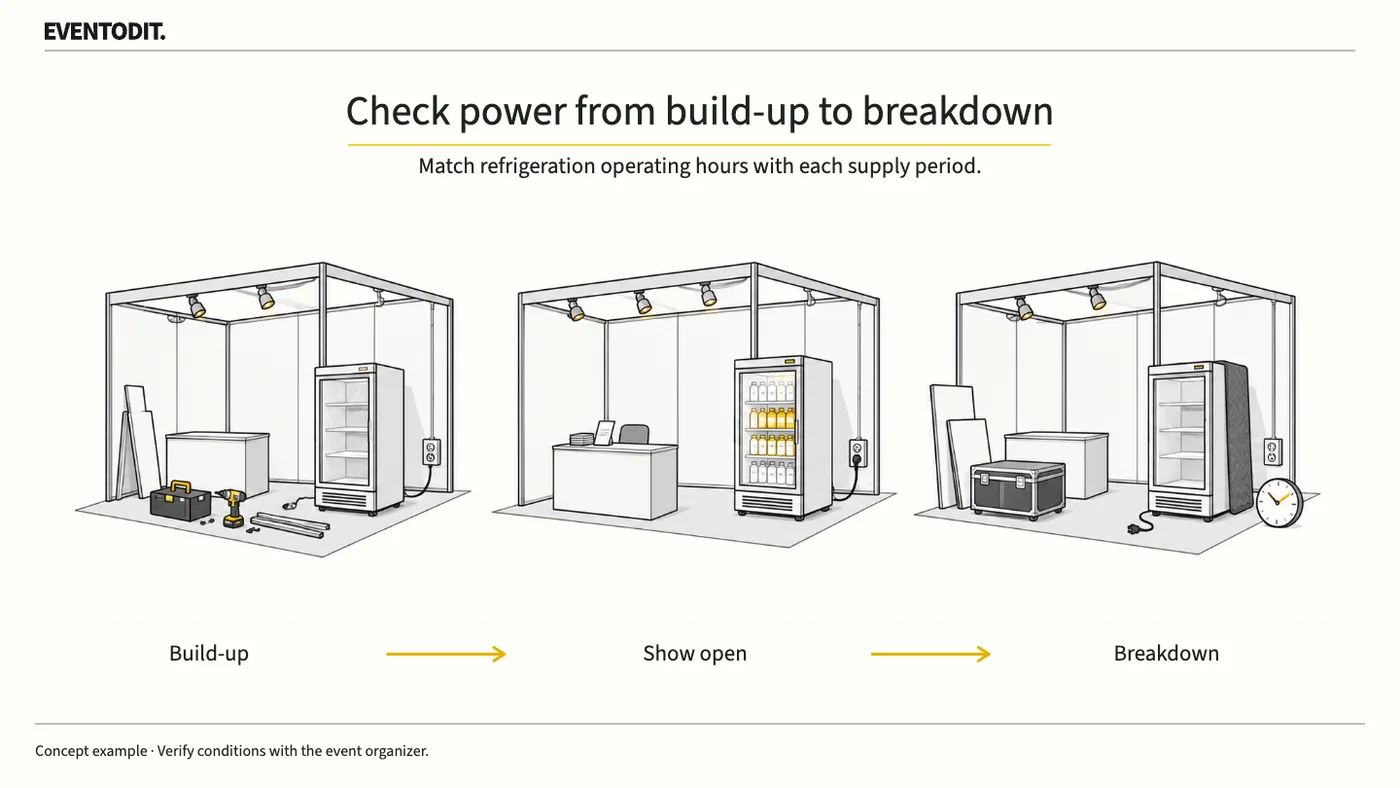
- Divide the requirement into build-up, open period and breakdown: Do not assume that ordering 24-hour stand power automatically includes build-up and breakdown. In the AEV 2024 guidance, 24-hour standard supply is available during the open period, is not guaranteed during build-up, and requires an arrangement during breakdown. Confirm availability for each of the three periods with the venue before the event.
- List continuously operated equipment and its operating window: List every item that must remain on, including refrigerators and temperature-controlled demonstration equipment. Record each item's first start and last required use, and indicate its power needs during build-up, the open period and breakdown. Pass the list to the venue team.
- Confirm storage requirements with the responsible specialist: Electricity alone does not establish safe storage for food, medicines or other sensitive items. Ask the quality or storage lead to confirm the applicable conditions and safety requirements separately.
- Plan alternative storage for supply gaps: If power will be unavailable during early build-up or breakdown, discuss changing the equipment start time or securing suitable alternative storage in advance.
- Do not generalise another venue's guidance: Examples in the AEV eGuide are references, not rules for every exhibition venue. Independently check the current exhibitor manual, actual supply windows, charges and permitted equipment load for each event.
| Period | Information the exhibitor provides | Outcome to confirm |
|---|---|---|
| Build-up | When equipment must start | Whether supply is available from that time |
| Open period | Overnight equipment and stand location | Whether 24-hour supply has been ordered and approved |
| Breakdown | Last required operating time | Supply end time and responsible contact |
Scroll sideways if needed to read every column.
This table is EVENTODIT's suggested sequence. Confirm the actual conditions and contacts with the venue.
Part 2. On-site installation and operations
"Compare the approval with the equipment on installation day, and prevent unauthorised connections to neighbouring stands."
- Check the approved position and equipment on installation day: Hand the venue's reply and the electrical order to the on-site lead. Compare the approved stand location and equipment with what has actually arrived before installation proceeds.
- Check energisation and shut-off times for each period: During build-up, verify that supply is available from the time equipment needs to start. During breakdown, check its last required operating time and cross-check the supply cut-off and responsible contact with the venue team.
- Do not connect to neighbouring stands or share supply without authorisation: The AEV guidance requires venue permission for a 24-hour block main shared by several stands. Do not plan to draw power from a neighbouring outlet for convenience. Ask the venue whether a separate dedicated circuit is needed.
- Hand over the order and venue response together: Provide the same confirmed supply conditions and electrical order to installation and on-site operations teams so unauthorised wiring changes or mistaken breaker operation can be prevented.
Part 3. Venue facilities and electrical lead
"Review load and distribution arrangements and establish an emergency response for overnight power loss."
- Review distribution using equipment specifications: Collect the stand location, equipment types, rated power consumption, start and stop times, and overnight requirements from the exhibitor. A qualified electrical specialist and the venue must jointly review the required capacity and distribution-board configuration.
- Establish the overnight power-failure response: Compare the event's electrical order instructions with the actual available supply windows. Agree the emergency contact and response in advance and communicate them to the exhibitor.
- Confirm each supply window and shut-off in writing: Give a clear written response on supply at the required build-up start time, the order and approval of 24-hour supply during the open period, and the breakdown cut-off time and responsible contact.
Use the original records and supporting templates
In the [electrical review and power-supply handover](/en/templates/power-review-handover.html), use one row for each equipment/booth ID in build-up, open-show and breakdown. Distinguish required equipment start/finish, venue-approved supply start/finish, and the times supply was actually confirmed; link the application, written reply and drawing version. Record the night/phase outage contact and response route, plus alternative storage, transfer timing and responsible confirmation for any supply gap. Hold unresolved periods and recheck equipment, position or schedule changes with the venue. Qualified leads separately assess circuit/load requirements and safe storage conditions.
Final check before use: Before energising continuous-power equipment or refrigeration at the stand, cross-check that approved power arrangements for build-up, the open period and breakdown, and overnight emergency contacts have been handed over without omissions.
Conditions for applying this elsewhere
Uses the supply windows in AEV’s 2024 guide as an example; responsible specialists must confirm storage and electrical safety.
Information not established
Current event-specific instructions, supply windows, charges and equipment load were not verified.
Reference material
Have a correction or additional evidence? Request a correction