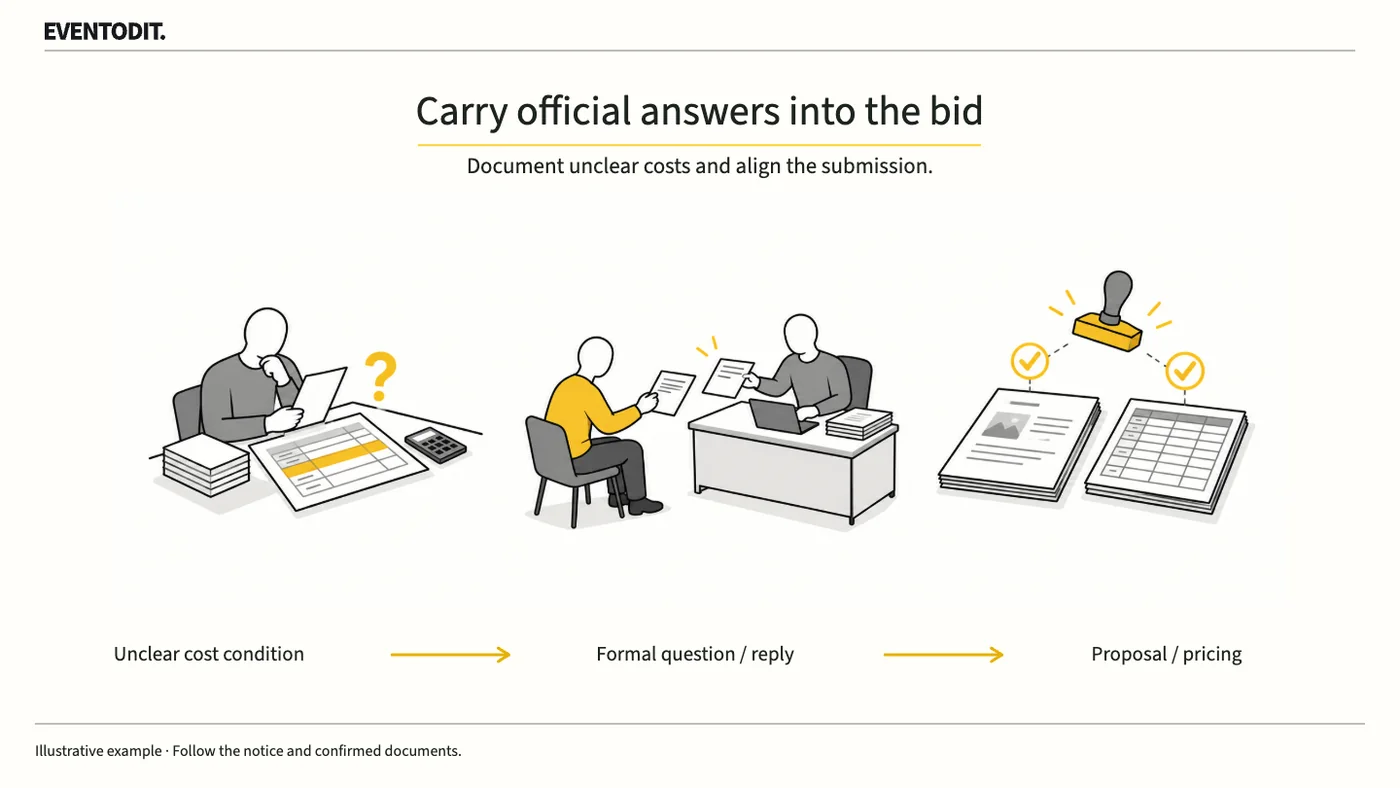
Part 1. Planning and Estimating
"Ambiguous requirements call for an official enquiry, not an arbitrary assumption."
- Identify hidden conditions that change costs: If you find vague wording such as “additional operation as needed,” do not simply omit or roughly add a cost. First identify whether the wording affects the budget for operating days, overnight security, equipment standby time or another specific item.
- Ask a precise question tied to its location: Do not merely copy the requirement when asking the contracting authority. Cite the notice number and revision, attachment name and page, and explain how each interpretation could change costs and the schedule.
Part 2. Tendering and Administration
"Do not assume a telephone explanation is an official reply."
- Make an official enquiry through the stated procedure: Check whether an explanation heard by telephone from the contracting authority is recognised as an official reply. Follow the notice's official submission route and deadline, such as a written enquiry or designated email, and obtain a documented reply.
- Confirm which documents apply for each reply status: Determine whether the authority's reply merely explains existing wording or indicates a change in quantity or schedule that may require a revised notice. If conditions change, ask the contracting officer to confirm the final version of the applicable documents.
The legal effect of a telephone explanation and whether it forms part of an official reply depend on the individual notice, contract documents and applicable rules. Email may also be an official reply route when the notice designates it. Check the submission route, responding authority, recipients and document precedence against the specific notice. The War Memorial's written-enquiry example and Scottish procurement guidance are reference examples, not universal rules for Korean event tenders.
| Reply status | What to verify | Action before applying it |
|---|---|---|
| Explanation of existing wording | Scope and authority of the respondent | Record the official reply's location |
| Quantity, scope or schedule change | Whether a revised notice or attachment has been issued | Confirm the applicable version with the contracting officer |
| No reply or unclear applicability | Remaining price and schedule assumptions | Submission lead decides within the notice's permitted scope |
Scroll sideways if needed to read every column.
Part 3. Proposal Coordination and Submission
"Official replies belong in the proposal register, not in one person's inbox."
- Update the proposal and price schedule together: When an official reply changes conditions, editing the relevant proposal sentence alone is not enough. Update related documents, including the cost breakdown, staffing plan and detailed schedule, so they all use the same assumptions and version.
- Control unanswered items: Do not add arbitrary qualifications or assumptions the notice does not permit for items that receive no clear reply from the authority. The submission lead must decide how to handle them within the scope allowed by the notice.
- Reconcile the complete submission: Immediately before submission, compare the original notice, revised attachments and official questions and answers against one register to ensure they are reflected consistently in the proposal and price schedule.
Do not assume every clarification or change necessarily requires a corrected notice; confirm the documents made applicable by the authority. Laryea's UK construction-tender research was reviewed only through its bibliographic record and abstract and does not establish legal effect or document precedence in Korean event tenders.
- Log the ambiguityPlanning and estimating: record page, wording and cost impact
- Compare official enquiry and replyBid lead: confirm designated route, authority, recipients and documents
Unresolved
Confirmed
- Update affected submissionsOwner: align versions used in proposal, pricing and schedule
Check each tender's enquiry effect and document precedence; this does not replace legal interpretation.
Final check before use: Before submitting the tender documents, cross-check that the contracting authority's official replies on ambiguous cost conditions have been reflected consistently in the proposal and quotation.
Conditions for applying this elsewhere
For tenders with official clarification procedures. Confirm legal effect, revised documents and permitted submission scope from the notice and the authority's official reply.
Information not established
This is not an authoritative interpretation of a particular live tender. Only the abstract of the construction study was reviewed; it does not support legal judgments on Korean event tenders.
Reference material
- War Memorial of Korea — Archive-development service RFP, pages 42–43: an example of written enquiry and reply applicability. Checked 2026.10.23.
- Scottish Government Procurement Journey — Questions from Suppliers: enquiry records and common information distribution. Not a Korean statutory procedure.
- Laryea (2011), Quality of tender documents: case studies from the UK — University repository bibliographic record and abstract only; full text not read. DOI 10.1080/01446193.2010.540019.
- Human Resources Development Service of Korea PDMS — Competency-unit list for a 2026 convention-planning training course, including budgets, suppliers, risk, sponsorship, follow-up and promotion. A particular course plan, not a universal certification textbook.
After reading, complete the next task
Bid enquiry, reply and application register
This article’s template
Bid Questions, Official Answers and Proposal Changes
A record showing where official answers were applied to prices, staffing and schedules.
Instructions, examples & downloadsRelated practical guides
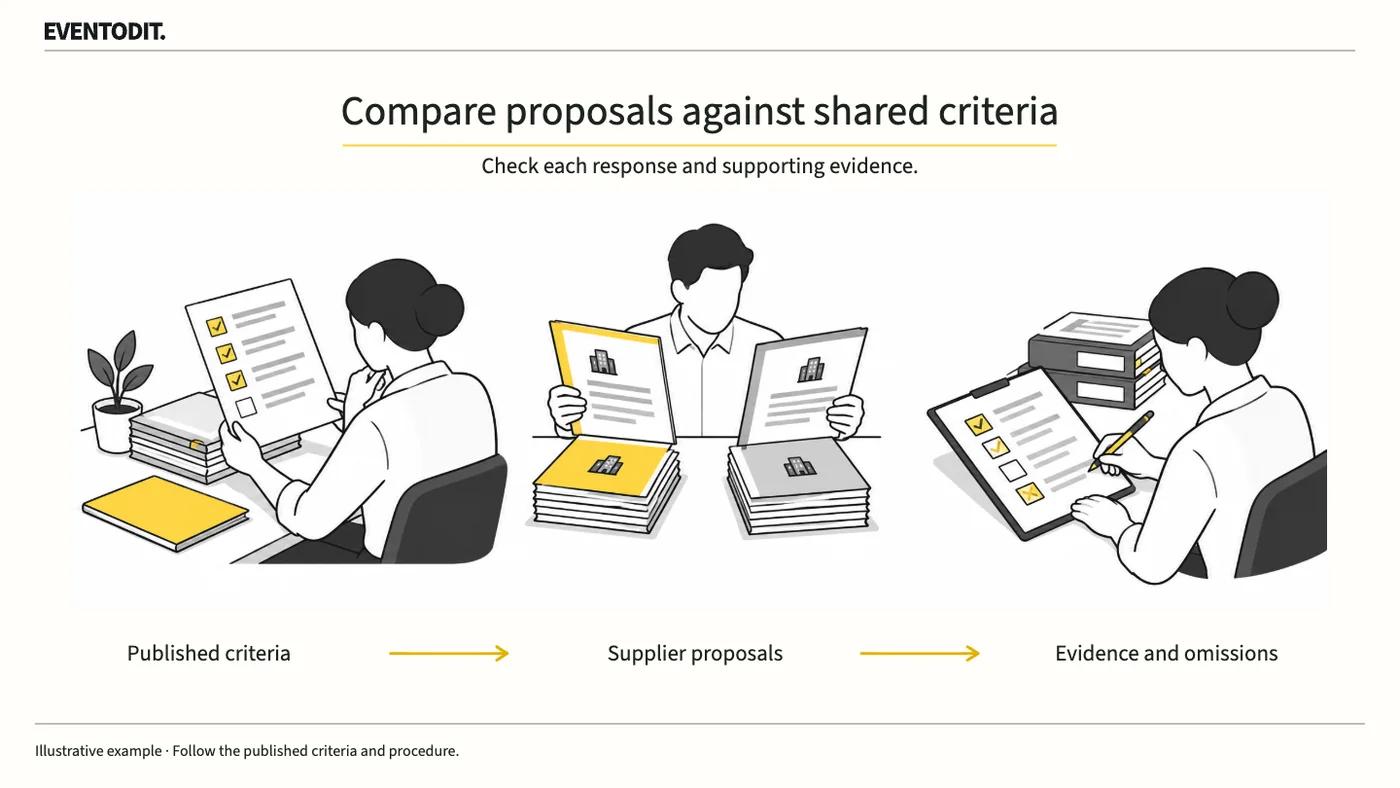
Event Proposal Evaluation and Comparison
Before reviewing proposals, identify the notice’s evaluation criteria and the evidence needed. Record where each bidder answered and leave missing information visible rather than filling it in by assumption.
Read guide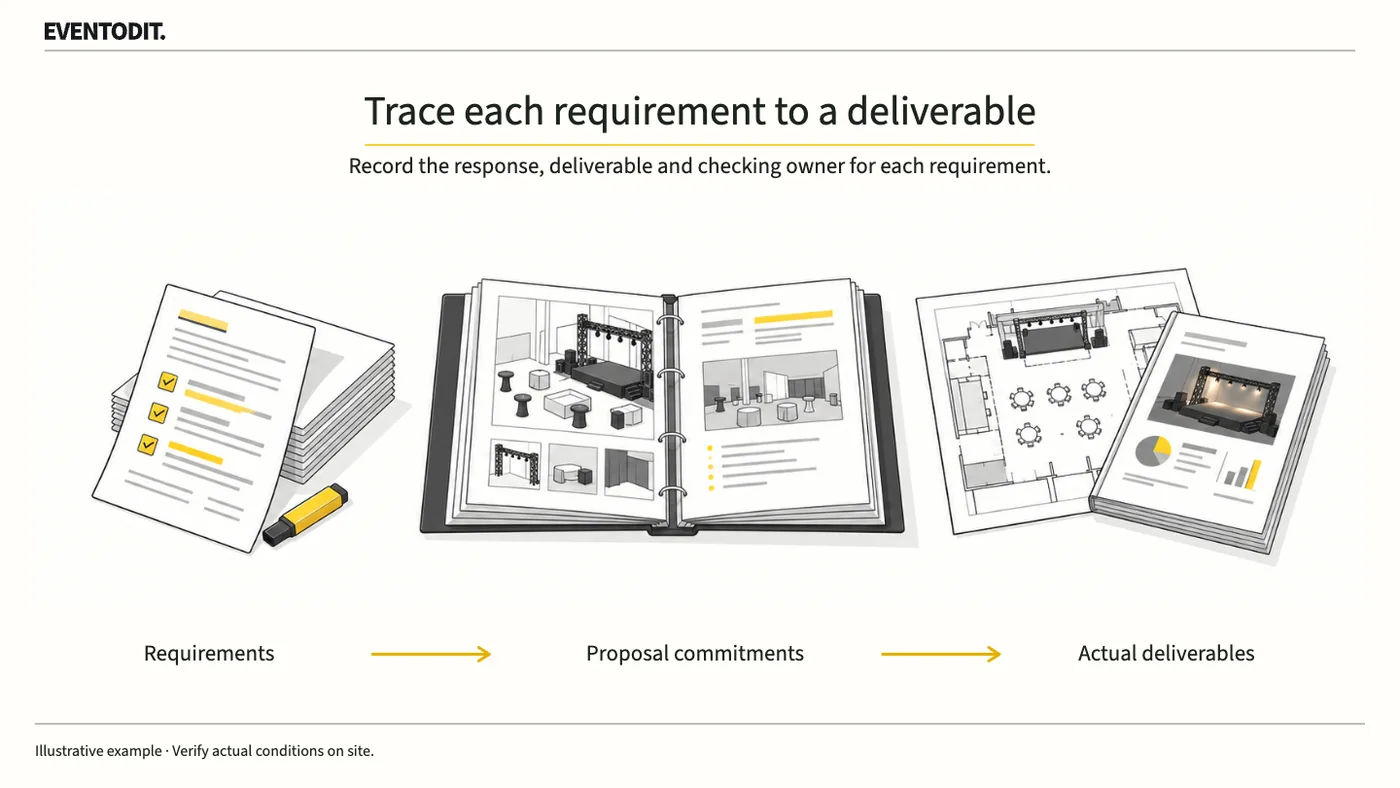
Event Proposal Requirements Traceability and Review
A promise of “smooth operations” does not tell the client what will be delivered or checked. For each requested task, identify the proposal response, output and person responsible for checking it.
Read guideHave a correction or additional evidence? Request a correction