Collect programme preferences and access needs together
A multi-venue music festival lets visitors build their own evening. Before recommending several sessions together, the planner checks which performances people want to combine and what they need during the journey. Ask about functions such as a step-free route, avoiding prolonged standing or receiving written information. Do not assign everyone with the same disability the same travel arrangement.
Visitor services gathers requests; venue staff check admission and viewing conditions; transport staff verify external services. Appoint one person to bring the journey together. Collect session schedules, venue admission deadlines, route information, transport guidance and supplier replies for the same date and version.
Separate leaving the station from entering the venue
Break the journey into the station or stop to the first venue, travel between venues, and the final venue to transport home. Check the actual exit, boarding point, surface, steps, slopes, resting places and contact. Record the start and end points, date and evidence for distances or journey times. Do not fill an unverified section with a map app’s walking time.
Seoul Metro’s notice of 19 April 2026 describes phone-requested train boarding and alighting assistance for wheelchair users and exit-elevator locations in the Ttota Subway app. Do not extend that station service into a promise of accompaniment to the festival. Separate the section to confirm with the operator from the section the organiser must arrange.
Confirm where each service starts and ends
If a shuttle is offered, ask about eligibility and booking, departure, the exact meeting point, boarding support and who meets arrivals. Connect the visitor and provider to check compatibility with mobility equipment and the required assistance. Having information staff does not establish that lifting assistance or mobility-equipment handling is provided.
The UK organisation Attitude is Everything’s current public Charter criteria include clear agreements with external providers on access responsibilities and contacts, and access information in staff briefings. These are criteria for that UK scheme, not Korean obligations or certification of this article.
Obtain replies specifying who meets visitors where, what they provide and where the next person takes over. If a gap remains, change the service or offer a verified viewing alternative rather than requiring everyone to bring a companion. Share individual requests only with staff who need them; do not copy medical certificates or detailed health information into general operating lists.
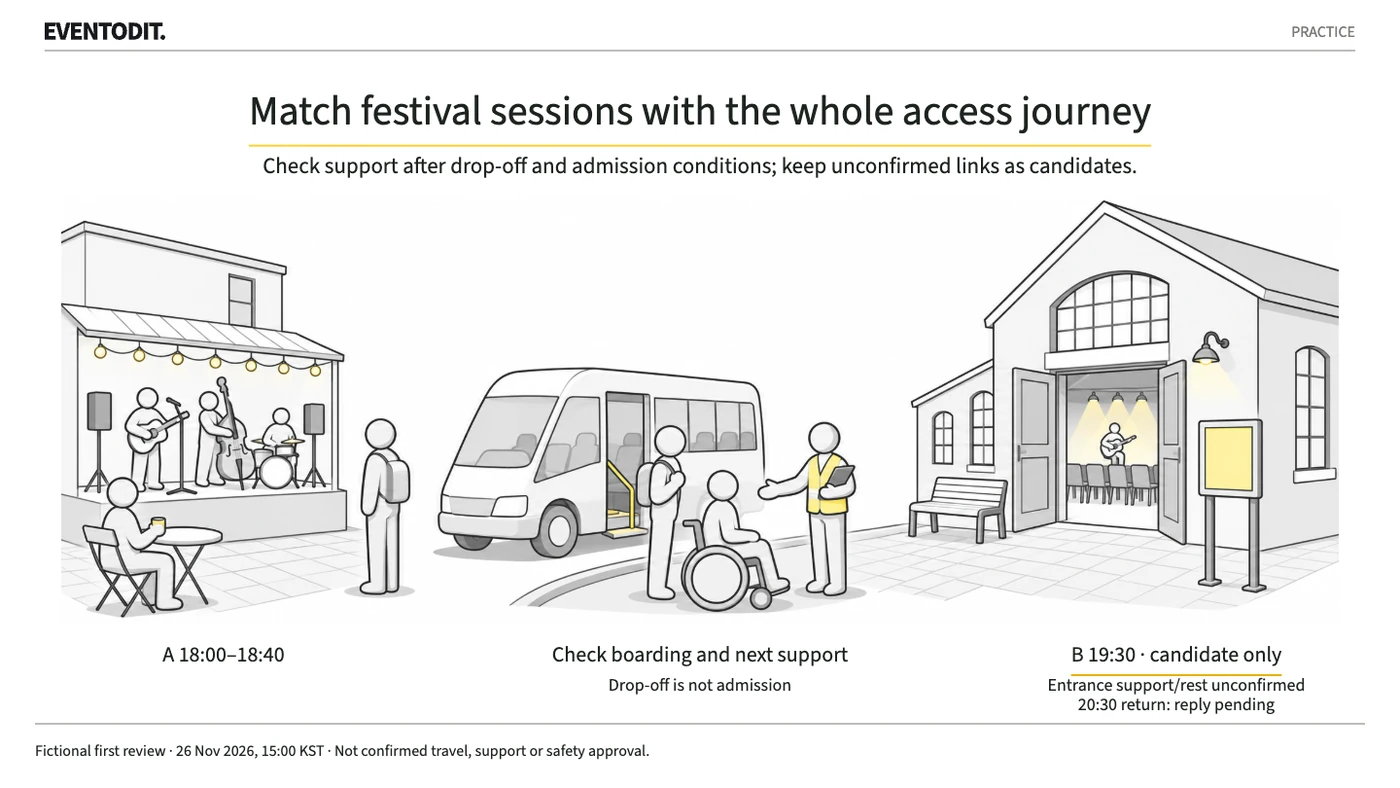
Compare session combinations against admission, not drop-off
This is a fictional city music festival devised by the editorial team. The event date is 13 February 2027; the review is assumed to take place at 15:00 on 26 November 2026. All times are Korean Standard Time. Sessions, replies, support and decisions are illustrative, not operating records or standard travel times.
Performance A runs from 18:00 to 18:40. Assume a proposed shuttle for visitors requesting travel support leaves at 18:50 after exit, assembly and boarding, then reaches B’s drop-off point at 19:05. B’s later session runs from 19:30 to 20:10. Arrival there is not the time a visitor passes the venue entrance or reaches their viewing position.
| Option to compare | Conditions checked | Current decision and next action |
|---|---|---|
| A → B at 19:00 | B admission closes at 18:50; shuttle drop-off is 19:05 | Remove the recommendation to combine these performances using this shuttle. Consider another session or separate direct visits. |
| A → B at 19:30 | B admission closes at 19:20. Support from drop-off to entrance and waiting/rest conditions remain unconfirmed. | Retain only as a timetable candidate. Hold confirmation of linked support until B replies about that section and its support hours. |
| Travel home after B | 20:30 return transport and meeting/boarding support requested; no reply yet | Return arrangements for the combined visit remain unconfirmed. Transport staff verify service scope and actual use conditions. |
Scroll sideways if needed to read every column.
Assume that the replies received at 11:00 on 27 November specify a support plan from B’s drop-off point to its entrance at 19:05–19:15, the subsequent waiting/resting place and where assistance ends. They also confirm the meeting point and boarding support for the 20:30 return vehicle. The coordinator adds this scope and its applicable times to note v2, explains it to visitors who need it and checks their choices. Matching times alone does not approve universal suitability or safety.
Publish information that lets visitors choose
The NSW Government’s access guidance describes providing travel and facility information in advance and updating information when access routes or viewing-area availability change during the event. Do not import its legal language or facility figures as general Korean standards.
Make verified entrances, meeting points, route conditions, request methods and support scope easy to find. Provide readable text and a contact method alongside an image map. Let visitors choose one session or different transport, and do not make an itinerary that depends on giving up rest the default recommendation.
Unconfirmed linked support does not require hiding other verified information. Distinguish direct-visit information for each performance from the link still being checked. However, do not sell or recommend the pair as guaranteeing travel between them. Check the organiser’s change and refund terms separately.
Revisit the recommended sessions when a section changes
An elevator fault, road closure, wet surface or changed meeting point requires more than an extra arrow on the map. Recheck affected session combinations, waiting and resting places, and staff coverage. Do not announce an unverified alternative as accessible or decide that staff can simply carry a visitor or wheelchair.
The operations lead tells visitor services, ticketing and site staff what has changed and what still awaits a reply. Inform visitors through the agreed contact method about revised choices and contacts. In an emergency, follow the venue’s emergency procedures and responsible staff; do not substitute the ordinary shuttle plan for an evacuation plan.
Check that receiving staff explain the same journey
Bring together session combinations, evidence and applicable times for each section, meeting-point photographs or descriptions, service boundaries, contacts and unresolved items. Keep original replies and earlier versions. This example is an in-article planning note; no separate blank XLSX, CSV or automatic assessment is supplied.
In the fictional example, assume that at 11:30 on 27 November visitor services and B’s site contact read note v2 and give matching replies about which session follows A, who meets arrivals and how return travel is explained. Document comparison and handover can then be recorded as complete. This does not establish a real journey trial, validation by disabled participants or delivery of support on event day.
Use the related booking/companion-seat and post-event exit guides as background for the parts they cover. A seat booking or one verified section does not establish the whole journey.
Conclusion
Planning access for a multi-venue festival means aligning visitors’ programme choices with the travel and support actually provided. Verify and explain arrival points, admission deadlines, service connections and the return journey; revise unconfirmed combinations or hold their announcement. Handover is complete when receiving staff can explain the same conditions and outstanding work.
Conditions for applying this elsewhere
Use after collecting schedules, admission deadlines, actual routes and replies from external transport/support providers. Visitors and providers check mobility-equipment and assistance compatibility; ordinary journeys do not replace emergency evacuation arrangements.
Information not established
The procedure and every date, time, reply, service and decision in the fictional festival are editorial proposals for explanation. No actual journey trial, validation by disabled participants, safety approval or event-day delivery was verified. Foreign criteria are not Korean obligations. Check actual services, contracts, access and personal-data conditions with responsible staff. No separate XLSX, CSV or automatic assessment is supplied.
Reference material
- NSW Government · event access planning and pre-event/on-site information · publication date not shown · checked 7 Nov 2026
- Seoul Metropolitan Government / Seoul Metro · access support notice · published 19 Apr 2026 · checked 7 Nov 2026
- Attitude is Everything · current public Charter criteria · publication date not shown · checked 7 Nov 2026
After reading, complete the next task
Combination decisions, section evidence and applicable times, meeting points, support scope and contacts, unresolved items and receiving staff’s comparison replies
Related practical guides
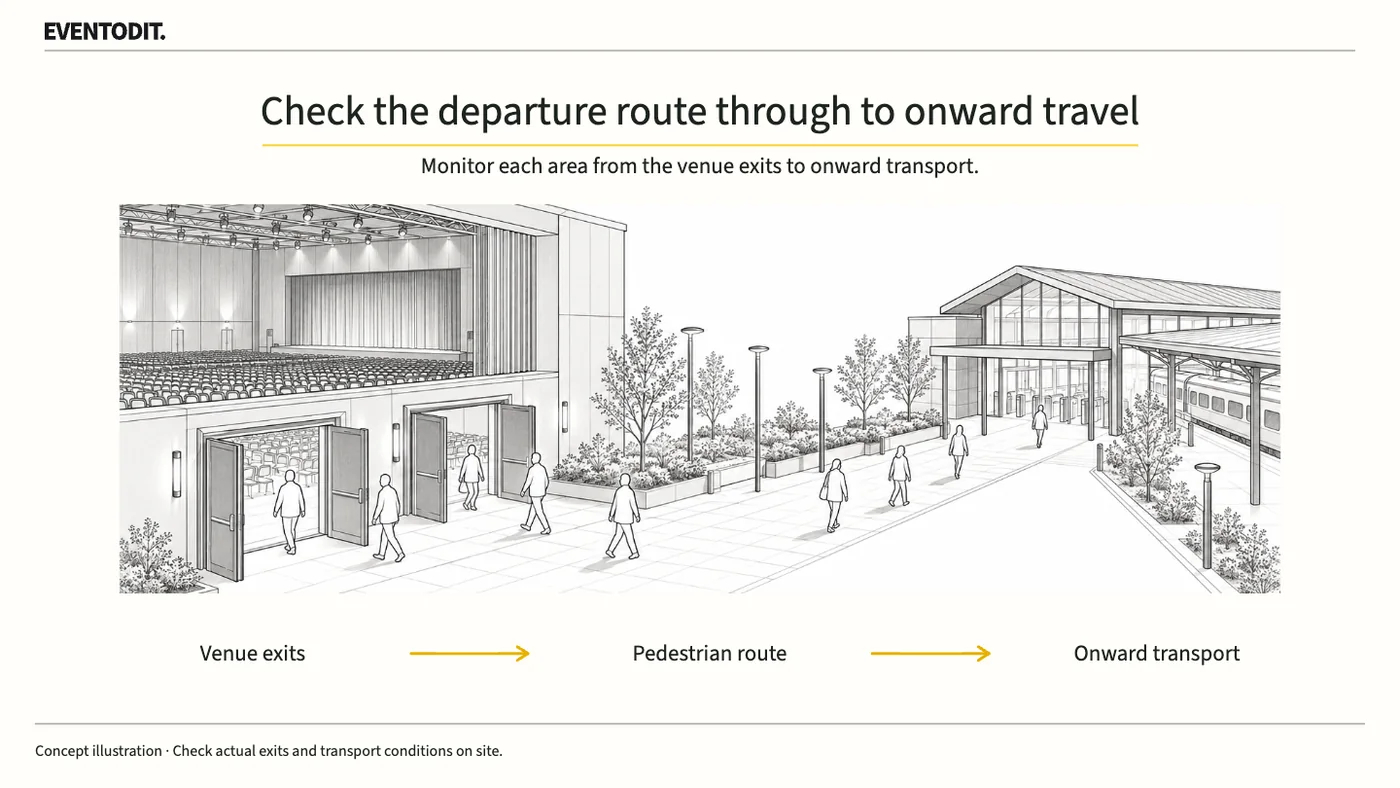
Plan from the end of the event to the final audience departure
Audience movement continues after the programme ends. Check exits and onward transport in advance, and agree how area reports and the handover to dismantling will work.
Read guide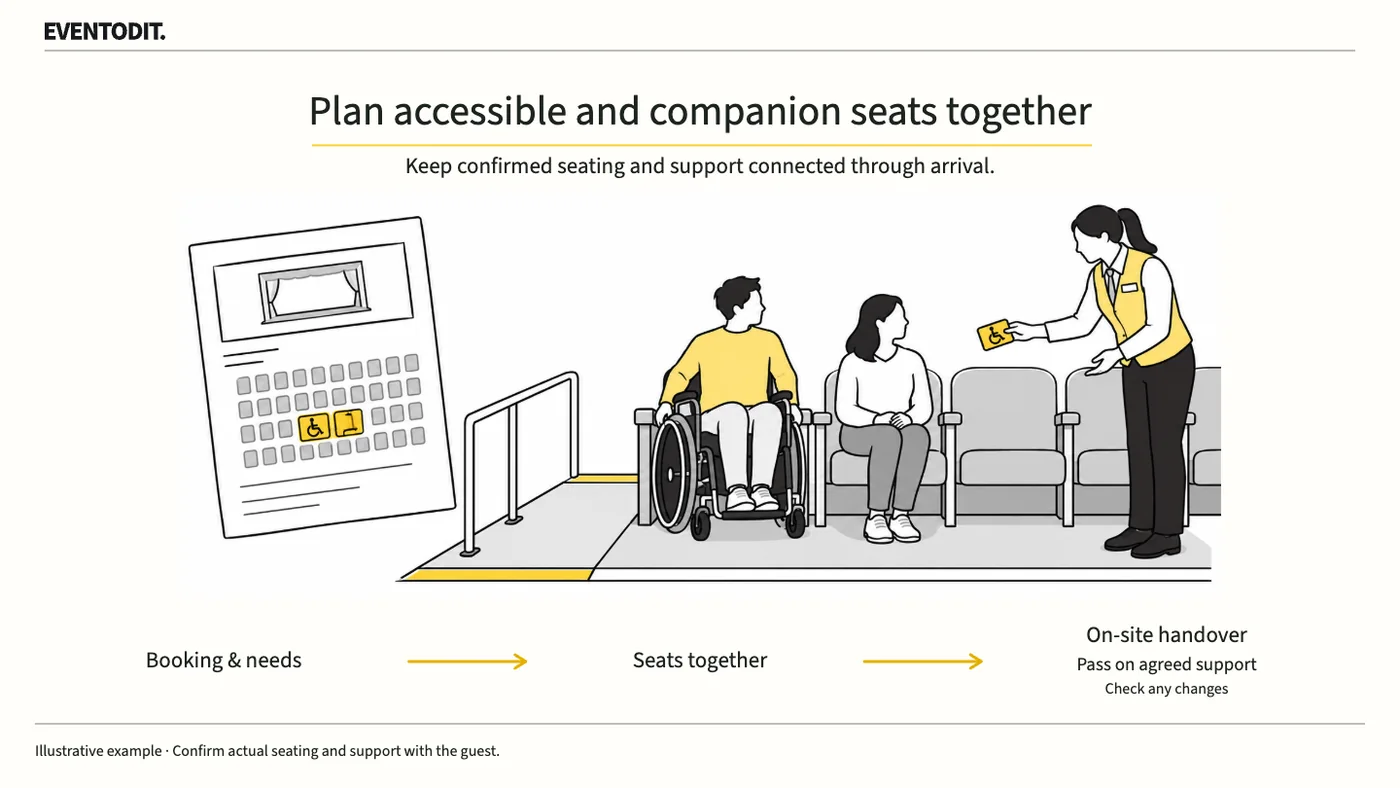
Accessible Seating and Companion Seat Operations: A Practical Guide by Role
Explain access routes, sightlines and available support when selling accessible seats. Confirm the visitor and companion’s seats, then tell the arrival team what support has been agreed.
Read guideHave a correction or additional evidence? Request a correction