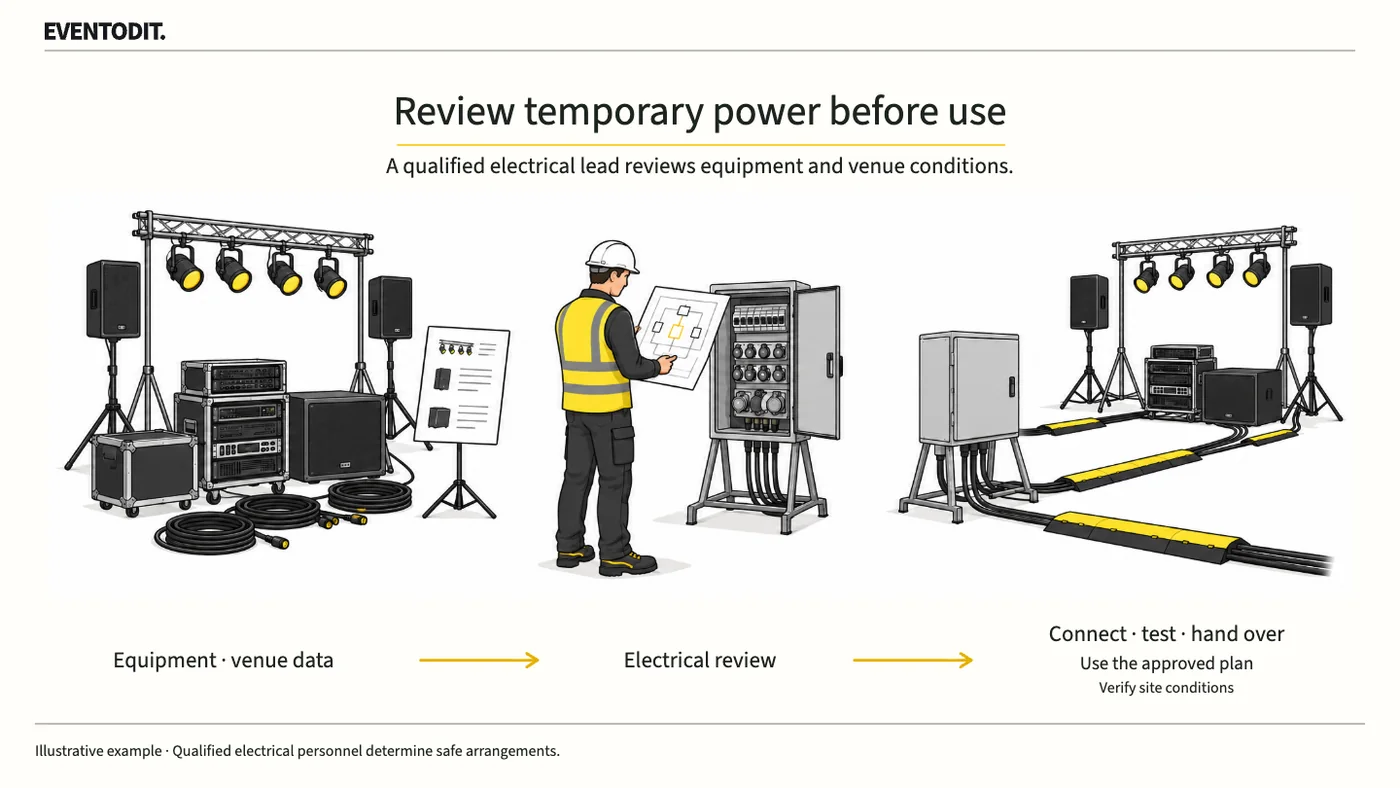
Part 1. Planning and Procurement Lead
"The sum of equipment power ratings does not guarantee a usable supply. Confirm the distribution review and approved scope."
- Do not rely on a simple sum of power consumption: Adding normal operating power for every device does not establish that they can be used safely. Do not independently approve simultaneous operation or circuit connections simply because the total appears to fit the available capacity.
- Gather and hand over equipment and venue information: Rather than designing circuits independently, the planner should gather supplier equipment lists showing models, quantities, installation locations and manufacturer specifications, together with the venue's supply conditions, and request a formal review by the competent electrical lead for the site.
- Record each review and handover state separately: Receiving a nameplate is not the same as completing a circuit review, and receiving a drawing does not mean that on-site connections and testing are complete. Record the progress of each stage separately.
- Obtain revised drawing approval after additions or changes: If LED, heating or cooling equipment is added after review, do more than update the equipment list. Send the changed equipment identification, installation location and intended usage time for review, and obtain approval of the revised drawing version and whether the equipment may be energised.
Scroll sideways if needed to compare the branches.
- Supplier equipment listModels, quantities, locations, nameplates and manufacturer power specifications
- Venue supply conditionsSupply points, permitted hours, access and operating conditions
- Electrical reviewCheck circuits, distribution routes and energisation against site conditions
- Hand over reviewed version and rolesRecord drawing version, energisation and isolation owners, and unresolved items
- Recheck changesSend additions and location or timing changes to the same reviewer
A document-handover structure, not a wiring construction plan or a substitute for Korean statutory inspection and safety approval.
Part 2. Equipment Suppliers
"Do not simply write ‘power included’. Provide inrush current and supporting manufacturer specifications."
- Define the power specification boundary: Do not write only “power included” on a quotation. Supply equipment names, models, quantities and installation locations along with nameplates or official manufacturer specification sources.
- Distinguish normal operation from startup inrush: The inrush current of LED lighting and other equipment at switch-on can differ greatly from normal operating current, and the number of units that may be connected varies with breaker characteristics. Provide the two sets of information separately.
- Do not invent unsupported values: Where a figure is not supported by a manufacturer specification, nameplate or another clear source, do not substitute a value from similar equipment. Mark it unverified for the site reviewer to assess.
ETC explains that LED fixture inrush differs from normal operating current and that the number of fixtures a circuit can support depends on breaker characteristics. The manufacturer does not give a fixture count valid for every circuit. A matching sum of normal power consumption is not approval to switch on that number simultaneously. Even when sequential startup is considered, a competent electrical lead must separately review circuit protection, capacity, earthing and cables.
Part 3. Facilities and Electrical Team
"Plugging in is not the end. Confirm circuit separation and responsibility for energisation and isolation."
- Review the distribution drawing and confirm circuits: Consider supply points, operating hours, earthing, isolation points, cable routes and weather exposure, as well as conflicts with audience and vehicle movement, before confirming each equipment connection on the drawing.
- Specify access and energisation and isolation procedures: Identify who is responsible on each side of the venue supply point, which competent personnel may access distribution boards, who directs energisation and isolation, and who must be contacted in an emergency.
- Separate emergency systems and determine safe startup: Keep emergency systems separate from general production circuits and prevent unauthorised connections to the same circuit. Decide actual connections and safety measures, including any sequential startup, according to the site's breaker and equipment combination.
UK HSE event electrical guidance considers supply points, operating hours, earthing, isolation points, cable routes and weather exposure alongside layout and power needs. Use it to define questions for the electrical lead, rather than importing UK specifications or figures as Korean statutory requirements.
| Material | Record the planner receives | Confirming party |
|---|---|---|
| Equipment list | Model, quantity, location and specification source | Equipment supplier |
| Reviewed distribution plan | Link between supply point, circuit and equipment ID | Competent site electrical lead and facilities team |
| Operations handover | Access authority, energisation, isolation and fault contacts | Facilities and electrical operations team |
Scroll sideways if needed to read every column.
Final check before use: Before energising the event supply, cross-check that the full equipment list and venue supply conditions have been handed over to the competent site electrical lead, and that the reviewed distribution drawing and safety management arrangements are confirmed.
Conditions for applying this elsewhere
For document handover at events with designated facilities and temporary-electrical personnel. Competent site personnel determine design, connection, testing and applicable Korean requirements.
Information not established
No event-specific supply capacity, breaker, wiring, startup order or spare-capacity ratio is specified. Candidate power-consumption research was not available in full and was not used as safety-review evidence.
Reference material
- UK HSE — Electrical safety at events: supply, layout, access and isolation conditions in event electrical planning. Checked 2026.10.23.
- ETC — Inrush Current and ETC LED Fixtures: operating current versus inrush, breaker differences and startup conditions. Checked 2026.10.23.
- Human Resources Development Service of Korea PDMS — Competency-unit list for a 2026 convention-planning course covering budgets, suppliers, risk, sponsorship, follow-up and promotion. A particular course plan, not a universal certification textbook.
After reading, complete the next task
Equipment power-data and distribution-review handover sheet
This article’s template
Event equipment electrical review and change log
An equipment record linking nameplates, startup conditions, reviewed drawings and onsite changes.
Instructions, examples & downloadsRelated practical guides
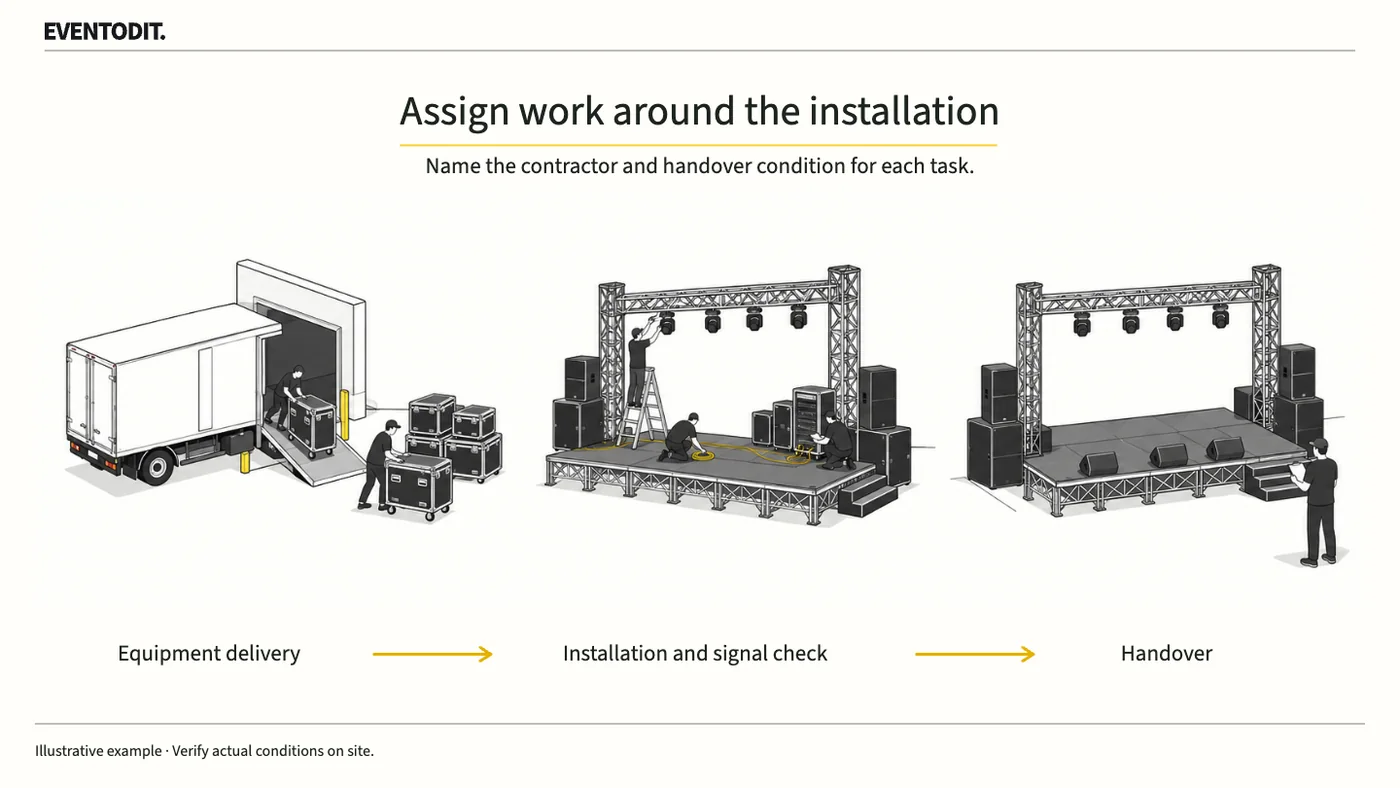
Event Equipment Procurement and Handover
“Equipment installation included” does not assign unloading, power connections, operation or removal. Name the contractor for each task and what they must hand to the next team to expose gaps and duplicate orders.
Read guide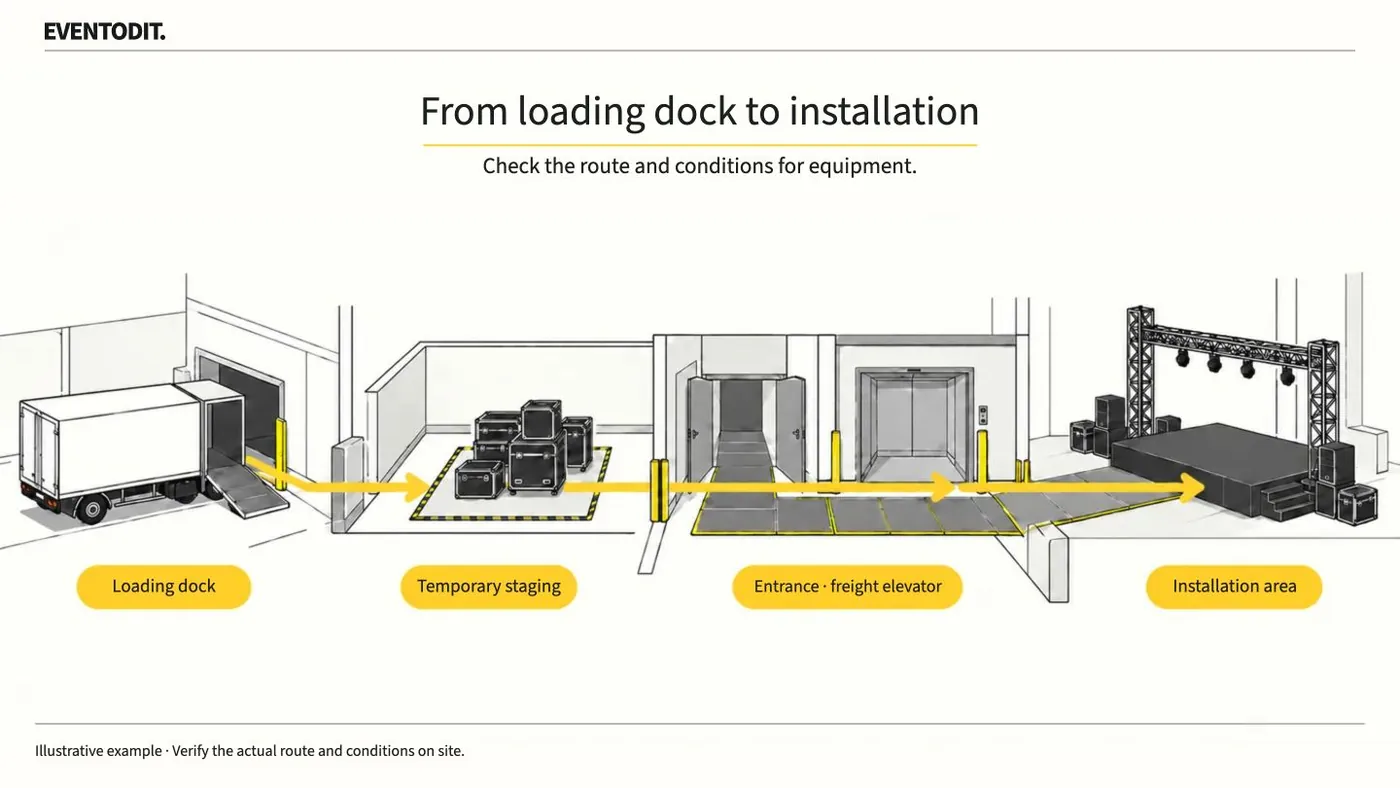
Venue Survey and Load-in
Check the route equipment will actually travel and the routes visitors will use. Mark questions for the facilities and technical teams on the plan and assign a person and deadline to resolve each one.
Read guideHave a correction or additional evidence? Request a correction