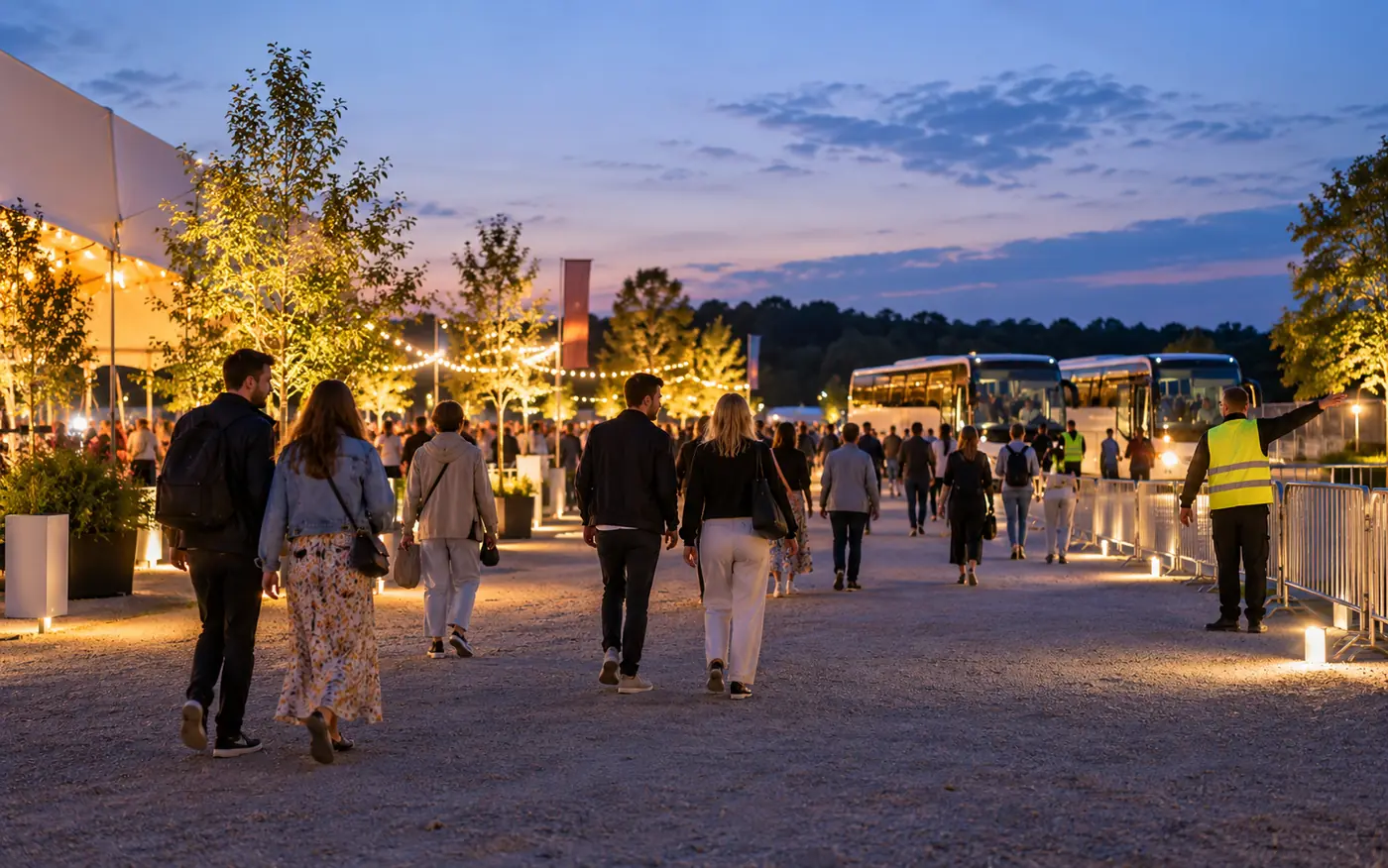
At a huge festival or Expo, the moment that makes a planner’s heart tighten most is not the opening fanfare. It is the nighttime outbound traffic, when the final evening programme—fireworks or a headliner’s performance—ends and tens of thousands of visitors pour towards the exits at once.
Expo 2025 Osaka, Kansai, which ran from April to October 2025, experienced an explosive concentration of departure demand in particular periods after 8pm, while arrivals were evenly spread across the morning hours. In response, the organising committee mandated earlier finish times for evening programmes towards the end of the Expo and urgently switched certain shuttle routes to advance reservations on busy days.
For practitioners, this offers a painful lesson: the stage cue sheet and the vehicle dispatch timetable outside the venue must never be separated. The event finish time determined by the stage manager must be signed off on the basis of the transport authorities’ carrying capacity.
1. The paradox of dispersal: you can stagger arrivals, but departures do not stagger themselves
Expos and theme parks can use advance reservations to spread audience arrival times effectively. Departure times, however, are much harder to control.
- The accumulation of departure bottlenecks: When the evening’s main attraction ends, visitors head to the stops together. The physical journey from the stage to the gate and the wait to board accumulate, sometimes extending the effects of an event that finished at 9pm until midnight.
- Work backwards from transport limits: Before setting the running time of the stage programme, the planning team must first obtain data from the transport contractor on “the maximum number of visitors that can be moved from a particular stop in one hour”, or transport capacity. Use those figures to calculate peak outbound numbers. If the demand simply cannot be handled, the team must make the hard-stop decision to bring forward the event’s finish time itself, as at Osaka Expo.
2. Advance shuttle reservations are a buffer, rather than a perfect solution
On busy days, Osaka Expo tried to manage the homebound crowds by requiring reservations for Sakurajima Station shuttles after 8pm.
- The illusion of reservations: Requiring bookings for a particular route can reduce disorderly queues at its boarding point. But this does not solve overall departure demand; it merely forces visitors who could not secure reservations to bypass it using other means, such as walking, taxis or buses on other routes.
- Responsibility for visitors left behind: As the official report’s account of around 100 people remaining at a stop after a June fireworks event illustrates, visitors still on site after all reserved buses have departed ultimately remain a risk the organiser must handle. Even when applying a “reservation holders board first” rule, it must be paired with a plan for spare vehicles, such as a sweeper bus, or an emergency holding area for people left without a ride after the last service.
3. Synchronise changes in three places (Triple Sync)
A major decision to bring the event’s finish time forward must not end inside a meeting room.
- Make the data match: If the stage programme’s finish is brought forward by 20 minutes, the shuttle operator’s last-service dispatch timetable and the times on the audience website and on-site banners must also be updated to the same revision, without even a minute’s discrepancy. Change only the finish time while leaving the shuttle booking app’s system times as they were, and visitors will wait indefinitely in a darkened venue for a bus that is not coming.
4. A four-stage protocol for practitioners managing nighttime outbound routes
To send tens of thousands of visitors home safely at night, the planning team should follow these four stages.
| Stage | Work standard |
|---|---|
| [Stage 1: check transport capacity in advance] | Before finalising the timetable for the evening’s main attraction, first obtain written confirmation from the relevant local authority and transport contractor of “maximum passengers per hour” and “last-service operating conditions”. |
| [Stage 2: separate routes and introduce reservations] | Require advance reservations for the main shuttle carrying crowds to a particular metro station to establish passenger numbers, and physically position alternative walking routes or taxi ranks well away for visitors unable to secure bookings. |
| [Stage 3: announce changes with triple synchronisation] | When event times change, cross-check the revised cue sheet, shuttle operator’s revised dispatch plan and audience notices on the web, app and on-site signs simultaneously, then issue them together. |
| [Stage 4: record remaining visitors and shut down] | Do not treat “the last shuttle’s departure time” as completion of audience departure. Activate a back-end command structure in which the site safety lead personally confirms and signs off that the last visitor has boarded before reporting the end of daily operations. |
A planner’s note: a perfect finale ends at the bus stop, rather than on stage
Spectacular fireworks and a headliner’s final farewell give audiences a thrilling experience. But it takes only a moment for that excitement to turn into irritation during a two-hour wait in a car park or on gridlocked roads.
The end of the event we need to manage is not the closing time on the cue sheet. Excellent back-end planning takes responsibility for the last steps of visitors who will be standing at a stop in the cold night air after every stage light has gone out. What allows them to take the Expo’s excitement all the way home comes from the planner’s spreadsheet calculating the last service with care, rather than the director’s intuition.
Conditions for applying this elsewhere
For evening programmes whose return demand concentrates at specific boarding points, after confirming actual service conditions with operators.
Information not established
The summary does not give each programme’s changed end time and implementation date, isolated waiting-time effects, rejected reservations, no-shows or additional dispatch costs.
Reference material
- Expo organising association · 18 December 2025 announcement of the transportation performance report: council approval date and reporting across the Expo run
- Official Visitor Transportation Performance Report summary · Findings, Departure Demand-Levelling and emergency-response sections on the first page: actual demand, changes and visitors left waiting
- Expo 2025 official overview: venue at Yumeshima, Osaka, and dates of 13 April–13 October 2025
Next tasks and related resources
A comparison of the final programme, shuttle reservation conditions and visitor information.
Related templates
Event Results and Counting-rules Record
A record that lets another person reproduce reported figures from the source data.
Use this for: Agree the counting method before the event, then compare registration, scans, surveys and leads afterwards. Use one row for each metric and population.
Instructions, examples & downloadsRelated practical guides
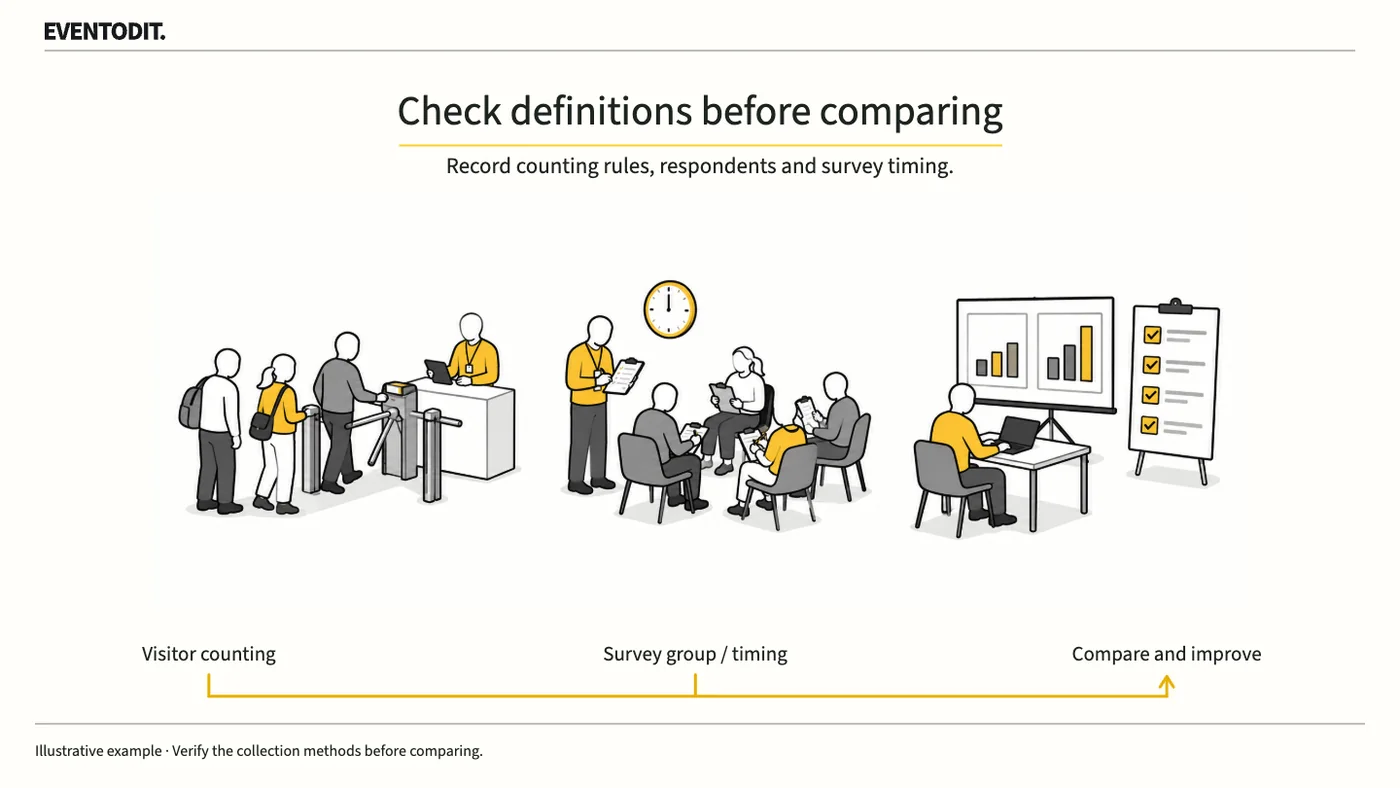
Event Review and Data Evaluation
This year’s attendance and last year’s may not be comparable if the method changed. Establish who was counted or surveyed, when and how, and what is missing before interpreting the result.
Read guide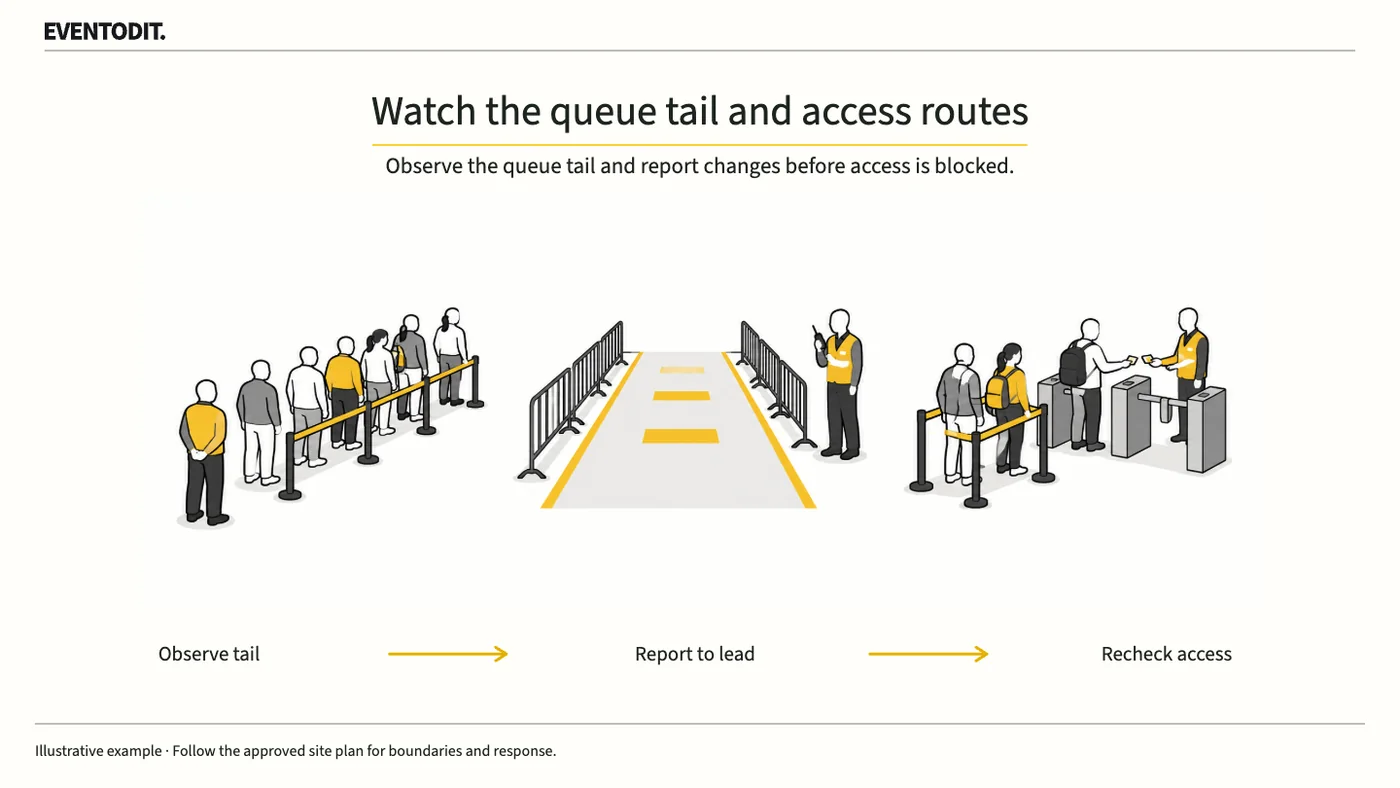
Event Entrance Queue Management
Track the tail of the queue and people spilling out to its sides, not just admissions processed. Agree where staff report a growing queue and who acts before it reaches vehicle or emergency routes.
Read guideHave a correction or additional evidence? Request a correction